JOIN WHATSAPP
STORIES

JEE Advanced 2026 Eligibility Criteria – Exam on May 17

JEE Advanced 2026 Eligibility Criteria – Exam on May 17

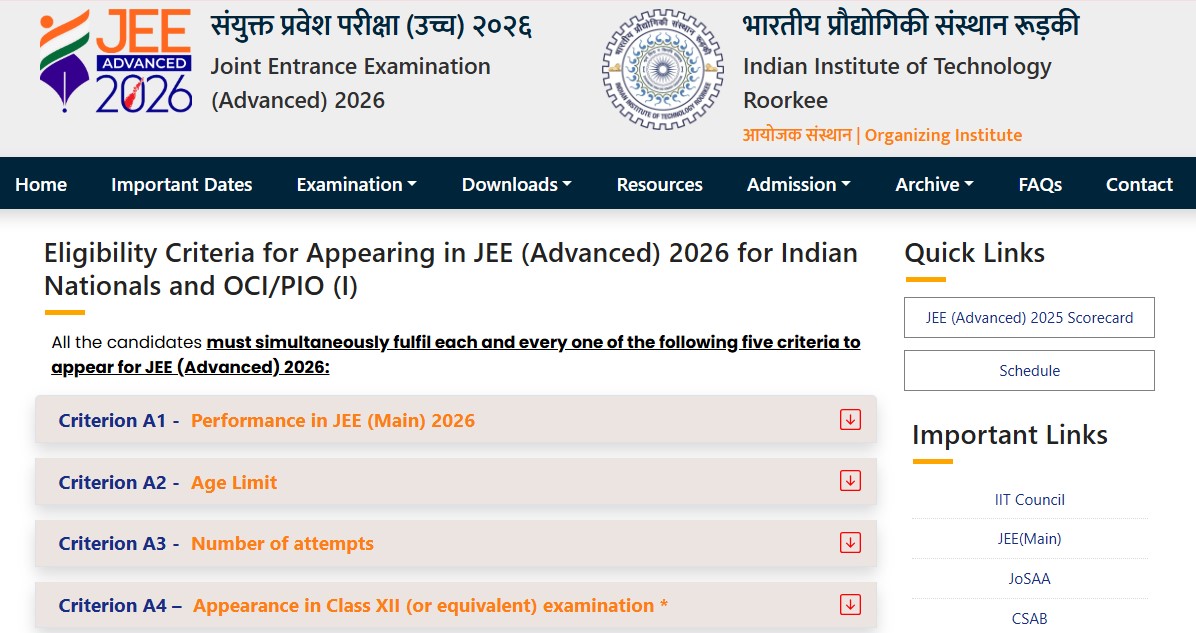
The Indian Institute of Technology (IIT) Roorkee has published the eligibility requirements and exam timetable for JEE Advanced 2026 on its official website. As per the notification, the examination will be conducted on 17 May 2026, with Paper 1 and Paper 2 scheduled on the same day in two separate sessions.

JEE Advanced continues to be the sole entrance exam for admission to undergraduate programmes at the IITs, offering seats in BTech, BS, BArch, and various integrated degree courses across the country.

I am sharing this update because every year thousands of students prepare for JEE without fully understanding the eligibility rules. A small misunderstanding about marks, age or attempt count can block admission even after qualifying for the exam. Many students also believe scoring well in JEE Main alone guarantees entry into IITs, but JEE Advanced has its own unique criteria. Clarity at this stage helps candidates prepare confidently, avoid last-minute mistakes and plan the year ahead properly.

Key Eligibility Criteria for JEE Advanced 2026

Students must meet all the following conditions to appear for the exam:

1. Performance in JEE Main 2026

  • Only the top candidates in JEE Main 2026 (as per official cut-off and rank list) can appear for JEE Advanced.
  • Students must clear JEE Main in the same year to qualify.

2. Age Limit

  • Candidates should be born on or after October 1, 2006.
  • Relaxation of 5 years is applicable for SC, ST and PwD categories.

3. Number of Attempts

  • Students can attempt JEE Advanced a maximum of twice in two consecutive years, regardless of attempts in JEE Main.

4. Class 12 Qualification

  • Students must have passed Class 12th or equivalent examination in 2025 or 2026.
  • Those who passed Class 12 earlier than 2025 are not eligible.

5. Previous Admission Rule

  • Any student who has been admitted to an IIT earlier is not eligible, even if the admission was cancelled or the student withdrew.

Exam Date and Schedule

  • JEE Advanced 2026 Exam Date: May 17, 2026
  • Papers:
    • Paper 1 (morning session)
    • Paper 2 (afternoon session)
  • Both papers are compulsory for ranking and admission.

For More Details: Click Here
Leave a Comment

End of Article

Maharashtra College Teachers Seek Higher Retirement Age, Urge UGC to Act

Maharashtra College Teachers Seek Higher Retirement Age, Urge UGC to Act

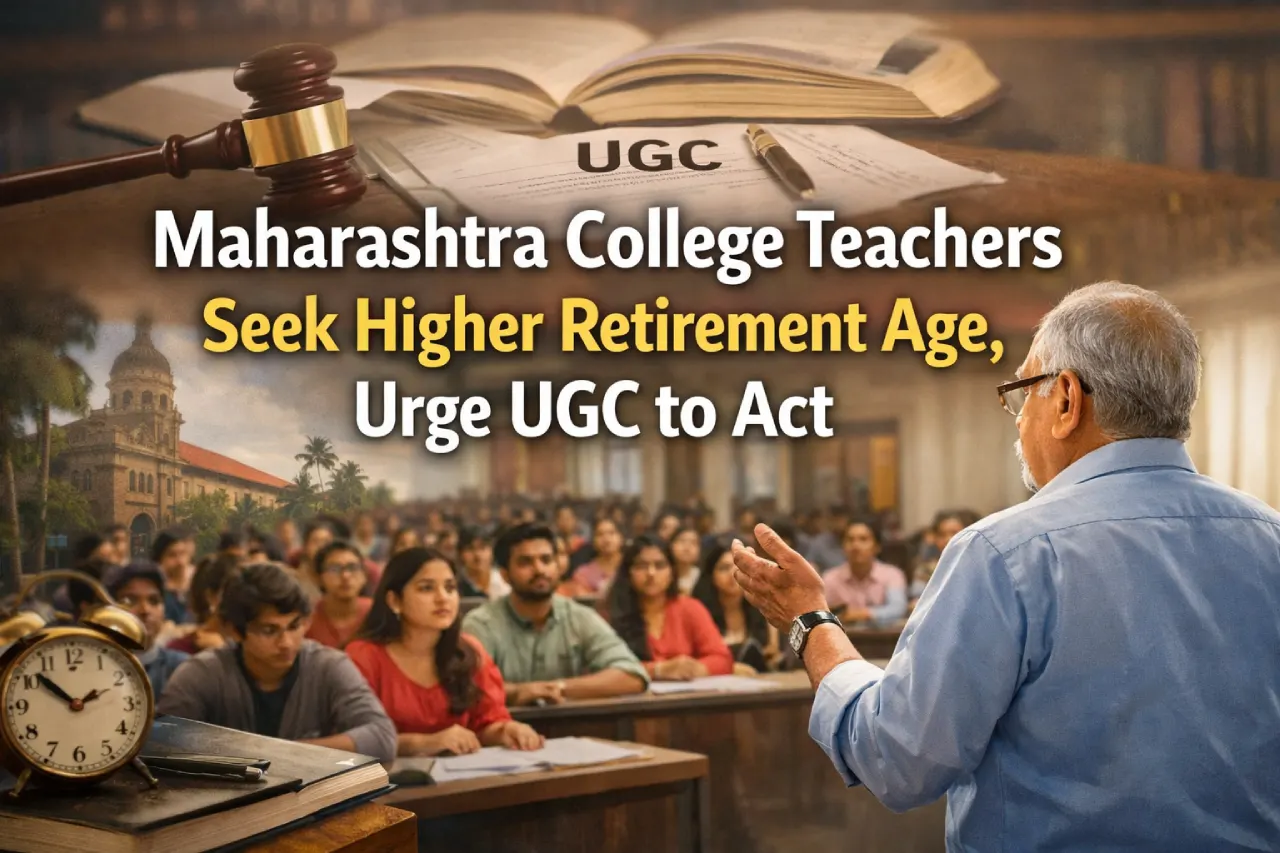
Teachers from colleges across Maharashtra have urged the University Grants Commission to raise the retirement age for teaching faculty from the current 60 years to 65 years. The demand has been made by teachers’ associations who argue that experienced educators are being forced to retire too early, even as colleges continue to face staff shortages. They believe extending the retirement age will help retain academic expertise and improve teaching quality in higher education institutions.

I am writing about this issue because it affects not just teachers, but also students and the overall higher education system. At a time when universities are struggling with vacant posts and delayed recruitments, losing senior faculty creates gaps in teaching, research, and mentorship. The demand also raises a larger question about how India values experience in academia and whether policy needs to evolve with changing life expectancy and professional capability.

What Maharashtra Teachers Are Demanding

Teachers’ bodies have formally requested UGC to revise the retirement age for college and university teachers to 65 years, bringing it in line with several central institutions. They argue that many educators remain academically active and physically fit well beyond 60.

According to them, forcing retirement at 60 leads to a loss of institutional memory and teaching continuity.

Why Teachers Want the Age Limit Raised

Teachers say the demand is based on practical realities. Many colleges face:

  • Acute shortage of qualified faculty
  • Delays in permanent recruitment
  • Heavy teaching loads on existing staff

Extending the retirement age would offer immediate relief without additional recruitment costs.

Comparison with Central Institutions

In several central universities and institutions, teachers are allowed to work up to 65 years, and in some cases even longer through re-employment. Maharashtra teachers feel this creates inequality between state and central institutions.

They believe a uniform retirement policy across the country would be fairer and more effective.

Impact on Students and Academic Quality

Senior teachers often play a key role in mentoring young faculty, guiding research scholars, and maintaining academic standards. Their early retirement disrupts this balance and places extra pressure on junior staff.

Students, especially at postgraduate and research levels, are among the biggest losers.

Concerns About Youth Employment

Some critics argue that extending retirement age could limit opportunities for younger aspirants. Teachers’ associations counter this by saying vacant posts already exist and recruitment processes are slow, so extending service will not block new jobs.

They stress that experience and new talent should coexist.

What UGC’s Role Will Be

UGC has the authority to frame regulations related to service conditions in higher education. Any change in retirement age would require policy review and coordination with state governments.

Teachers are hopeful that the commission will consider the request seriously.

Leave a Comment

End of Article

Loading more posts...