JOIN WHATSAPP
STORIES

JEE Main 2019 Paper 1 Shift 2 (9th April) PDF Download Here

JEE Main 2019 Paper 1 Shift 2 (9th April) PDF

The JEE Main 2019 Paper 1 for Shift 2 held on 9th April was conducted in the evening session by NTA. The exam followed the standard structure with three subjects—Physics, Chemistry, and Mathematics—each carrying 30 questions. This paper was part of the online format introduced from January 2019, and the questions were based on a mix of theory and application-based concepts from the Class 11 and 12 syllabus. Students found this particular shift slightly more calculative in Mathematics, while Chemistry was relatively easy and Physics had a balanced difficulty level.

The reason I’ve chosen to write about this specific paper is because it provides real insight into how NTA structures its questions post the online shift. Many aspirants still rely on mock papers, but actual shift-wise papers like this one give better clarity on time management, recurring topics, and question language. When I interacted with a few students preparing for JEE 2025, this paper came up often as a good example for practice. Especially for those aiming for 200+ scores, solving actual past papers is non-negotiable. This paper, with its moderate-to-tough balance, is perfect for assessing one’s readiness for the main exam.

JEE Main 9th April 2019 Shift 2 – Paper Highlights

Here’s a quick overview of this particular exam shift:

  • Exam Date: 9th April 2019
  • Shift: Evening (Shift 2)
  • Total Questions: 90 (30 each from Physics, Chemistry, and Maths)
  • Total Marks: 360
  • Time Duration: 3 hours
  • Mode: Computer-Based Test (CBT)
  • Marking Scheme: +4 for correct answers, -1 for incorrect ones

Subject-Wise Analysis

Physics

  • Overall difficulty: Moderate
  • Key chapters: Current Electricity, Rotational Motion, Modern Physics
  • Mix of theory-based and numerical questions
  • Conceptual clarity was needed, especially for application-based questions

Chemistry

  • Easiest among all three
  • Heavy focus on NCERT concepts, especially in Inorganic and Organic Chemistry
  • Questions were mostly fact-based and scoring

Mathematics

  • Time-consuming
  • Topics like Calculus, Coordinate Geometry, Vectors, and Algebra dominated
  • Some questions were lengthy but solvable if you had practiced well

Common Observations

  • No out-of-syllabus questions reported
  • Chemistry helped in saving time for tougher Maths problems
  • Students who managed time well scored better

Download PDF

Click here to download the JEE Main 2019 Paper 1 Shift 2 (9th April) PDF
Leave a Comment

End of Article

IFS Mains 2025 Agricultural Engineering Paper I PDF Download

IFS Mains 2025 Agricultural Engineering Paper I PDF Download with Exam Pattern and Preparation Tips

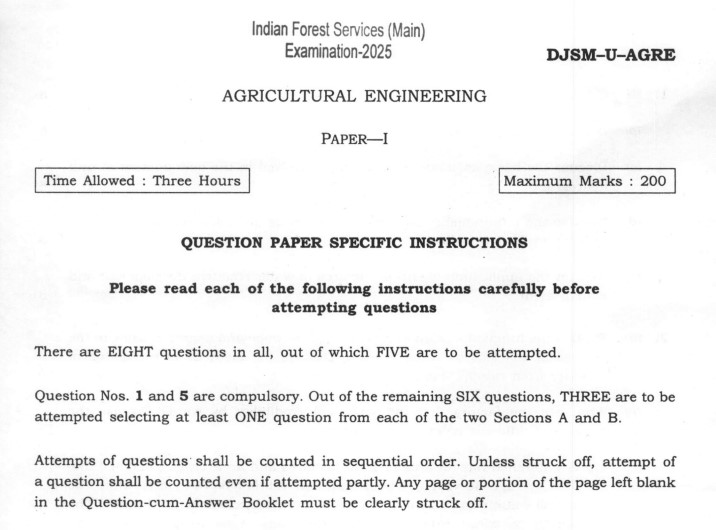
The Indian Forest Service (Main) Examination 2025 is a crucial stage for candidates who want to enter one of India’s most respected services. For those who have chosen Agricultural Engineering as their optional subject, Paper – I plays a very important role. In this article, I am sharing how you can download the Agricultural Engineering Paper – I question paper and what you can expect from it. This will help you understand the structure, difficulty level, and focus areas of the exam.

I decided to write about this because many aspirants keep searching for genuine previous year papers but often end up on unreliable sources. From my own observation, solving actual UPSC papers is one of the smartest ways to prepare. It not only builds confidence but also gives clarity on what to study and what to avoid. This particular paper is especially helpful for those who want to fine-tune their preparation strategy and improve answer writing.

About Agricultural Engineering Paper – I

Agricultural Engineering Paper – I mainly focuses on the core engineering concepts applied in agriculture. It tests both theoretical knowledge and practical understanding.

The paper generally includes topics like:

  • Farm machinery and equipment
  • Soil and water engineering
  • Irrigation systems and drainage
  • Agricultural structures
  • Renewable energy in agriculture
  • Engineering mechanics and basic electrical engineering

The aim is to evaluate how well candidates can apply engineering principles in agricultural contexts.

Key Details of the Question Paper

ParticularsDetails
Exam NameIndian Forest Service (Main) Examination 2025
PaperAgricultural Engineering Paper – I
Conducting BodyUPSC
Paper TypeDescriptive
Duration3 Hours
Total Marks250
ModeOffline (Written)

Why This Question Paper Matters

In my opinion, previous year question papers are one of the most practical tools for preparation. This paper can help you in many ways:

  • Gives a clear idea of question trends and patterns
  • Helps identify important and high-weight topics
  • Improves answer writing and presentation skills
  • Builds confidence before the actual exam
  • Helps in time management practice

If you are preparing seriously, you should definitely include this paper in your study plan.

What You Can Expect in the Paper

Based on recent exam patterns, Agricultural Engineering Paper – I usually includes:

  • Concept-based numerical and theoretical questions
  • Application-oriented problems
  • Questions requiring diagrams and calculations
  • Balanced coverage of different syllabus sections

UPSC often tests clarity of concepts rather than rote learning, so understanding basics is very important.

PDF Download of Agricultural Engineering Paper – I

Aspirants can easily download the Indian Forest Service (Main) Examination 2025 Agricultural Engineering Paper – I question paper by following these steps:

  • Visit the official UPSC website
  • Go to the “Examinations” section
  • Click on “Previous Question Papers
  • Select “Indian Forest Service (Main) Examination, 2025
  • Look for “Agricultural Engineering Paper – I
  • Click on the PDF link and download it

N.B: If you want to download the question paper without any difficulty, you can easily download it by Click Here.

It is always better to keep a copy saved so you can practise anytime.

Leave a Comment

End of Article

Loading more posts...