JOIN WHATSAPP
STORIES

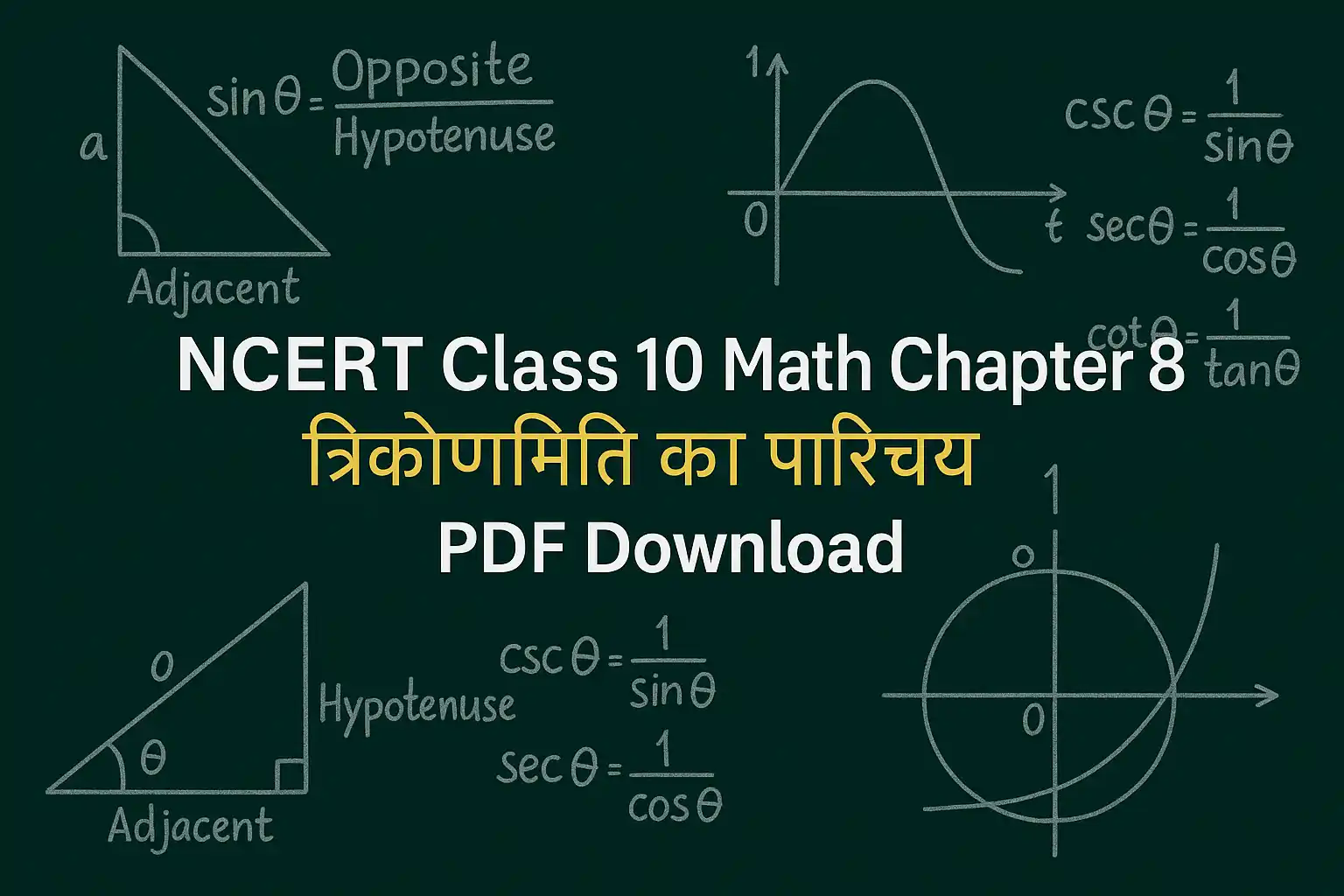
NCERT Class 10 Math Chapter 8: त्रिकोणमिति का परिचय PDF Download

NCERT Class 10 Math Chapter 8: त्रिकोणमिति का परिचय PDF Download

NCERT Class 10 Math Chapter 8 त्रिकोणमिति का परिचय (Introduction to Trigonometry) is one of the most important chapters in the Class 10 syllabus. It explains the basics of trigonometry by introducing students to the concepts of trigonometric ratios, their values at specific angles, and the fundamental relationships between them. This chapter also helps in understanding how trigonometry connects algebra with geometry and is widely used in higher studies and competitive exams. With proper practice, students can easily master these formulas and score full marks in this section.

I am writing about this chapter because trigonometry is a milestone in a student’s mathematics journey. Many students initially find the terms sine, cosine, and tangent confusing, but once they understand the ratios with the help of right-angled triangles, things become much clearer. The chapter is not only essential for board exams but also forms the base for advanced concepts in Class 11 and 12, like calculus and coordinate geometry. Personally, I have seen how regular practice of NCERT examples makes students confident in solving tricky questions. That is why having the PDF of this chapter is very important, as it allows students to revise formulas anytime and improve their preparation.

Key Topics in Chapter 8 त्रिकोणमिति का परिचय

Some of the main concepts taught in this chapter are:

  • Understanding the meaning of trigonometry and its applications
  • Definition of trigonometric ratios (sine, cosine, tangent, cosecant, secant, cotangent)
  • Ratios of standard angles like 0°, 30°, 45°, 60°, and 90°
  • Trigonometric identities and their proofs
  • Solving problems using trigonometric values

Example for Better Understanding

Consider a right-angled triangle ABC with ∠B = 90°. If AB = 3 and AC = 5, then BC = 4 by Pythagoras theorem. Now,
sin A = (opposite side / hypotenuse) = 4/5
cos A = (adjacent side / hypotenuse) = 3/5
This simple example shows how trigonometric ratios are directly linked to sides of a triangle.

Download PDF

Students can download NCERT Class 10 Math Chapter 8: त्रिकोणमिति का परिचय PDF from this website.
Leave a Comment

End of Article

Class 11 Sanskrit Shashwati Chapter 11 PDF: नवद्रव्याणि Explained

Class 11 Sanskrit Shashwati Chapter 11 PDF: नवद्रव्याणि Explained

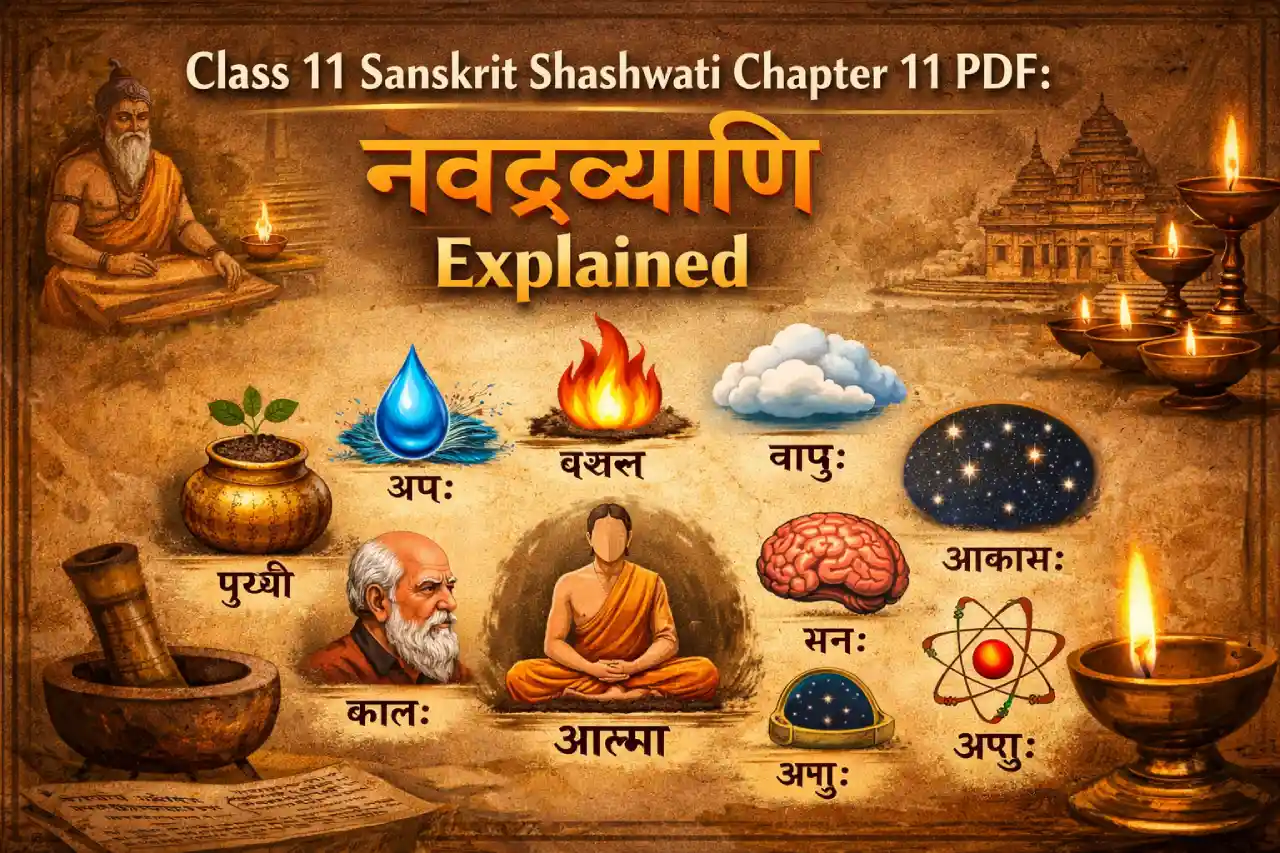
NCERT Class 11 Sanskrit Shashwati Chapter 11, titled “नवद्रव्याणि”, introduces students to an important concept from Indian philosophy—the nine fundamental substances that make up the universe. The chapter explains these elements in a simple and structured way, helping students understand how ancient thinkers tried to explain the nature of reality through observation and logic.

I am writing about this chapter because many students search for the official NCERT PDF along with a simple explanation before exams. In my experience, topics like “नवद्रव्याणि” may feel slightly abstract at first, but once you understand the list and their meanings, it becomes quite easy to remember and revise. This chapter is important not only for Sanskrit exams but also for gaining a basic idea of traditional Indian philosophy. It helps students connect language learning with deeper concepts. Studying from the official NCERT book and revising regularly can make this chapter scoring and easy to handle.

About the Chapter: नवद्रव्याणि

The term “नवद्रव्याणि” means “nine substances.” These are considered the basic elements that exist in the universe according to classical Indian thought.

The chapter explains each of these substances and their role in the functioning of the world.

The Nine Substances Explained

Here is a simple table to understand the nine dravyas:

Sanskrit TermMeaning (Simple English)
पृथ्वी (Prithvi)Earth
आपः (Apah)Water
तेजः (Tejas)Fire
वायु (Vayu)Air
आकाश (Akasha)Space
काल (Kala)Time
दिशा (Disha)Direction
आत्मा (Atma)Soul
मनः (Manas)Mind

These elements together explain the physical and non-physical aspects of existence.

Key Ideas in the Chapter

1. Understanding the Universe

The chapter explains how everything in the world is made up of basic substances.

2. Physical and Non-Physical Elements

Some substances like earth and water are physical, while others like time and soul are abstract.

3. Connection Between Mind and Body

The inclusion of “मनः” (mind) and “आत्मा” (soul) shows the importance of inner consciousness.

Why This Chapter Is Important for Students

  • Helps understand basic philosophical concepts
  • Improves Sanskrit reading and comprehension
  • Important for exam questions and explanations
  • Builds logical and conceptual thinking

Students who understand the list properly can easily score marks.

Study Tips for Chapter 11

  • Memorise the nine dravyas and their meanings
  • Understand the difference between physical and abstract elements
  • Practise writing short explanations
  • Revise regularly using a table format

This makes the chapter easier to revise before exams.

How to Download NCERT Class 11 Sanskrit Shashwati Chapter 11 PDF

Students can download the official chapter PDF from the National Council of Educational Research and Training website by following these steps:

Always use the official NCERT website to ensure you get the correct and updated version.

Leave a Comment

End of Article

Loading more posts...