JOIN WHATSAPP
STORIES

NCERT Class 11 Economics Chapter 8: Use of Statistical Tools PDF Download

NCERT Class 11 Economics Chapter 8: Use of Statistical Tools

Chapter 8 of Class 11 Economics is titled Use of Statistical Tools. This chapter ties together everything you’ve learned in the earlier chapters—like mean, median, mode, correlation, and index numbers—and explains how these tools are used to analyse real-world economic data. It shows how statistics help in understanding economic issues, making predictions, and drawing conclusions based on actual figures.

I chose to write on this topic because it is the final chapter in the statistics section of your Economics syllabus, and it plays a crucial role in helping you apply all the concepts you’ve studied so far. Many students study the formulas but don’t know how to use them in real situations. This chapter bridges that gap by giving practical applications. It is also helpful for anyone preparing for exams or competitions because it improves your ability to interpret economic data, answer case-study-based questions, and write clear conclusions. That’s why I’ve included the PDF download link as well—it’s always good to have a clean, official copy of the chapter handy while studying.

What Is the Use of Statistical Tools in Economics?

Statistical tools help us make sense of data. In economics, where decisions are based on population trends, income levels, inflation, production, and consumption, these tools play a key role.

The chapter shows how we use:

  • Mean, Median, Mode to find averages and typical values
  • Correlation to check if two things like income and spending are related
  • Index Numbers to compare price levels or quantities over time
  • Graphs and Diagrams to present data clearly

These tools are not just theoretical. Economists, government departments, businesses, and even NGOs use them regularly.

How Statistical Tools Are Applied

Let’s say the government wants to find out if rural income is increasing. They will:

  • Collect income data from different states
  • Use mean to calculate average income
  • Use correlation to see if employment schemes have helped
  • Use index numbers to compare growth rates over years
  • Make graphs to show trends for easier understanding

Similarly, students can use these methods in projects or assignments to study local economic data like shop prices, wages, or even population trends.

Why You Must Learn This Chapter

  • It helps in real-world economic analysis
  • It teaches how to summarise large data sets into simple conclusions
  • It strengthens your base for higher studies in economics, business, or commerce
  • Case-study-based questions in exams are often based on these tools
  • It also improves your analytical skills

The CBSE syllabus is designed in such a way that this chapter brings together theory and practical skills. Once you understand it, you’ll feel more confident reading economic reports or interpreting data-based questions.

Download PDF

Click Here to Download NCERT Class 11 Economics Chapter 8: Use of Statistical Tools PDF
Leave a Comment

End of Article

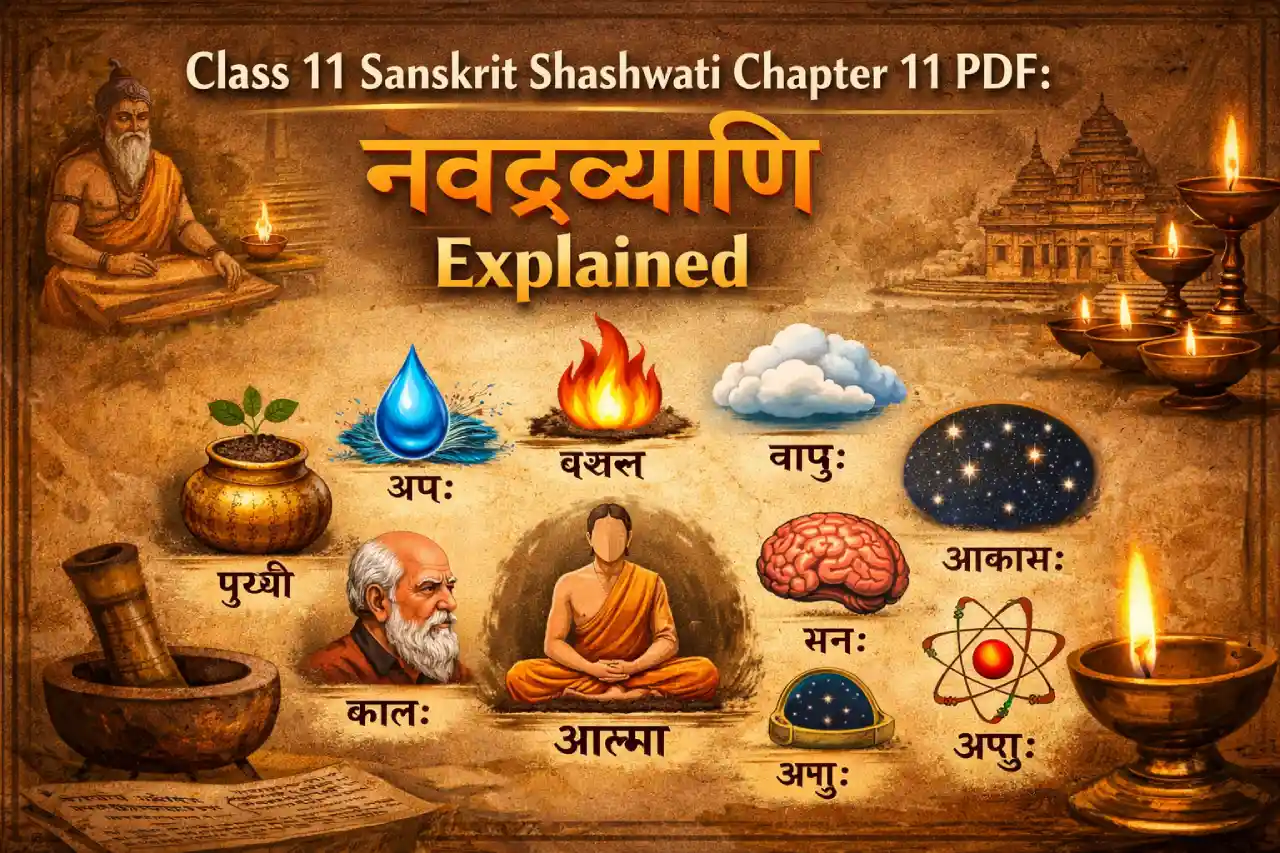
Class 11 Sanskrit Shashwati Chapter 11 PDF: नवद्रव्याणि Explained

Class 11 Sanskrit Shashwati Chapter 11 PDF: नवद्रव्याणि Explained

NCERT Class 11 Sanskrit Shashwati Chapter 11, titled “नवद्रव्याणि”, introduces students to an important concept from Indian philosophy—the nine fundamental substances that make up the universe. The chapter explains these elements in a simple and structured way, helping students understand how ancient thinkers tried to explain the nature of reality through observation and logic.

I am writing about this chapter because many students search for the official NCERT PDF along with a simple explanation before exams. In my experience, topics like “नवद्रव्याणि” may feel slightly abstract at first, but once you understand the list and their meanings, it becomes quite easy to remember and revise. This chapter is important not only for Sanskrit exams but also for gaining a basic idea of traditional Indian philosophy. It helps students connect language learning with deeper concepts. Studying from the official NCERT book and revising regularly can make this chapter scoring and easy to handle.

About the Chapter: नवद्रव्याणि

The term “नवद्रव्याणि” means “nine substances.” These are considered the basic elements that exist in the universe according to classical Indian thought.

The chapter explains each of these substances and their role in the functioning of the world.

The Nine Substances Explained

Here is a simple table to understand the nine dravyas:

Sanskrit TermMeaning (Simple English)
पृथ्वी (Prithvi)Earth
आपः (Apah)Water
तेजः (Tejas)Fire
वायु (Vayu)Air
आकाश (Akasha)Space
काल (Kala)Time
दिशा (Disha)Direction
आत्मा (Atma)Soul
मनः (Manas)Mind

These elements together explain the physical and non-physical aspects of existence.

Key Ideas in the Chapter

1. Understanding the Universe

The chapter explains how everything in the world is made up of basic substances.

2. Physical and Non-Physical Elements

Some substances like earth and water are physical, while others like time and soul are abstract.

3. Connection Between Mind and Body

The inclusion of “मनः” (mind) and “आत्मा” (soul) shows the importance of inner consciousness.

Why This Chapter Is Important for Students

  • Helps understand basic philosophical concepts
  • Improves Sanskrit reading and comprehension
  • Important for exam questions and explanations
  • Builds logical and conceptual thinking

Students who understand the list properly can easily score marks.

Study Tips for Chapter 11

  • Memorise the nine dravyas and their meanings
  • Understand the difference between physical and abstract elements
  • Practise writing short explanations
  • Revise regularly using a table format

This makes the chapter easier to revise before exams.

How to Download NCERT Class 11 Sanskrit Shashwati Chapter 11 PDF

Students can download the official chapter PDF from the National Council of Educational Research and Training website by following these steps:

Always use the official NCERT website to ensure you get the correct and updated version.

Leave a Comment

End of Article

Loading more posts...