
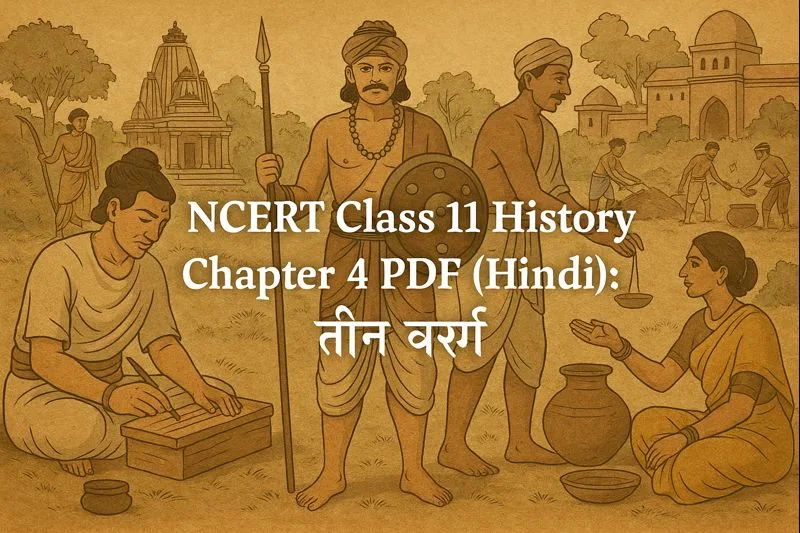
Chapter 4 of Class 11 History (Hindi Medium), तीन वर्ग, takes us to medieval Europe, where society was divided into three main social groups known as the “Three Orders.” These orders included the clergy (religious leaders), the nobility (land-owning warriors), and the peasants (common people who worked on farms). This chapter explains how these groups lived, worked, and contributed to medieval life. It helps us understand that European society during that period was not only controlled by kings but also by priests, knights, and ordinary farmers who formed the backbone of the economy.
The medieval European system may look different from modern times, yet it teaches us how power, religion, and labour together controlled everyday life. Many students assume history is only about wars and rulers, but this chapter highlights the importance of farmers who grew food, knights who protected lands, and priests who influenced people’s beliefs. This structure defined what people could wear, eat, learn, and even who they could marry. Understanding the Three Orders helps students connect social structure with economics, politics, and religion, giving a clear picture of how people lived before the modern world emerged.
About Chapter 4: Medieval Three Orders (तीन वर्ग)
Medieval European society was organised into three major categories known as Three Orders:
| Category | Role in Society | Example |
|---|---|---|
| Clergy (धार्मिक वर्ग) | Provided religious guidance and education | Priests, Bishops |
| Nobles (युद्ध वर्ग/श्रेष्ठ वर्ग) | Protected society and controlled land | Knights, Lords |
| Peasants (कृषि व सामान्य वर्ग) | Worked on farms and produced food | Farmers, Labourers |
1. Clergy: The Religious Class
- Controlled churches and monasteries
- Influenced education, rituals, and social life
- Collected taxes in the form of tithes
- Guided kings and nobles on religious matters
- Enjoyed high respect and authority
2. Nobility: The Warrior Class
- Owned land and collected taxes from peasants
- Provided military support to the king
- Trained as knights with weapons and horseback skills
- Followed the “Code of Chivalry” (rules of honour and duty)
3. Peasants: The Working Class
- Worked on large estates called manors
- Paid rent or taxes to nobles
- Produced food, raised animals, and made goods
- Had limited freedom and rights
- Some peasants were serfs who were bound to the land
Medieval Manor System
The manor was like a small village controlled by a noble. It included:
- Fields and farms
- A church and houses
- Workshops and mills
- Living quarters for peasants
This system worked as a local economic and social unit.
Change in Social Structure
Over time, trade grew and towns developed. A new group emerged: merchants and artisans, reducing the power of nobles. The rise of cities eventually weakened the medieval structure, leading to modern changes like business, wages, and urban life.
NCERT Class 11 History Chapter 4 PDF Download (Hindi Medium)
Students can download the official NCERT Class 11 History Chapter 4 PDF (Hindi): तीन वर्ग from here.





1 thought on “NCERT Class 11 History Chapter 4 PDF (Hindi): तीन वर्ग”
हा उपक्रम विद्यार्थ्यांसाठी चांगला आहे