JOIN WHATSAPP
STORIES

NCERT Class 11 Political Science Chapter 6: Citizenship PDF Download and Notes

NCERT Class 11 Political Science Chapter 6: Citizenship

Chapter 6 of Class 11 Political Science covers Citizenship, one of the most debated and important topics in any democracy. This chapter explains who is a citizen, what rights and duties come with citizenship, and how it connects individuals to the state. It also discusses different types of citizenship, such as full and partial, and how it is acquired or lost. The chapter also introduces global issues related to citizenship like statelessness, dual citizenship, and migration.

I chose to write about this topic because citizenship is not just a legal term from textbooks, but a real-life identity that affects our day-to-day rights and responsibilities. Today, debates around who is a citizen and who is not have become very common in India and across the world. Whether it’s voting, getting a passport, or accessing welfare schemes, everything depends on your citizenship status. By studying this chapter properly, students can better understand what it means to be an Indian citizen and how that shapes their role in society. It also builds awareness about global challenges like refugees and nationality laws. This is not just exam material—it’s the base of your identity in a nation.

What Is Citizenship?

Citizenship is a relationship between an individual and the state. A citizen is someone who is legally recognised as a member of a country and has certain rights and duties.

Key ideas from the chapter include:

  • Citizenship is both legal and political
  • It gives individuals the right to participate in the political life of the country
  • Citizens enjoy civil, political, and social rights
  • Along with rights, citizens also have moral and legal duties

Types of Citizenship

The chapter explains different types of citizenship in theory and real life:

TypeMeaningExample
Natural CitizenshipAcquired by birthA person born in India to Indian parents
Naturalised CitizenshipAcquired after fulfilling legal conditionsA foreigner who gets Indian citizenship after marriage or residence
Dual CitizenshipHolding citizenship of two countries at the same timeAllowed in some countries, but not in India
Global CitizenshipA broader idea of being a responsible member of the world communityVoluntary work for global causes like climate change, human rights, etc.

Citizenship in the Indian Constitution

  • Articles 5 to 11 in Part II of the Constitution deal with Indian citizenship
  • The Constitution only gave guidelines; detailed laws were made later
  • The Citizenship Act, 1955 defines how citizenship can be acquired, lost, or renounced
  • Amendments like CAA (Citizenship Amendment Act) have created new debates around citizenship

Download NCERT Class 11 Political Science Chapter 6 PDF

You can get the complete Chapter 6 from the official NCERT website. It is useful for exams, understanding the Constitution, and gaining clarity on a current issue.

Click here to download the NCERT Class 11 Political Science Chapter 6 PDF
Leave a Comment

End of Article

Class 11 Sanskrit Shashwati Chapter 11 PDF: नवद्रव्याणि Explained

Class 11 Sanskrit Shashwati Chapter 11 PDF: नवद्रव्याणि Explained

NCERT Class 11 Sanskrit Shashwati Chapter 11, titled “नवद्रव्याणि”, introduces students to an important concept from Indian philosophy—the nine fundamental substances that make up the universe. The chapter explains these elements in a simple and structured way, helping students understand how ancient thinkers tried to explain the nature of reality through observation and logic.

I am writing about this chapter because many students search for the official NCERT PDF along with a simple explanation before exams. In my experience, topics like “नवद्रव्याणि” may feel slightly abstract at first, but once you understand the list and their meanings, it becomes quite easy to remember and revise. This chapter is important not only for Sanskrit exams but also for gaining a basic idea of traditional Indian philosophy. It helps students connect language learning with deeper concepts. Studying from the official NCERT book and revising regularly can make this chapter scoring and easy to handle.

About the Chapter: नवद्रव्याणि

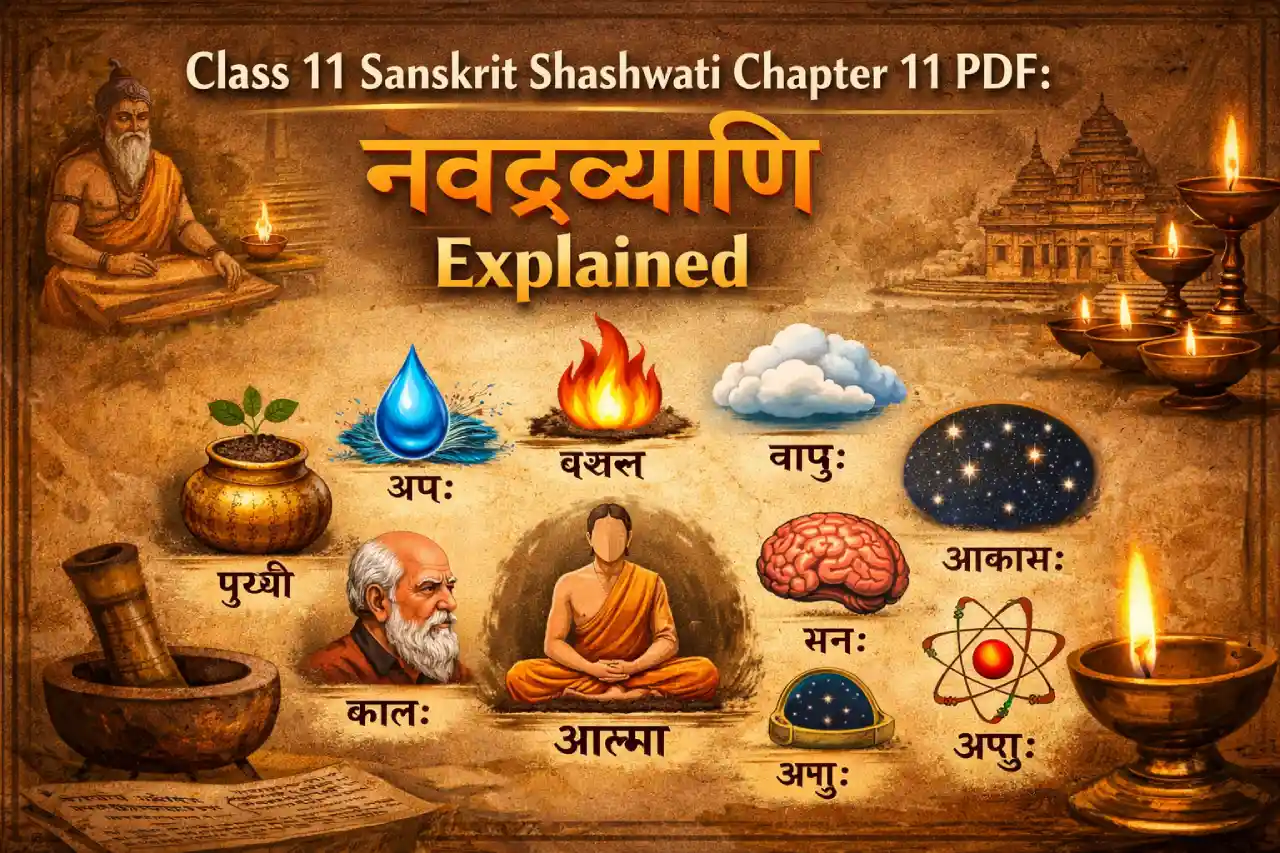
The term “नवद्रव्याणि” means “nine substances.” These are considered the basic elements that exist in the universe according to classical Indian thought.

The chapter explains each of these substances and their role in the functioning of the world.

The Nine Substances Explained

Here is a simple table to understand the nine dravyas:

Sanskrit TermMeaning (Simple English)
पृथ्वी (Prithvi)Earth
आपः (Apah)Water
तेजः (Tejas)Fire
वायु (Vayu)Air
आकाश (Akasha)Space
काल (Kala)Time
दिशा (Disha)Direction
आत्मा (Atma)Soul
मनः (Manas)Mind

These elements together explain the physical and non-physical aspects of existence.

Key Ideas in the Chapter

1. Understanding the Universe

The chapter explains how everything in the world is made up of basic substances.

2. Physical and Non-Physical Elements

Some substances like earth and water are physical, while others like time and soul are abstract.

3. Connection Between Mind and Body

The inclusion of “मनः” (mind) and “आत्मा” (soul) shows the importance of inner consciousness.

Why This Chapter Is Important for Students

  • Helps understand basic philosophical concepts
  • Improves Sanskrit reading and comprehension
  • Important for exam questions and explanations
  • Builds logical and conceptual thinking

Students who understand the list properly can easily score marks.

Study Tips for Chapter 11

  • Memorise the nine dravyas and their meanings
  • Understand the difference between physical and abstract elements
  • Practise writing short explanations
  • Revise regularly using a table format

This makes the chapter easier to revise before exams.

How to Download NCERT Class 11 Sanskrit Shashwati Chapter 11 PDF

Students can download the official chapter PDF from the National Council of Educational Research and Training website by following these steps:

Always use the official NCERT website to ensure you get the correct and updated version.

Leave a Comment

End of Article

Loading more posts...