JOIN WHATSAPP
STORIES

NCERT Class 12 Business Studies Chapter 7: Directing PDF with Examples and Key Points

NCERT Class 12 Business Studies Chapter 7: Directing

Chapter 7 of Class 12 Business Studies is based on Directing, which is an important function of management that focuses on guiding, supervising, and motivating employees. Directing is the step where planning and organising are actually turned into actions by the people involved in an organisation. This chapter discusses the role of leadership, motivation, communication, and supervision in managing people at work.

I wanted to cover this chapter because many students either underestimate it or assume it’s all theory without real-world use. But in reality, directing is something we experience every day — from a teacher explaining a topic to a manager encouraging the sales team. Learning this chapter not only helps in scoring good marks in the exam but also builds a better understanding of human behaviour in professional settings. If you want to pursue careers in management, HR, or even run your own business someday, mastering the concepts of direction will give you a solid head start.

What is Directing?

Directing is the managerial function that involves leading, guiding, and influencing employees to work efficiently and effectively to achieve organisational goals. It helps in translating plans into performance.

There are four key elements of directing:

  • Supervision – Monitoring and guiding employees during work
  • Motivation – Encouraging employees to work better through rewards or recognition
  • Leadership – Influencing people positively with vision and confidence
  • Communication – Ensuring ideas and instructions are clearly shared

For example, if a factory supervisor notices that the workers are losing focus, they can motivate them by offering incentives or guiding them through improved techniques. This is a practical form of directing.

Importance of Directing in Management

Directing brings life to the other functions of management. Here’s why it matters:

  • It helps in building team spirit and coordination
  • Employees feel more involved and motivated
  • Communication ensures clarity and reduces confusion
  • Good leadership brings discipline and trust
  • Supervision ensures work stays on track and mistakes are minimised

For instance, in a retail store, if the store manager properly communicates daily targets and motivates the team with rewards for meeting goals, sales are likely to improve. That’s the power of good direction.

Types of Communication

In this chapter, communication is further classified into two types:

Formal Communication

  • Follows the official chain of command
  • Example: Manager to employee via written instructions

Informal Communication

  • Happens casually among employees
  • Also known as the grapevine
  • Example: Casual conversation during tea breaks

Both types are important. While formal communication ensures structure, informal communication builds relationships and team bonding.

Barriers to Effective Communication

Sometimes, even if we speak clearly, the message doesn’t reach the way we intend. These are known as barriers to communication. Common ones include:

  • Language or semantic issues
  • Poor listening
  • Emotional bias
  • Technical disturbances
  • Lack of attention or interest

Understanding these helps in improving workplace interaction and avoiding misunderstandings.
Download PDF – NCERT Class 12 Business Studies Chapter 7

NCERT Class 12 Business Studies Chapter 7: Directing PDF

Leave a Comment

End of Article

Class 11 Sanskrit Shashwati Chapter 11 PDF: नवद्रव्याणि Explained

Class 11 Sanskrit Shashwati Chapter 11 PDF: नवद्रव्याणि Explained

NCERT Class 11 Sanskrit Shashwati Chapter 11, titled “नवद्रव्याणि”, introduces students to an important concept from Indian philosophy—the nine fundamental substances that make up the universe. The chapter explains these elements in a simple and structured way, helping students understand how ancient thinkers tried to explain the nature of reality through observation and logic.

I am writing about this chapter because many students search for the official NCERT PDF along with a simple explanation before exams. In my experience, topics like “नवद्रव्याणि” may feel slightly abstract at first, but once you understand the list and their meanings, it becomes quite easy to remember and revise. This chapter is important not only for Sanskrit exams but also for gaining a basic idea of traditional Indian philosophy. It helps students connect language learning with deeper concepts. Studying from the official NCERT book and revising regularly can make this chapter scoring and easy to handle.

About the Chapter: नवद्रव्याणि

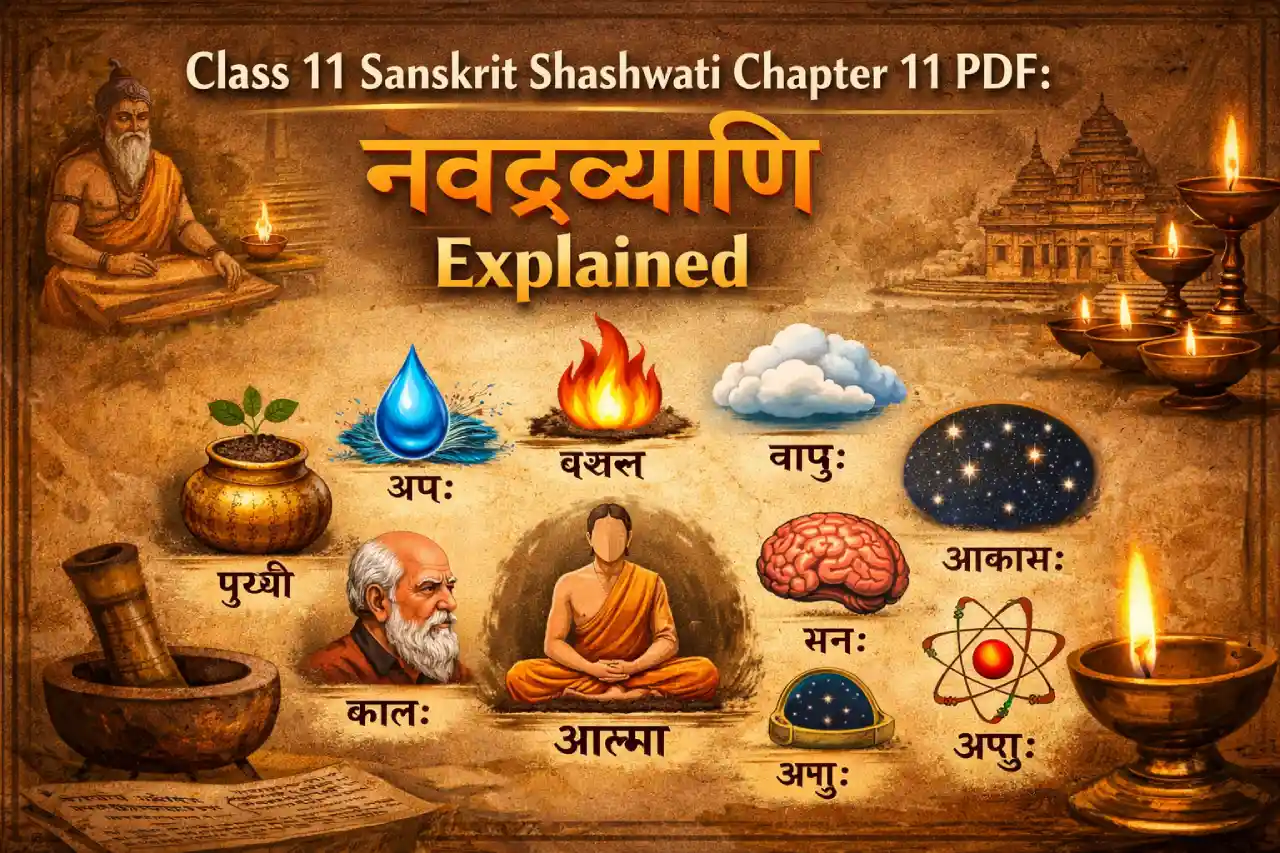
The term “नवद्रव्याणि” means “nine substances.” These are considered the basic elements that exist in the universe according to classical Indian thought.

The chapter explains each of these substances and their role in the functioning of the world.

The Nine Substances Explained

Here is a simple table to understand the nine dravyas:

Sanskrit TermMeaning (Simple English)
पृथ्वी (Prithvi)Earth
आपः (Apah)Water
तेजः (Tejas)Fire
वायु (Vayu)Air
आकाश (Akasha)Space
काल (Kala)Time
दिशा (Disha)Direction
आत्मा (Atma)Soul
मनः (Manas)Mind

These elements together explain the physical and non-physical aspects of existence.

Key Ideas in the Chapter

1. Understanding the Universe

The chapter explains how everything in the world is made up of basic substances.

2. Physical and Non-Physical Elements

Some substances like earth and water are physical, while others like time and soul are abstract.

3. Connection Between Mind and Body

The inclusion of “मनः” (mind) and “आत्मा” (soul) shows the importance of inner consciousness.

Why This Chapter Is Important for Students

  • Helps understand basic philosophical concepts
  • Improves Sanskrit reading and comprehension
  • Important for exam questions and explanations
  • Builds logical and conceptual thinking

Students who understand the list properly can easily score marks.

Study Tips for Chapter 11

  • Memorise the nine dravyas and their meanings
  • Understand the difference between physical and abstract elements
  • Practise writing short explanations
  • Revise regularly using a table format

This makes the chapter easier to revise before exams.

How to Download NCERT Class 11 Sanskrit Shashwati Chapter 11 PDF

Students can download the official chapter PDF from the National Council of Educational Research and Training website by following these steps:

Always use the official NCERT website to ensure you get the correct and updated version.

Leave a Comment

End of Article

Loading more posts...