JOIN WHATSAPP
STORIES

NCERT Class 12 Maths Chapter 11 Three Dimensional Geometry PDF – Concepts, Formulas and Free Download

NCERT Class 12 Maths Chapter 11 Three Dimensional Geometry PDF – Concepts, Formulas and Free Download

Chapter 11 of NCERT Class 12 Mathematics covers Three Dimensional Geometry, a topic that explains how to work with points, lines, and planes in space. It introduces direction cosines, direction ratios, the angle between two lines, the shortest distance between skew lines, and how to find the angle between a line and a plane. These concepts are very useful in higher-level geometry, physics, and engineering, and this chapter builds directly on what students have already learnt in earlier vector-based chapters.

I am writing about this topic because I remember how many students, including myself, found 3D Geometry confusing at first glance. Unlike 2D coordinate geometry, here we deal with the x, y, and z axes together. But with the help of diagrams, formulas, and clear NCERT explanations, the chapter becomes easier to understand and solve. Also, this chapter often carries high-weightage questions in board exams and JEE. A detailed, well-structured PDF helps in quick revision and better practice. That’s why I have also added links for downloading the chapter easily.

Key Concepts in Chapter 11: Three Dimensional Geometry

Three Dimensional Geometry is all about locating and connecting geometric objects in space using three axes — x, y, and z. Let’s break down what’s covered in this chapter:

1. Direction Cosines and Direction Ratios of a Line

2. Equation of a Line in 3D

There are two forms used:

  • Vector form
  • Cartesian form

3. Angle Between Two Lines

4. Shortest Distance Between Two Skew Lines

If two lines don’t intersect and are not parallel, they are called skew lines.

5. Equation of a Plane

  • Vector form
  • Cartesian form

6. Angle Between Line and Plane

7. Angle Between Two Planes

Why This Chapter is Important

This chapter has both theoretical and practical significance. In CBSE Class 12 board exams, questions from this chapter can appear as 3-marker or even 5-marker problems. In JEE Main and Advanced, 3D geometry is a favourite for concept-based MCQs that test understanding of direction cosines, shortest distances, and angles. I personally found that solving 2–3 example questions from NCERT before jumping into the exercises gave me more confidence.

Students should focus on writing vector and cartesian equations properly, avoid calculation errors in square roots and dot products, and draw clear diagrams to understand the geometry. These small things make a big difference while solving the tougher problems.

Download NCERT Class 12 Maths Chapter 11 Three Dimensional Geometry PDF

You can get the full chapter PDF for offline study and quick revision.
Leave a Comment

End of Article

Class 11 Sanskrit Shashwati Chapter 11 PDF: नवद्रव्याणि Explained

Class 11 Sanskrit Shashwati Chapter 11 PDF: नवद्रव्याणि Explained

NCERT Class 11 Sanskrit Shashwati Chapter 11, titled “नवद्रव्याणि”, introduces students to an important concept from Indian philosophy—the nine fundamental substances that make up the universe. The chapter explains these elements in a simple and structured way, helping students understand how ancient thinkers tried to explain the nature of reality through observation and logic.

I am writing about this chapter because many students search for the official NCERT PDF along with a simple explanation before exams. In my experience, topics like “नवद्रव्याणि” may feel slightly abstract at first, but once you understand the list and their meanings, it becomes quite easy to remember and revise. This chapter is important not only for Sanskrit exams but also for gaining a basic idea of traditional Indian philosophy. It helps students connect language learning with deeper concepts. Studying from the official NCERT book and revising regularly can make this chapter scoring and easy to handle.

About the Chapter: नवद्रव्याणि

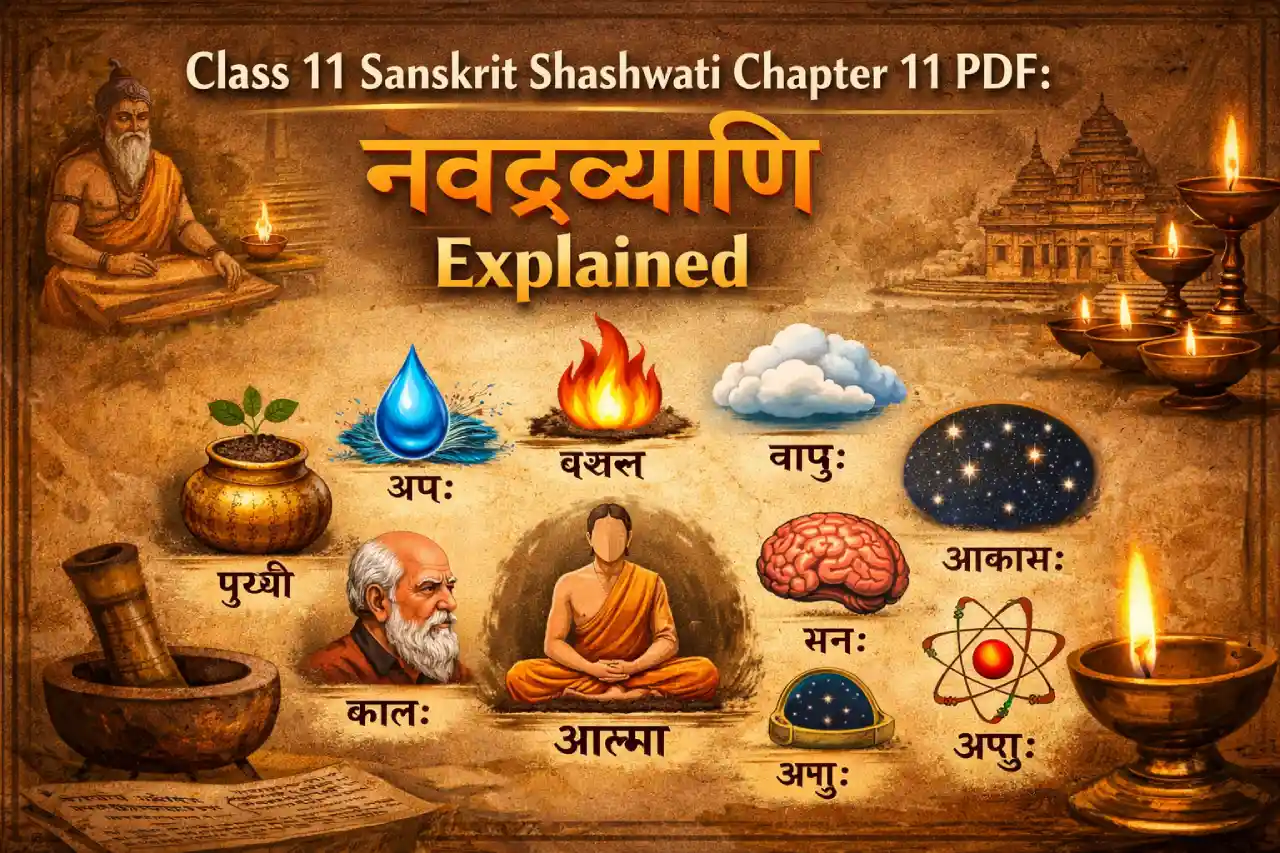
The term “नवद्रव्याणि” means “nine substances.” These are considered the basic elements that exist in the universe according to classical Indian thought.

The chapter explains each of these substances and their role in the functioning of the world.

The Nine Substances Explained

Here is a simple table to understand the nine dravyas:

Sanskrit TermMeaning (Simple English)
पृथ्वी (Prithvi)Earth
आपः (Apah)Water
तेजः (Tejas)Fire
वायु (Vayu)Air
आकाश (Akasha)Space
काल (Kala)Time
दिशा (Disha)Direction
आत्मा (Atma)Soul
मनः (Manas)Mind

These elements together explain the physical and non-physical aspects of existence.

Key Ideas in the Chapter

1. Understanding the Universe

The chapter explains how everything in the world is made up of basic substances.

2. Physical and Non-Physical Elements

Some substances like earth and water are physical, while others like time and soul are abstract.

3. Connection Between Mind and Body

The inclusion of “मनः” (mind) and “आत्मा” (soul) shows the importance of inner consciousness.

Why This Chapter Is Important for Students

  • Helps understand basic philosophical concepts
  • Improves Sanskrit reading and comprehension
  • Important for exam questions and explanations
  • Builds logical and conceptual thinking

Students who understand the list properly can easily score marks.

Study Tips for Chapter 11

  • Memorise the nine dravyas and their meanings
  • Understand the difference between physical and abstract elements
  • Practise writing short explanations
  • Revise regularly using a table format

This makes the chapter easier to revise before exams.

How to Download NCERT Class 11 Sanskrit Shashwati Chapter 11 PDF

Students can download the official chapter PDF from the National Council of Educational Research and Training website by following these steps:

Always use the official NCERT website to ensure you get the correct and updated version.

Leave a Comment

End of Article

Loading more posts...