JOIN WHATSAPP
STORIES

NCERT Class 12 Maths Chapter 12 Linear Programming PDF – Free Download with Concepts and Solutions

NCERT Class 12 Maths Chapter 12 Linear Programming PDF – Free Download with Concepts and Solutions

Chapter 12 of NCERT Class 12 Mathematics is about Linear Programming, a very practical and scoring chapter. It teaches students how to find the best possible outcome (like maximum profit or minimum cost) by applying mathematical techniques. This chapter is all about formulating problems based on real-life situations and solving them using graph-based methods. It mainly includes linear inequalities, constraints, objective functions, and feasible solutions. Even though the graphs are simple, understanding how to read them correctly is the key.

I chose to write on this chapter because many students take it lightly, thinking it’s just about drawing graphs. But the real challenge lies in writing the correct inequalities from word problems and identifying the feasible region properly. Linear Programming has high application in business, supply chain, operations, and economics. Even in competitive exams like JEE (Main), CUET, or NDA, questions come directly from this chapter. It’s also one of the easiest topics to score full marks in the Class 12 board exam. That’s why it’s important to learn the concepts clearly and use the NCERT PDF regularly for practice.

What is Linear Programming?

Linear Programming (LP) is a method used to optimise (maximize or minimize) a particular quantity, usually profit or cost, under given constraints. In simple terms, LP helps us to take the best decision when there are limited resources and multiple conditions to satisfy.

Key Terms You Need to Know

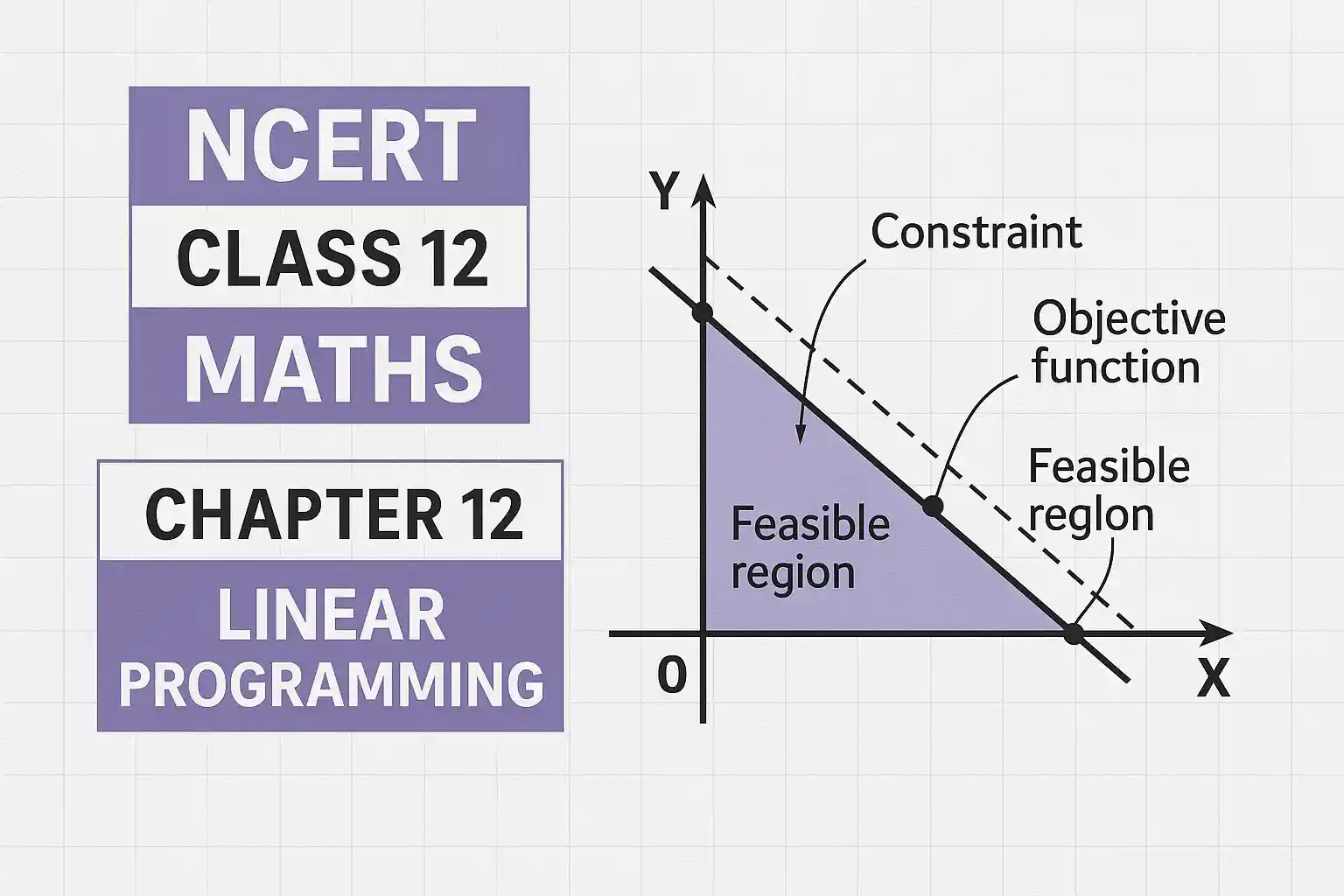
  • Objective Function: The function to be optimised (like z = ax + by)
  • Constraints: The conditions given in the problem as inequalities
  • Feasible Region: The region that satisfies all the constraints
  • Bounded Region: A region that is closed on all sides
  • Optimal Solution: The point in the feasible region where the objective function is maximum or minimum

Types of Linear Programming Problems Covered

In NCERT, three types of problems are mostly discussed:

  1. Diet Problem – Minimising cost of food with given nutrition constraints
  2. Manufacturing Problem – Maximising profit with limited resources
  3. Transportation Problem – Finding the cheapest or shortest route for delivery

These are presented in the form of word problems and have to be converted into mathematical inequalities and solved by drawing graphs.

Step-by-Step Method to Solve LPP

Here is a simple way to solve any Linear Programming Problem in exams:

  1. Identify the variables (usually x and y)
  2. Write the constraints as linear inequalities
  3. Plot the inequalities on a graph to find the feasible region
  4. Write the objective function
  5. Find corner points of the feasible region
  6. Substitute corner points in the objective function to get the optimal value

Why This Chapter is Scoring and Useful

What I like most about this chapter is that it’s completely application-based. If you know how to draw basic linear graphs and find intersection points, you’re already halfway there. Most CBSE papers ask 5-mark questions from this topic, and students can easily score full marks if they follow the method step-by-step.

Also, the real-world examples make this chapter more relatable. From choosing the best production method to optimising a delivery route, LP is everywhere. Many commerce and engineering students use these concepts later in their professional studies, especially in management, economics, and logistics.

Download NCERT Class 12 Maths Chapter 12 Linear Programming PDF

To revise this chapter anytime, it’s helpful to have the official PDF with you.
Leave a Comment

End of Article

Class 11 Geography Chapter 9 Hindi PDF: वायुमंडलीय परिसंरचण तथा मौसम प्रणालियाँ

Class 11 Geography Chapter 9 Hindi PDF: वायुमंडलीय परिसंरचण तथा मौसम प्रणालियाँ

NCERT Class 11 Geography Chapter 9, वायुमंडलीय परिसंरचण तथा मौसम प्रणालियाँ, explains how air moves in the atmosphere and how different weather systems are formed. This chapter connects pressure belts, winds, cyclones, and anticyclones to everyday weather conditions we experience. It helps students understand why winds blow from one place to another and how large-scale atmospheric circulation controls global and regional weather.

I am writing about this chapter because many students struggle to link theory with real weather events. Terms like pressure gradient force, Coriolis force, trade winds, or cyclones often sound heavy, but this chapter actually explains things we see around us, such as changing wind direction, storms, and seasonal weather patterns. For Class 11 students, this chapter is very important because it builds the base for understanding monsoons, climate systems, and even disaster-related topics later. From an exam point of view too, this chapter carries weight in school exams and competitive tests, where conceptual clarity matters much more than memorising definitions.

What This Chapter Covers

Chapter 9 focuses on how the atmosphere behaves at a global level and how this behaviour results in different weather systems. It explains the movement of air from high-pressure areas to low-pressure areas and how Earth’s rotation affects this movement.

Pressure Belts and Wind Systems

One of the key parts of this chapter is pressure belts. Students learn about:

  • Equatorial low-pressure belt
  • Subtropical high-pressure belts
  • Subpolar low-pressure belts
  • Polar high-pressure belts

Along with this, the chapter explains major wind systems such as trade winds, westerlies, and polar winds, which play a crucial role in shaping global climate.

Forces Affecting Wind Movement

This chapter clearly explains why winds do not move in a straight line. The main forces discussed are:

  • Pressure gradient force
  • Coriolis force
  • Frictional force

Understanding these forces helps students answer both short and long questions confidently.

Weather Systems: Cyclones and Anticyclones

Another important section of this chapter deals with weather systems. Students learn about:

  • Tropical cyclones
  • Temperate cyclones
  • Anticyclones

These concepts help explain storms, heavy rainfall, and sudden weather changes, which are often discussed in current affairs as well.

Why Chapter 9 Is Important for Students

This chapter acts as a bridge between basic physical geography and applied climatology. Without understanding atmospheric circulation, it becomes difficult to grasp topics like monsoon winds, jet streams, and climate change patterns later in the syllabus.

From an exam point of view, questions are commonly asked on:

  • Pressure belts and wind systems
  • Difference between cyclones and anticyclones
  • Forces controlling wind movement

How to Download NCERT Class 11 Geography Chapter 9 PDF (Hindi)

Students can download the official Hindi PDF by following these steps:

Using the official NCERT source ensures correct content, proper diagrams, and updated explanations.

Leave a Comment

End of Article

Loading more posts...