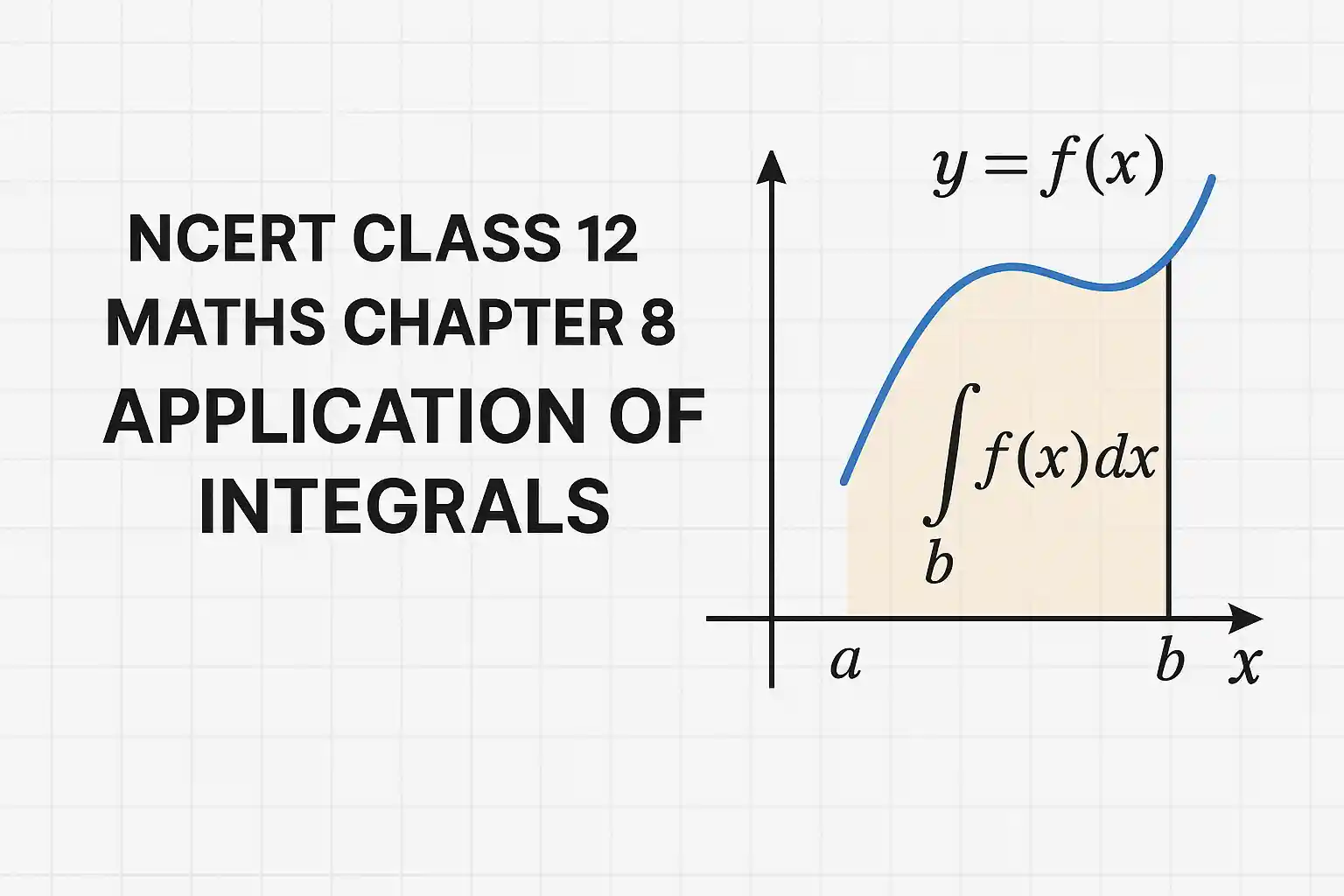
Chapter 8 of Class 12 Maths is titled Application of Integrals, and it builds directly on what students learned in the previous chapter. This chapter mainly deals with finding the area under curves and between two curves using definite integrals. These topics are not just theoretical – they have direct applications in physics, economics, and engineering, especially in calculating displacement, area, and even in data analysis. In this chapter, students will learn how to use integration practically, which makes it very important from both exam and application point of view.
I decided to write about this chapter because many students struggle when integrals are no longer abstract. When I was preparing for my Class 12 board exam, I found this chapter tricky at first because drawing graphs and setting correct limits confused me. But once I understood how the area is calculated using definite integration, the chapter became one of the easiest to score full marks. This chapter usually carries a 5- or 6-mark question in the CBSE exam, and JEE aspirants also see related problems quite often. That’s why I believe it’s important to understand the basics of area under curves and have easy access to the NCERT PDF for regular practice.
What You Will Learn in Chapter 8: Application of Integrals
This chapter teaches how integration can be used to calculate area in various situations. Here’s a simple breakdown:
1. Area Under a Curve
- How to calculate area under a curve from
x = atox = b - Use of definite integrals in finding area
- Graph-based understanding of the region being covered
2. Area Between Two Curves
- Formula for finding area between two curves: Area=∫ab[f(x)−g(x)]dx\text{Area} = \int_{a}^{b} \left[ f(x) – g(x) \right] dxArea=∫ab[f(x)−g(x)]dx
- Cases where curves intersect and how to find points of intersection
- Area when functions are expressed in terms of
y(vertical vs horizontal strip method)
3. Examples of Application
- Finding area enclosed between
y = x²andy = √x - Area between a line and a parabola
- Area bounded by
y = sinxandy = cosxin a given interval
Important Concepts Table
| Concept | Key Idea |
|---|---|
| Area under curve | Integration between two x-values |
| Area between two curves | Subtract lower curve from upper curve and integrate |
| Symmetry | Use symmetry to simplify calculation (e.g., even/odd functions) |
| Graph sketching | Helps in deciding limits and upper/lower curves |
Understanding graphs is very important here. If you don’t draw the curves, you might end up subtracting the wrong function from the other, leading to negative or wrong values.
Why Chapter 8 Is Important
This chapter has real-world relevance. In physics, engineers often use this concept to calculate the area under velocity-time graphs to find displacement. In economics, it’s used to calculate consumer and producer surplus. In maths exams, this chapter often gives direct questions that become scoring once you understand the graphical part.
From my own experience, I would suggest you don’t skip the graph part. Many students jump directly to integration without understanding which curve is on top. Also, always remember to find the intersection points first, because they help you decide the limits of integration. NCERT examples and exercises do a good job of gradually increasing difficulty, so it’s a good idea to solve all of them, especially the examples before Exercise 8.1.
Download NCERT Class 12 Maths Chapter 8 Application of Integrals PDF
To help you revise anywhere, you can download the official NCERT PDF for Chapter 8