
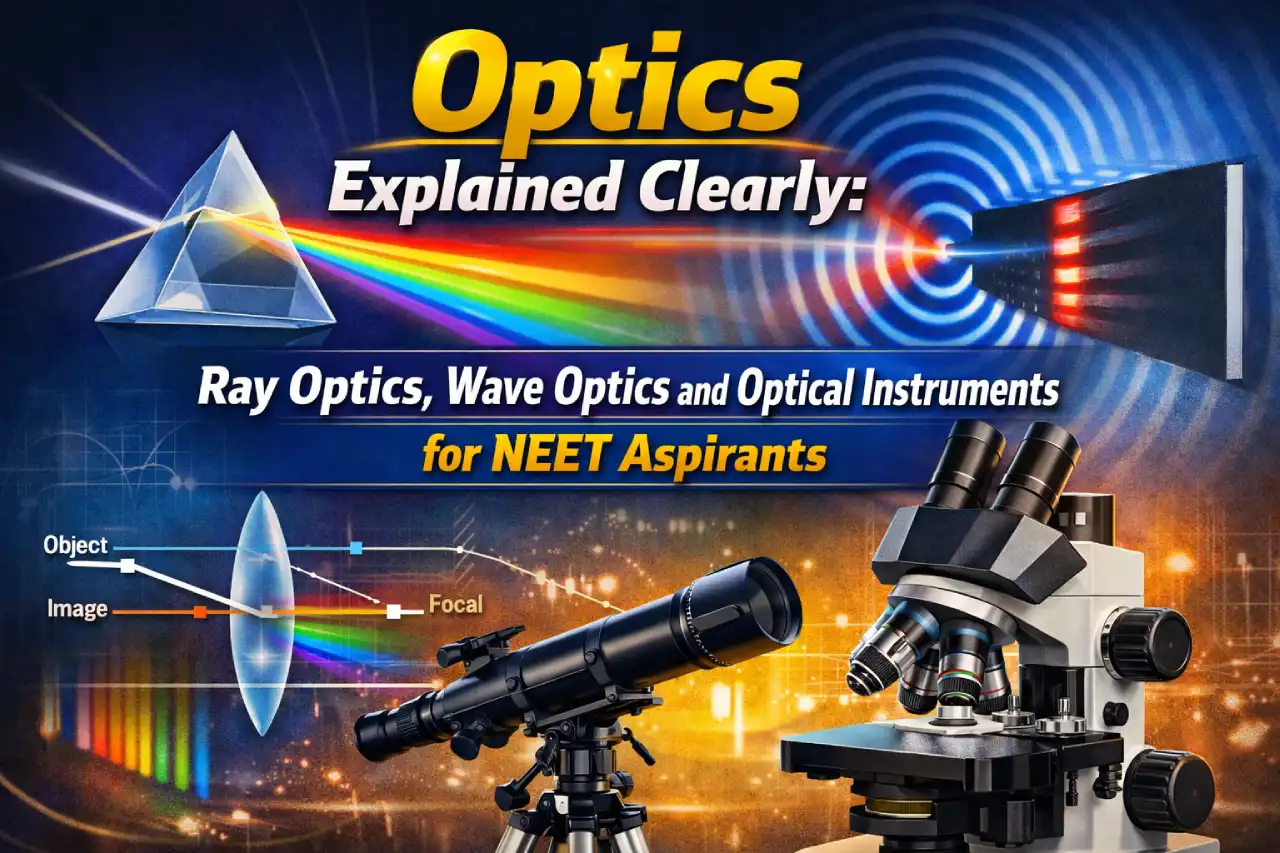
Optics is one of those Physics chapters that looks heavy at first glance but becomes very logical once the basics are clear. This chapter deals with how light behaves when it reflects, refracts, interferes, diffracts, or passes through lenses and mirrors. From simple plane mirrors to complex optical instruments like microscopes and telescopes, Optics connects theory directly with what we see in everyday life and in competitive exams like NEET OPTICS.
I am writing this article because Optics consistently carries good weight in NEET and many students lose marks not due to difficulty, but due to confusion between formulas, sign conventions, and concepts. Once the fundamentals are organised properly, this chapter becomes scoring. This write-up is meant to explain Optics in a clean, exam-oriented way, while keeping the language simple and practical for students preparing seriously.
Reflection of Light and Spherical Mirrors
Reflection of light happens when a ray strikes a smooth surface and returns to the same medium. The two laws of reflection form the backbone of this topic. First, the angle of incidence is equal to the angle of reflection. Second, the incident ray, reflected ray, and normal lie in the same plane OPTICS.
Spherical mirrors are of two types: concave and convex. A concave mirror can form real or virtual images depending on object position, while a convex mirror always forms a virtual, erect, and diminished image. Understanding image formation tables for different object positions is extremely important for NEET.
Mirror Formula and Magnification
The mirror formula connects object distance, image distance, and focal length using
1/f = 1/u + 1/v
Magnification for mirrors is given by
m = −v/u
Sign convention plays a crucial role here. Most numerical mistakes happen because students ignore the Cartesian sign convention explained in the chapter OPTICS.
Refraction of Light and Snell’s Law
Refraction is the bending of light when it moves from one transparent medium to another. The speed and wavelength of light change, but frequency remains constant. Snell’s law explains this behaviour and is written as
n₁ sin i = n₂ sin r
The refractive index is defined as the ratio of the speed of light in vacuum to its speed in a medium. This concept is frequently tested in NEET through numericals and reasoning questions OPTICS.
Total Internal Reflection and Its Applications
Total internal reflection occurs when light travels from a denser to a rarer medium and the angle of incidence exceeds the critical angle. At this point, light is completely reflected back into the denser medium.
This principle is used in optical fibres, prisms, and many medical and communication technologies. Questions based on critical angle and refractive index appear regularly in exams.
Download this OPTICS PDF File: Click Here
Lenses and Image Formation
Lenses are transparent media bounded by curved surfaces. Convex lenses converge light, while concave lenses diverge it. Like mirrors, image formation depends on object position.
The lens formula is
1/f = 1/v − 1/u
Magnification is
m = v/u
Power of a lens is measured in dioptre and is given by
P = 1/f
Combination of lenses is another high-scoring area, where total power is the sum of individual powers OPTICS.
Optical Instruments: Microscope and Telescope
A simple microscope uses a single convex lens, while a compound microscope uses two lenses for higher magnification. The final image is magnified and inverted.
Telescopes are used to observe distant objects. Refracting and reflecting telescopes differ in construction, but both depend on focal length and aperture for magnifying power and resolving power. NEET often tests formulas related to telescope magnification and resolving power.
Wave Optics and Huygens’ Principle
Wave optics explains the wave nature of light. Huygens’ principle states that every point on a wavefront acts as a source of secondary wavelets. This principle helps derive laws of reflection and refraction logically.
Young’s Double Slit Experiment proves interference and explains the formation of bright and dark fringes. Fringe width depends on wavelength, slit separation, and screen distance, a very common NEET question area OPTICS.
Diffraction and Polarisation
Diffraction occurs when light bends around obstacles or passes through narrow slits. The central maximum is the brightest and widest. Conditions for minima and maxima are important from an exam point of view.
Polarisation proves that light is a transverse wave. Only transverse waves can be polarised. Polaroids, Brewster’s law, and applications of polarised light are frequently asked conceptual questions.

















