
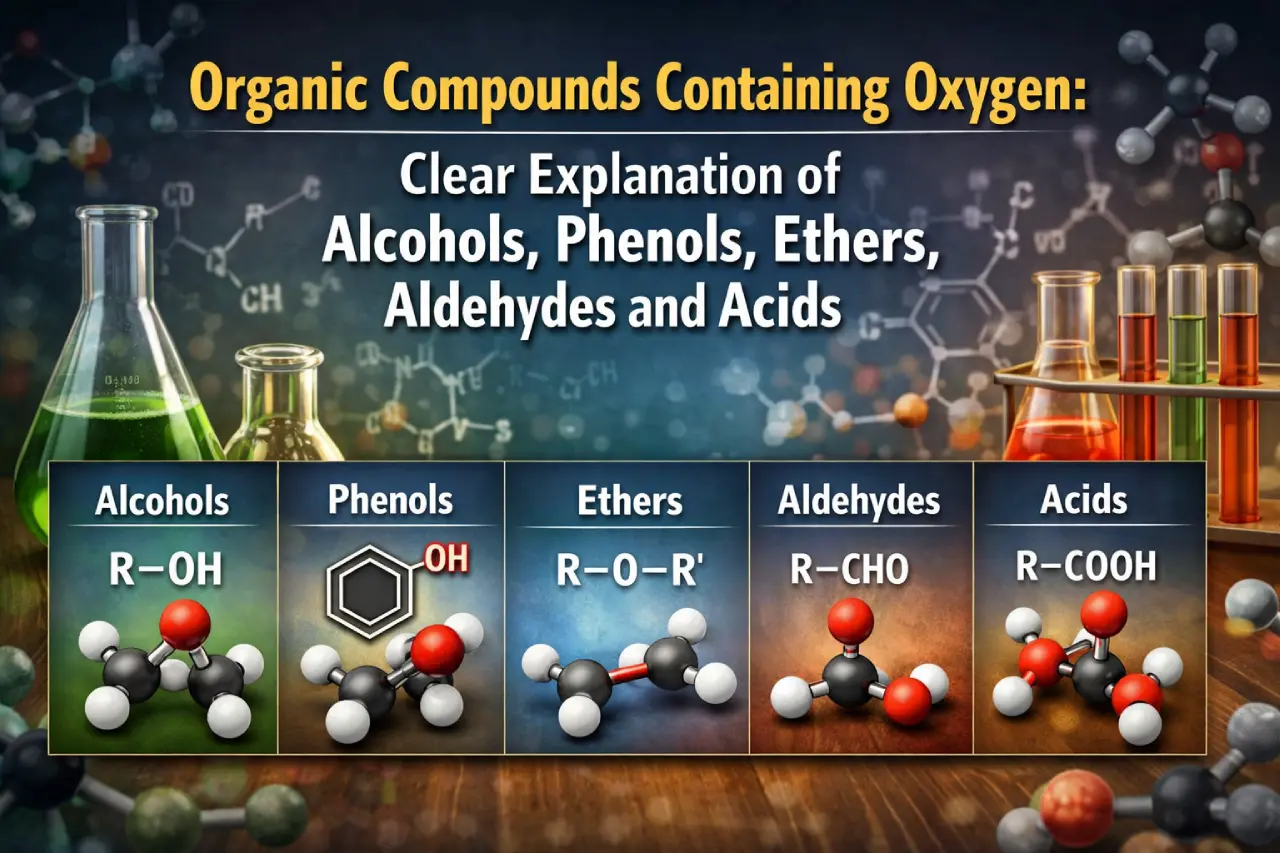
topic explains how oxygen enters organic molecules and changes their structure, properties, and reactions. The PDF focuses on five major classes of oxygen-containing compounds: alcohols, phenols, ethers, aldehydes, ketones, and carboxylic acids. Each group has a specific functional group that decides how the compound behaves chemically and physically.
I am writing about this topic because students often memorise reactions without understanding why they happen. This chapter is not just about formulas and tests; it explains real chemical behaviour such as acidity, boiling points, oxidation, and nucleophilic reactions. A clear understanding of oxygen-containing organic compounds is essential for exams like NEET and for building a strong base in organic chemistry. This article simplifies what is explained in the PDF and presents it in an easy, readable manner.
Alcohols: Structure, Types, and Behaviour
Alcohols are compounds formed when a hydrogen atom of an alkane is replaced by a hydroxyl (–OH) group. Their general formula is CₙH₂ₙ₊₁OH. Based on the number of –OH groups, alcohols are classified as monohydric, dihydric, and trihydric. Based on the carbon attached to the –OH group, they are primary, secondary, or tertiary alcohols.
Alcohols are colourless liquids or solids with relatively high boiling points due to hydrogen bonding. Their solubility in water decreases as the alkyl chain becomes longer. Chemically, alcohols show both nucleophilic and electrophilic behaviour depending on whether the O–H bond or C–O bond breaks. The PDF clearly explains reactions such as oxidation, dehydration, ester formation, and substitution using Lucas reagent.
Phenols: Aromatic Hydroxyl Compounds
Phenols differ from alcohols because their –OH group is directly attached to an aromatic ring. This structural difference makes phenols more acidic than alcohols. The acidity arises due to resonance stabilisation of the phenoxide ion.
Phenols undergo electrophilic substitution reactions such as nitration, halogenation, and sulphonation more easily than benzene. The PDF also explains preparation methods like the cumene process, diazonium salt hydrolysis, and Dow’s process. Special reactions such as Kolbe’s reaction and Reimer–Tiemann reaction are highlighted to show how phenols are converted into useful aromatic compounds.
Ethers: Formation and Properties
Ethers have the general structure R–O–R′ and can be symmetrical or unsymmetrical. They are prepared mainly by Williamson synthesis and dehydration of alcohols. Ethers are relatively inert compared to alcohols and phenols.
Physically, ethers have low boiling points due to the absence of hydrogen bonding between ether molecules. Chemically, ethers undergo cleavage reactions with strong acids like HI and HBr. Aromatic ethers show electrophilic substitution reactions similar to phenols but with less reactivity due to the –OR group’s effect.
Download this ORGANIC COMPOUND CONTAINING NITROGEN PDF: Click Here
Aldehydes and Ketones: Carbonyl Compounds
Aldehydes and ketones contain the carbonyl (C=O) group. In aldehydes, the carbonyl carbon is attached to at least one hydrogen, while in ketones it is attached to two carbon atoms. The polarity of the carbonyl group makes these compounds highly reactive.
The PDF covers preparation methods such as oxidation of alcohols, ozonolysis of alkenes, hydration of alkynes, and reactions involving Grignard reagents. Important reactions include nucleophilic addition, aldol condensation, Cannizzaro reaction, reduction, oxidation, and tests like Tollens’, Fehling’s, and iodoform tests, all explained with exam-oriented clarity.
Carboxylic Acids and Their Chemistry
Carboxylic acids contain the –COOH functional group and show acidic behaviour due to resonance stabilisation of the carboxylate ion. Their acidity is influenced by substituents attached to the carbon chain.
The PDF explains preparation methods from alcohols, aldehydes, nitriles, esters, and Grignard reagents. Carboxylic acids undergo reactions involving cleavage of O–H and C–O bonds, esterification, reduction, and substitution. Their physical properties such as boiling point and solubility are linked directly to hydrogen bonding and molecular size.

















