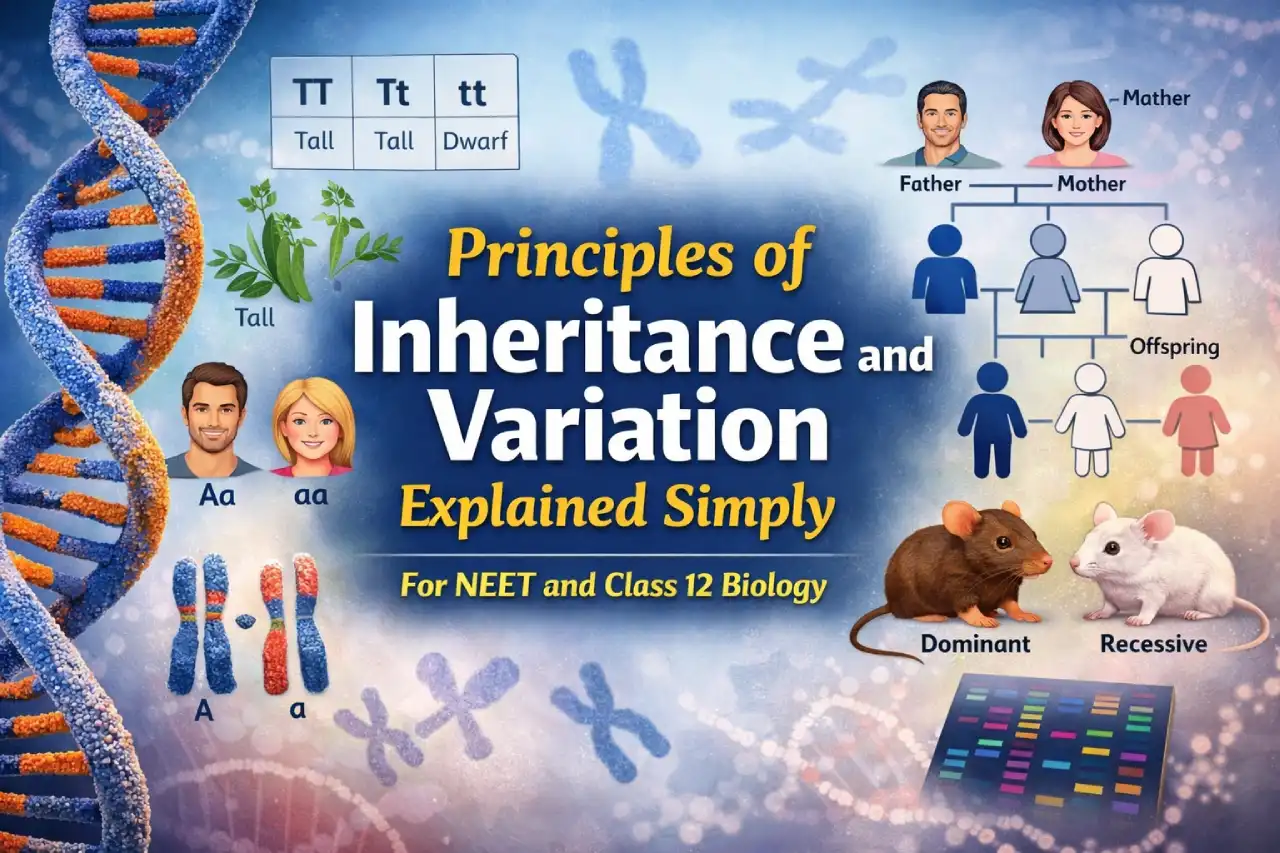
Principles of Inheritance and Variation is one of the most important and concept-heavy chapters in Class 12 Biology. This topic explains how traits are passed from parents to offspring and why differences appear among individuals of the same species. From eye colour and height to blood groups and genetic disorders, everything is connected to inheritance. This chapter also forms the base for understanding evolution, biotechnology, and human genetics, making it crucial for board exams as well as NEET preparation.
I am writing about this topic because many students feel overwhelmed by genetics, mainly due to unfamiliar terms and ratios that seem hard to remember. In reality, this chapter is very logical if explained step by step. Once the basics of Mendel’s experiments and gene behaviour are clear, the rest of the chapter becomes easier to follow. Knowing this topic well can help students score confidently and understand real-life biological phenomena better.
What Are Genetics, Heredity, and Variation?
Genetics is the branch of biology that deals with heredity and variation. Heredity refers to the transmission of characters from parents to offspring, while variation explains the differences seen among individuals of the same species. These variations may be physical, physiological, or behavioural. Genes are the basic units of inheritance and are located on chromosomes. They carry information that determines how a trait is expressed.
Gregor Mendel and the Beginning of Genetics
Gregor Johann Mendel is known as the Father of Genetics. He conducted experiments on garden pea plants because they were easy to grow, had clear contrasting traits, and allowed controlled pollination. Mendel carefully analysed the inheritance of traits over several generations and recorded numerical results. His work laid the foundation of modern genetics and introduced the idea that inheritance follows specific laws.
Monohybrid Cross and Law of Dominance
A monohybrid cross involves the study of one pair of contrasting traits, such as tall and dwarf plants. When Mendel crossed pure tall plants with pure dwarf plants, all offspring in the first generation were tall. This showed that one trait can dominate over the other. This observation led to the Law of Dominance, which states that in a heterozygous condition, only the dominant allele expresses itself.
Law of Segregation Explained Clearly
The Law of Segregation states that the two alleles of a gene separate during gamete formation. As a result, each gamete carries only one allele. This explains why recessive traits reappear in the second generation even though they were not visible in the first generation. This law is also called the Law of Purity of Gametes.
Download this PDF: Click Here
Dihybrid Cross and Law of Independent Assortment
A dihybrid cross studies the inheritance of two pairs of contrasting traits at the same time. Mendel observed that traits assort independently of each other, leading to a 9:3:3:1 ratio in the F2 generation. This observation formed the Law of Independent Assortment. This law applies only when the genes are located on different chromosomes or far apart on the same chromosome.
Exceptions to Mendel’s Laws
Not all traits follow Mendel’s laws strictly. In incomplete dominance, the heterozygous condition shows an intermediate phenotype, such as pink flowers produced from red and white parents. In codominance, both alleles express equally, as seen in the AB blood group in humans. Some traits are controlled by more than two alleles, known as multiple alleles, like the ABO blood group system.
Chromosomal Theory of Inheritance
The Chromosomal Theory of Inheritance explains that genes are located on chromosomes and that their behaviour during meiosis explains Mendel’s laws. This theory was proposed by Sutton and Boveri and later supported by experimental evidence. It linked cytology with genetics and provided a physical basis for inheritance.
Sex Determination and Sex-Linked Traits
In humans, sex determination follows the XX-XY mechanism. Females have two X chromosomes, while males have one X and one Y chromosome. Some traits are linked to the X chromosome and are called sex-linked traits. Colour blindness and haemophilia are common examples. These traits appear more frequently in males because they have only one X chromosome.
Linkage and Crossing Over
Genes located close together on the same chromosome tend to be inherited together, a phenomenon called linkage. However, during meiosis, crossing over can occur between homologous chromosomes. This exchange of genetic material creates new combinations of genes and increases variation. The frequency of crossing over helps in locating genes on chromosomes.