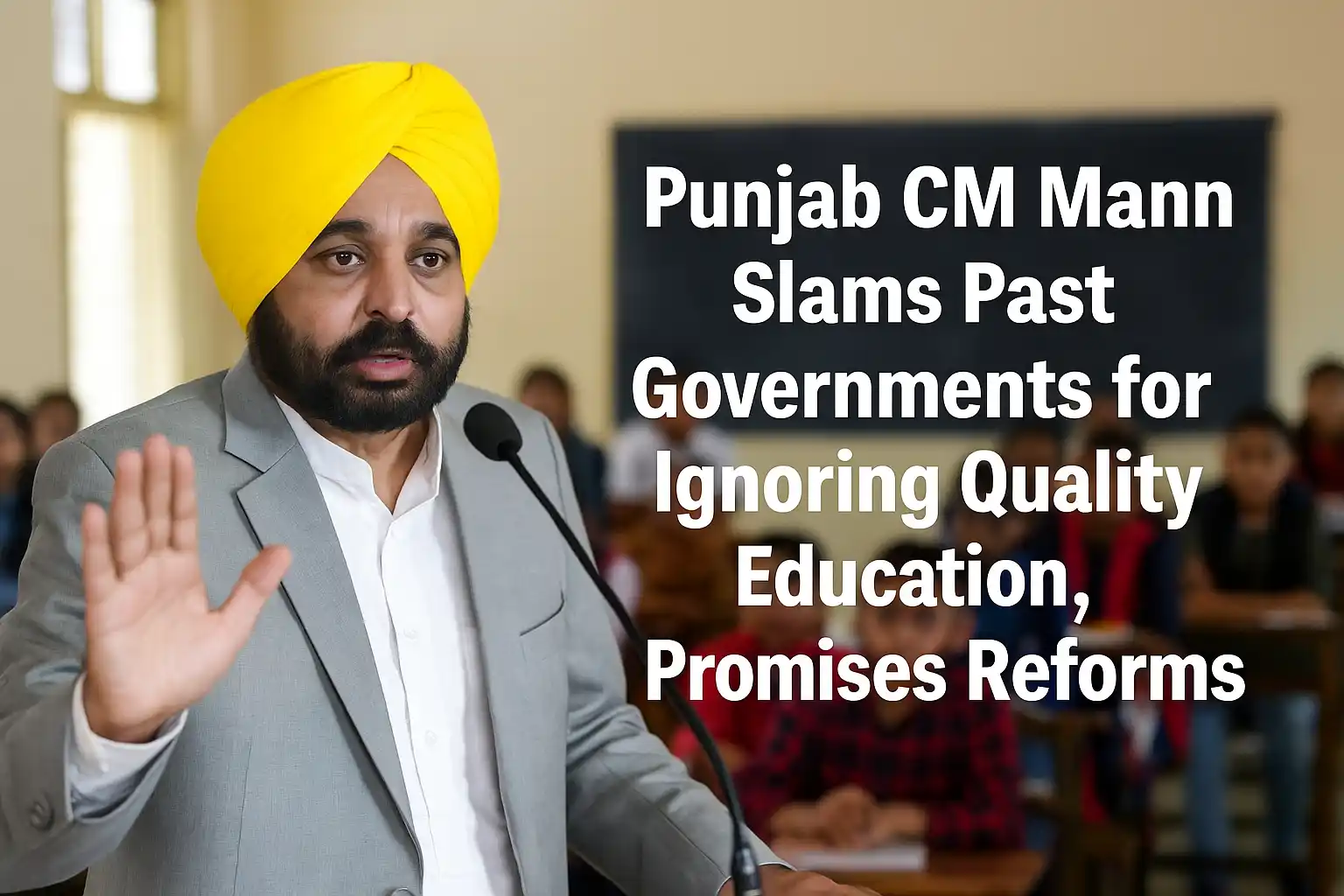
Punjab Chief Minister Bhagwant Mann has said that previous governments in the state failed to give importance to quality education, which left the system weak and students at a disadvantage. He pointed out that for years, governments focused only on buildings, announcements, and token measures, while the actual teaching standards and resources for students remained neglected.
I am writing about this issue because education is the backbone of any society, and when a state like Punjab admits its system has suffered from years of neglect, it raises an important question about accountability. Many families in Punjab spend heavily to send their children to private schools or even abroad because they do not trust the government schools. This is not just a matter of academic performance; it directly impacts the future of young people and the growth of the state. By highlighting what the Chief Minister said and the steps being promised now, we can understand where the gaps were and what reforms are needed to restore trust in public education.
Why CM Mann Criticised Previous Governments
During his speech, CM Mann highlighted that governments in the past only paid lip service to education. Schools were left without basic infrastructure, teachers were not trained properly, and innovation in learning was completely missing. According to him, political leaders treated education as a secondary issue, while priority was always given to populist schemes that could fetch votes.
Current State of Education in Punjab
Punjab has close to 20,000 government schools, but many still lack modern classrooms, laboratories, or digital resources. A large number of parents prefer private institutions, even if it means financial hardship, because they believe government schools do not provide the same opportunities. At the same time, the number of students migrating abroad for higher studies continues to rise, showing the lack of trust in the system.
What the Mann Government Promises
The present government has announced several measures to change this scenario. These include:
- Sending teachers abroad for training to bring global practices back to Punjab
- Upgrading government schools with smart classrooms and better facilities
- Introducing English as a medium of instruction in select schools to match private institutions
- Strengthening vocational and skill-based education so that students are job-ready after school
These steps are aimed at reducing the gap between government and private schools while giving students confidence that they can succeed without leaving their hometowns.
Why Education Reform Matters Now
Punjab has a young population, but without proper schooling, their potential cannot be realised. If government schools improve in quality, it can reduce the financial burden on families, stop the unnecessary rush to private schools, and even prevent large-scale student migration abroad. More importantly, it can restore equality in education, giving rural and urban children the same chances to succeed.