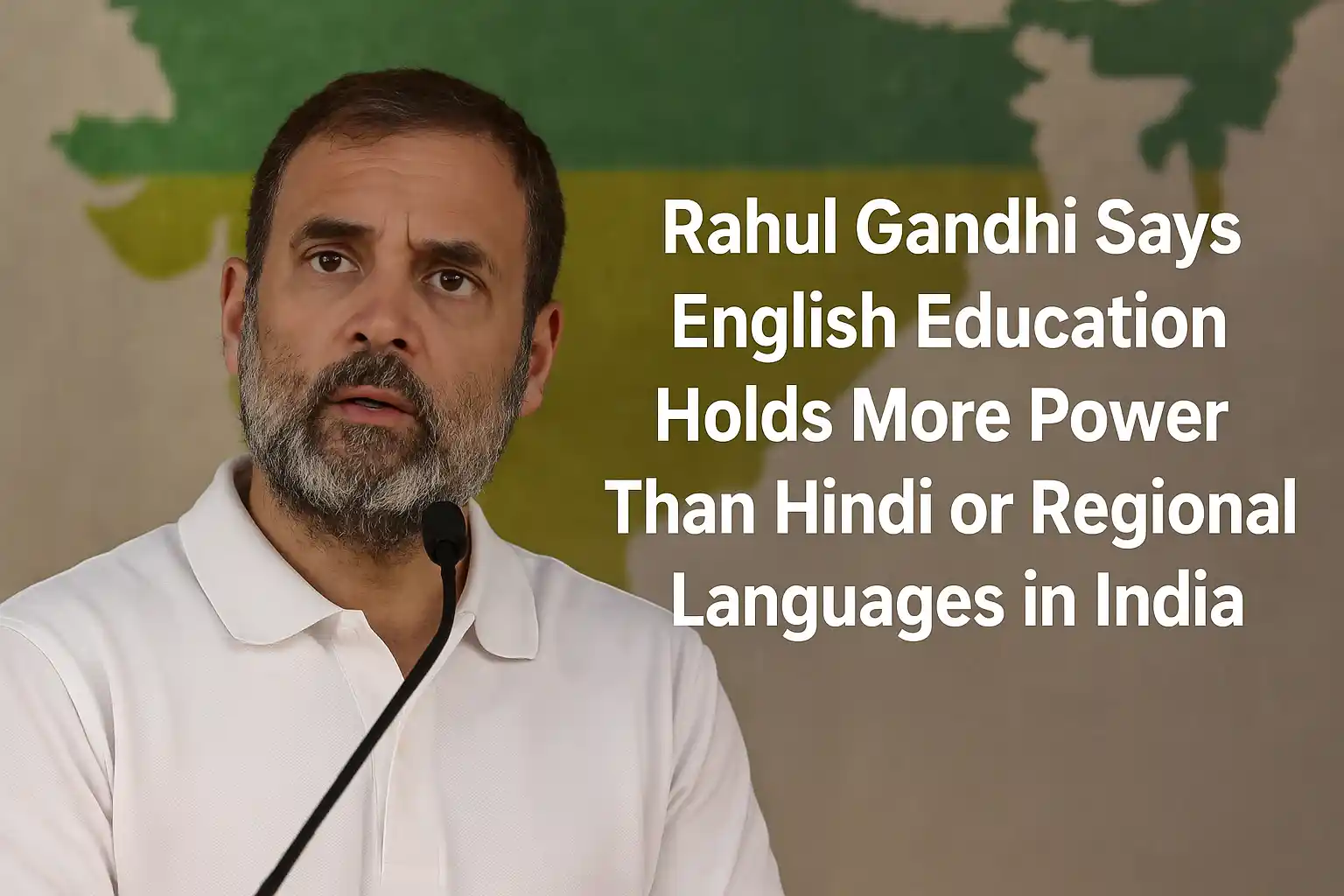
Congress leader Rahul Gandhi recently sparked a fresh conversation on the role of English in India’s education system. During a public address, he said that English education holds more power today than Hindi or any regional language. He explained that children studying in English medium schools have a clear advantage when it comes to jobs, social mobility, and overall confidence. His remarks triggered both support and criticism, especially from those promoting local language education.
I found this statement worth discussing because it touches a deep concern shared by many parents, students and educators across India. While English has definitely opened global doors for many Indians, it has also created a divide where regional language students often feel left behind. I’ve seen this divide in urban and rural schools, and even among family members. So, when a national leader openly addresses this issue, it gives us a chance to reflect on what kind of education system we want—one that empowers everyone equally or one that only benefits a few. This article breaks down what Rahul Gandhi said, the reactions it got, and why the debate around language in education matters now more than ever.
What Rahul Gandhi Actually Said
Speaking at a Bharat Jodo Nyay Yatra event in Odisha, Rahul Gandhi highlighted that English medium students in India have a stronger edge in terms of job opportunities and exposure. He said that while India takes pride in its rich regional languages, the reality is that the system continues to reward English more.
He gave examples from villages he visited during the yatra. Many parents in rural areas told him they want their kids to learn English because they believe it’s the only way to succeed. He also criticised the imbalance in the education system that puts Hindi and regional language students at a disadvantage.
The Divide Between English and Regional Language Schools
Rahul’s statement reflects a growing truth—students from English medium schools often have better access to private colleges, top jobs, and global exposure. On the other hand, students from Hindi or other state board schools struggle with language barriers even after clearing competitive exams.
Here’s what adds to the gap:
- Most government job exams are still in English or Hindi, not always in regional languages
- Higher education courses, especially in science and technology, are largely available in English
- Private companies often prefer English-speaking candidates for most roles
This makes English not just a language but a ticket to opportunity, creating an uneven playing field.
Reactions and Political Responses
After the statement, several political figures and education activists criticised Rahul Gandhi, saying he was undermining Indian languages. Some accused him of favouring elite systems and ignoring the emotional and cultural value of regional languages.
However, others backed his point, arguing that the focus should be on equal access, not just romanticising mother tongues. They felt it’s time for serious reforms where students get quality education in their chosen language, and regional language schools are not left underfunded or outdated.
Is It Time to Rebalance the System?
The larger issue isn’t English vs Hindi. It’s about who gets quality education and who doesn’t. If English education offers better outcomes, we must ask why our Hindi or regional medium schools don’t offer the same.
Possible steps to bridge the gap:
- Improve teaching quality and infrastructure in regional medium schools
- Provide students the option to switch smoothly between languages
- Promote bilingual education models that teach English without removing the local language
- Update textbooks and teaching materials in regional languages
Rahul Gandhi’s comment brings forward the idea that language should not be a barrier to growth, and that we need to ensure quality and dignity in education, no matter the medium.