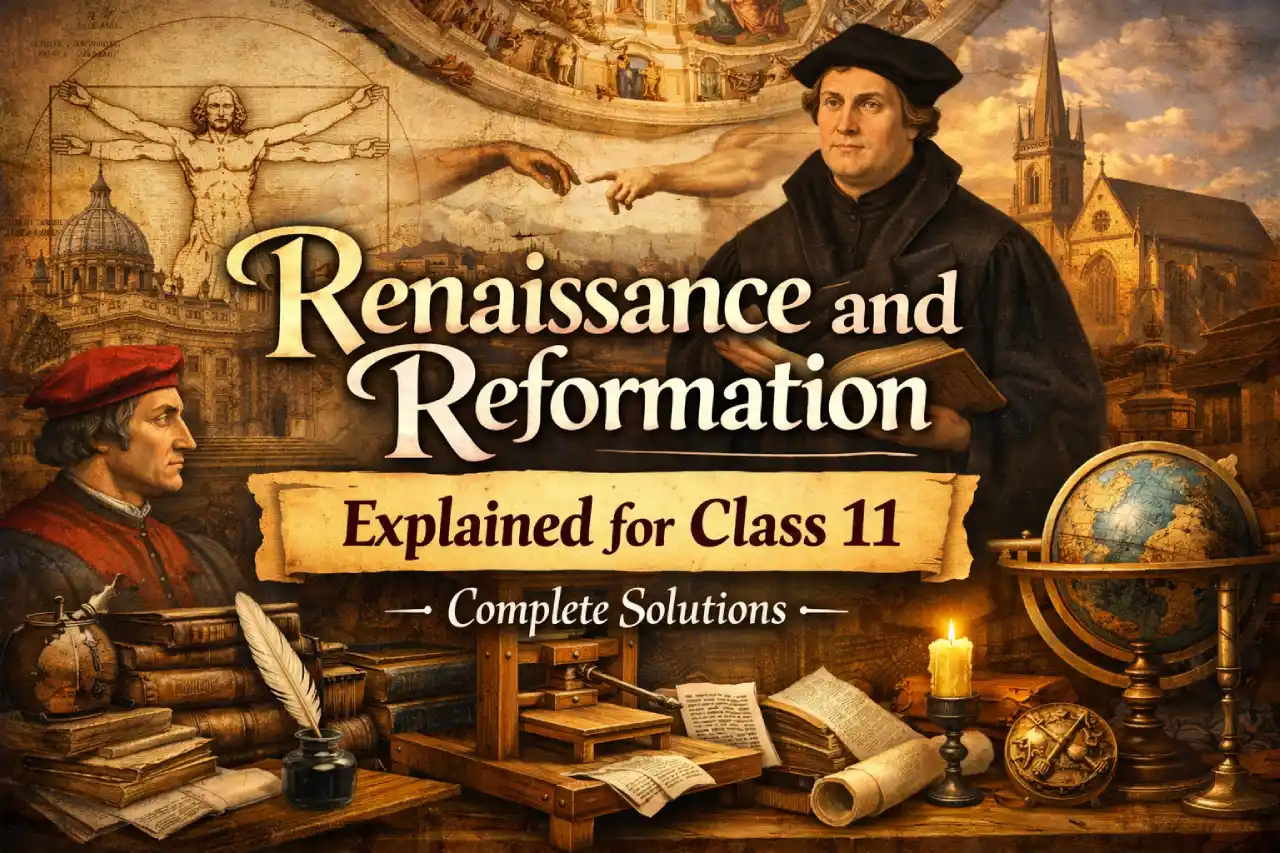
The Class 11 History chapter on cultural transformation in Europe explains how the Renaissance, Humanism, scientific discoveries and the Protestant Reformation changed the face of the medieval world. This chapter covers major personalities like Francesco Petrarch, Leonardo da Vinci, Michelangelo, Martin Luther, Erasmus, Copernicus and Machiavelli. It also discusses the invention of the printing press, decline of feudalism, rise of towns and the beginning of modern political thought. Together, these developments marked a turning point in European history.
I am writing about this because many students find this chapter overwhelming due to the large number of names, dates and movements. However, once we understand how all these changes are connected, the chapter becomes much easier and far more interesting. In my experience, when students revise it theme-wise instead of memorising randomly, they gain clarity and confidence. This is not just a history lesson; it explains how modern Europe was born.
Meaning and Beginning of the Renaissance
The word Renaissance literally means “rebirth.” It refers to the revival of classical Greek and Roman learning that began in Italy during the 14th century and later spread across Europe.
Italian cities like Florence, Venice, Genoa and Padua became major centres of trade, art and education. Universities in these cities promoted new ways of thinking. Humanists studied ancient texts and believed that human beings have dignity, talent and the ability to shape their own lives.
Francesco Petrarch is regarded as the Father of Humanism. Humanists stressed freedom of the individual, importance of worldly life and rational thinking instead of blind faith.
Features of Humanism
Humanism focused on:
- Study of classical literature
- Importance of individual rights
- Encouragement of debate and discussion
- Emphasis on human potential
Giovanni Pico della Mirandola, in his work On the Dignity of Man, highlighted the importance of debate for discovering truth. Humanists believed that education should develop a well-rounded personality.
The term “Renaissance Man” was used for someone who had many interests and skills in different fields.
Renaissance Art and Cultural Growth
Art during the Renaissance became more realistic and scientific. Artists studied anatomy and geometry to improve their work.
Important artistic developments included:
- Use of perspective through geometry
- Study of light and shadow for three-dimensional effect
- Use of oil paints for richer colour
Leonardo da Vinci is the best example of a Renaissance Man. He painted Mona Lisa and The Last Supper. Apart from painting, he studied anatomy, mathematics and even designed a flying machine after observing birds.
Michelangelo worked as a sculptor, painter and architect. Donatello created life-like statues that revived classical traditions.
These artists transformed European art permanently.
Download this Changing Cultural Traditions WS PDF File: Click Here
Printing Press and Spread of Knowledge
The invention of the printing press by Johannes Gutenberg in 1455 was a revolutionary development. Earlier, books were hand-written and available only in limited copies. Printing made books cheaper and more accessible.
The printing press helped:
- Spread humanist ideas
- Circulate scientific discoveries
- Encourage religious reform
Without printing, new ideas would not have reached common people so quickly.
Scientific Revolution and New Discoveries
The Renaissance spirit encouraged questioning old beliefs. Copernicus proposed that the earth revolves around the sun. He delayed publication because he feared opposition from Church authorities.
Later scientists strengthened his ideas:
- Johannes Kepler explained planetary motion
- Galileo Galilei supported heliocentric theory
- Isaac Newton developed the theory of gravitation
These discoveries changed the traditional belief that the earth was the centre of the universe.
Protestant Reformation and Religious Change
Religious reform began when Martin Luther wrote the Ninety-Five Theses in 1517. He argued that faith alone could guide people and that priests were not necessary to reach God.
He criticised the Catholic Church for corruption and the sale of indulgences. His ideas spread to Switzerland through Ulrich Zwingli and Jean Calvin.
William Tyndale translated the Bible into English so that common people could read it in their own language. This was a major step towards religious freedom and awareness.
The Anglican Church was later established in England, further weakening the authority of the Pope.
Political Thought and Machiavelli
Niccolo Machiavelli wrote The Prince in 1513. He believed that rulers should be practical and realistic. According to him, self-interest is the strongest motive in human actions.
He separated politics from religion and is often regarded as the Father of Modern Political Science. His ideas were bold and practical for his time.
Decline of Feudalism and Rise of Modern Age
The modern age began with the decline of the feudal system. Towns expanded, trade increased and merchants gained influence.
Chronological events such as:
- Publication of Utopia by Thomas More
- Luther’s Ninety-Five Theses
- Translation of the Bible into German
- Introduction of the Gregorian calendar
show how Europe moved towards modern institutions.
This period marked the transition from the Middle Ages to the modern world.