Sexual reproduction in flowering plants is a core chapter of Class 12 Biology, and this PDF provides a detailed, structured explanation of how plants reproduce through specialised organs and well-defined biological processes. The document begins with a clear introduction to sexual reproduction in angiosperms, explaining how diploid cells undergo meiosis to form haploid gametes, followed by fertilisation that results in seeds and fruits. Throughout the PDF, the focus remains on structure, sequence, and function, supported by labelled diagrams and concise definitions.
I am writing about this PDF because it covers one of the most concept-heavy chapters in the Class 12 Biology syllabus, which students often find difficult to revise from scattered notes. This material brings together theory, diagrams, processes, and NCERT-style questions in one place. Understanding these concepts is important not only for board exams but also for competitive exams like NEET, where clarity about plant reproduction stages, terminology, and processes is essential.
Introduction to Sexual Reproduction in Flowering Plants
The PDF starts by defining sexual reproduction in flowering plants as a process involving meiosis and fusion of male and female gametes to form a diploid zygote. It highlights that all angiosperms reproduce sexually and that flowers are the primary reproductive organs. The introduction sets the foundation for understanding how complex floral structures ensure successful reproduction, seed formation, and fruit development.
Flower as the Reproductive Organ of Angiosperms
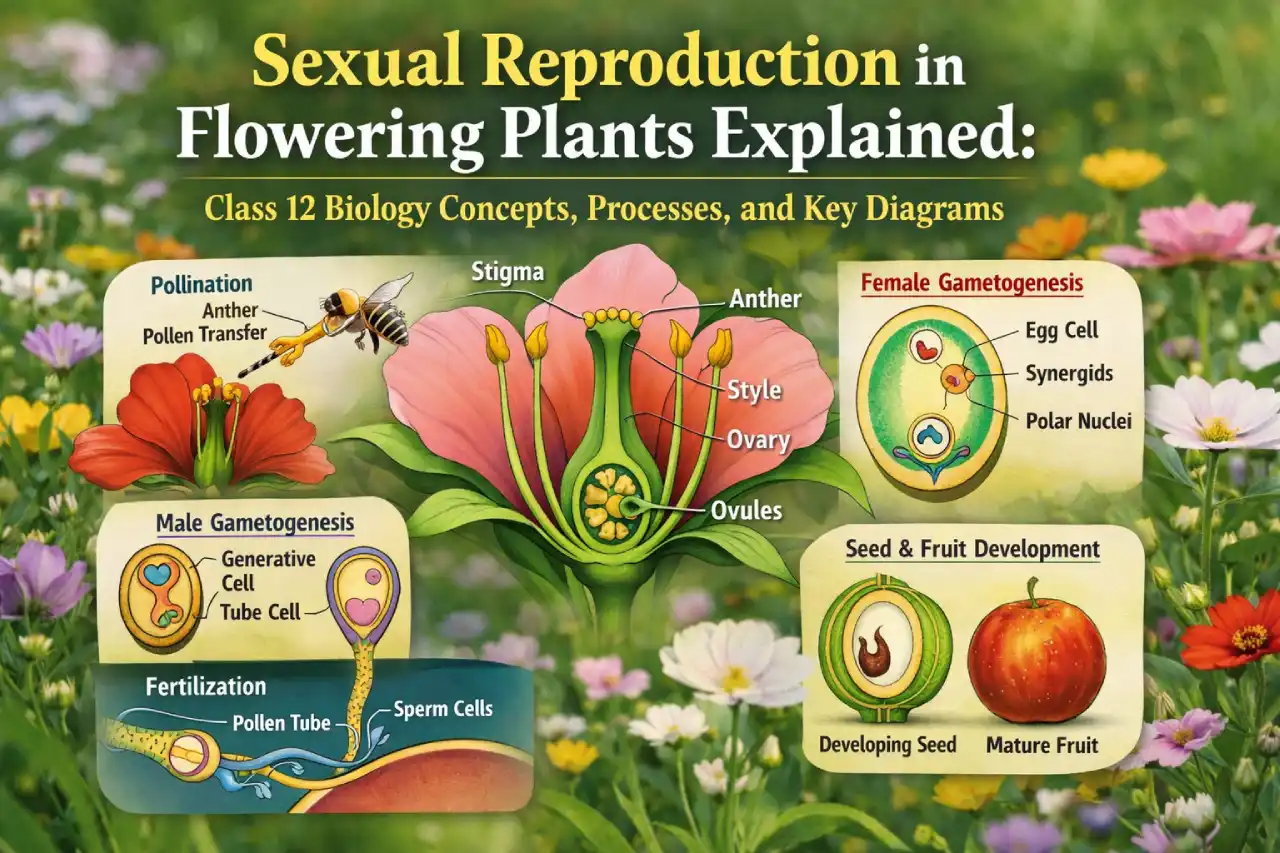
A major section of the PDF explains the flower as a specialised reproductive structure. It classifies flowers as monoecious or dioecious based on the presence of male and female parts. The document clearly describes the four floral whorls — calyx, corolla, androecium, and gynoecium — along with their individual roles. The structure of a typical flower is supported by labelled diagrams that help visualise each part and its function in reproduction.
Male Reproductive Structure: Stamen and Pollen Formation
The PDF provides a detailed explanation of the male reproductive unit, the stamen, including the anther and filament. It covers the internal structure of the anther, microsporangia, and wall layers such as epidermis, endothecium, middle layers, and tapetum. The process of microsporogenesis is explained step by step, showing how pollen mother cells undergo meiosis to form pollen grains. The structure and composition of pollen grains, including exine and intine layers, are also discussed in depth.
Download this CLASS 12 – SEXUAL REPRODUCTION IN FLOWERING PLANTS PDF File: Click Here
Female Reproductive Structure: Gynoecium and Ovule
Another key part of the PDF focuses on the female reproductive structure, the gynoecium. It explains the structure of the pistil, including stigma, style, and ovary, and introduces the ovule as the megasporangium. The document details the anatomy of the ovule, covering parts like funicle, hilum, integuments, micropyle, nucellus, and embryo sac. The process of megasporogenesis and the development of the female gametophyte are explained using clear stages and diagrams.
Pollination and Its Types
The PDF dedicates a full section to pollination, defining it as the transfer of pollen grains from anther to stigma. It explains the three types of pollination — autogamy, geitonogamy, and xenogamy — along with their biological significance. Pollination agents are classified into abiotic and biotic, and characteristics of wind, water, and insect-pollinated flowers are described with examples. Special attention is given to adaptations that promote or prevent self-pollination.
Pollen–Pistil Interaction and Fertilisation
This section explains pollen–pistil interaction as a selective and chemical process that determines successful fertilisation. The growth of the pollen tube, entry into the ovule, and release of male gametes are described in sequence. The PDF clearly explains double fertilisation, including syngamy and triple fusion, which is a unique feature of flowering plants. Diagrams help illustrate how the zygote and primary endosperm nucleus are formed CLASS 12 – SEXUAL REPRODUCTION ….
Post-Fertilisation Events: Seed and Fruit Development
The document covers post-fertilisation changes such as development of the embryo, endosperm, seeds, and fruits. It explains embryogeny, differences between dicot and monocot embryos, and types of seeds like albuminous and non-albuminous seeds. The formation of fruits, including true fruits, false fruits, and parthenocarpic fruits, is explained with relevant examples. The advantages and viability of seeds are also discussed in this section.
Apomixis, Polyembryony, and Their Importance
Towards the end, the PDF introduces apomixis as seed formation without fertilisation and explains different types of apomixis. Polyembryony is discussed with examples like citrus and mango. The importance of apomixis in the hybrid seed industry is highlighted, especially its role in maintaining hybrid characteristics and reducing seed production costs.
NCERT-Based Questions and Exam Relevance
The final section of the PDF includes NCERT exercise questions with clear, exam-oriented answers. These cover definitions, diagrams, differences between key processes, and short explanatory questions. This makes the document especially useful for Class 12 board preparation and competitive exams, as it aligns closely with the NCERT syllabus and question pattern.