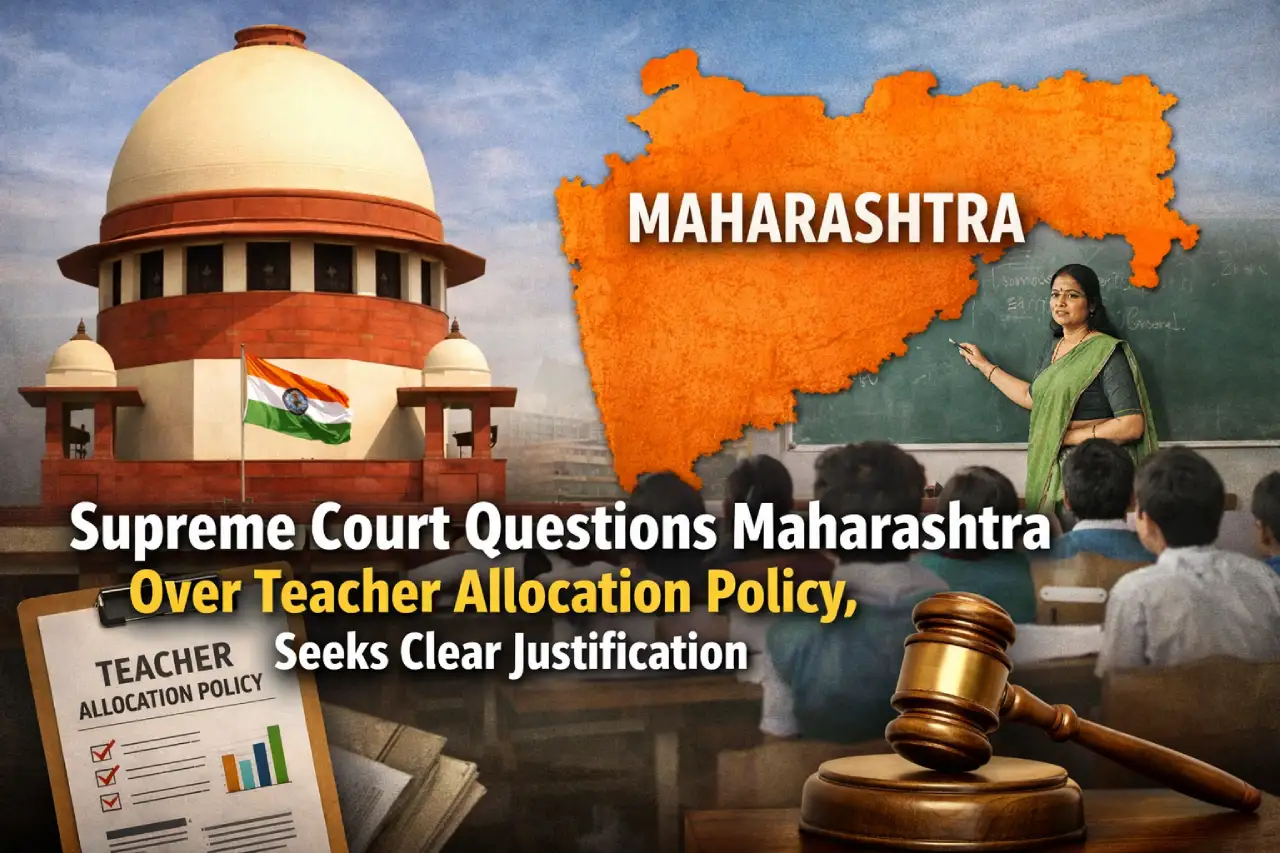
The Supreme Court has asked the Maharashtra government to explain and justify its teacher allocation policy, which determines how teaching posts are sanctioned in government schools based on student enrolment. The court’s intervention comes amid concerns that the policy may adversely affect schools with lower enrolment and could be inconsistent with statutory norms under the Right to Education framework. By seeking a detailed response from the state, the apex court has signalled that staffing decisions in public education must be backed by clear logic and legal compliance.
I am writing about this development because teacher availability directly shapes classroom learning, especially in government schools serving vulnerable communities. When policies change how teachers are deployed, the impact is felt immediately by students and educators. A judicial review of such policies matters because it can bring clarity, ensure accountability, and protect the intent of education laws that prioritise access and quality over administrative convenience.
What Prompted the Supreme Court’s Intervention
The issue reached the Supreme Court of India through a plea challenging Maharashtra’s method of allocating teachers based primarily on enrolment figures. Petitioners argue that the approach may lead to staff shortages in schools with fluctuating or low enrolment, particularly in rural and tribal areas, thereby affecting learning outcomes.
The court has asked the state to place its rationale on record and explain how the policy aligns with existing education laws and constitutional principles.
What the Teacher Allocation Policy Is About
Maharashtra’s policy links the number of sanctioned teaching posts to student enrolment in a school. In theory, this aims to optimise resources and deploy teachers where student numbers are higher.
However, critics point out that:
- Enrolment can vary year to year, creating instability
- Small schools may lose essential subject teachers
- Multi-grade teaching pressures can increase
- Teacher workload may rise without support
These concerns have pushed the policy into legal scrutiny.
Concerns Around Compliance With Education Norms
At the heart of the challenge is whether the policy complies with norms prescribed under the Right to Education Act, which sets pupil–teacher ratios to ensure quality instruction.
Petitioners contend that rigid enrolment-linked staffing could undermine these ratios and weaken statutory safeguards meant to protect children’s right to education. The court has indicated it will examine whether administrative efficiency is being prioritised over legal obligations.
State Government’s Stand So Far
The Maharashtra government has maintained that the policy is intended to ensure efficient use of public resources and address imbalances in teacher deployment. Officials have suggested that the framework allows flexibility and is designed to respond to demographic changes.
The Supreme Court has now asked the state to substantiate these claims with data and legal reasoning.
Why This Case Matters for Students and Teachers
Teacher allocation is not a technical issue alone. It affects:
- Classroom continuity and subject coverage
- Teacher morale and workload
- School stability in low-enrolment regions
- Learning outcomes for students
A policy that appears efficient on paper can have unintended consequences on the ground, especially in underserved areas.