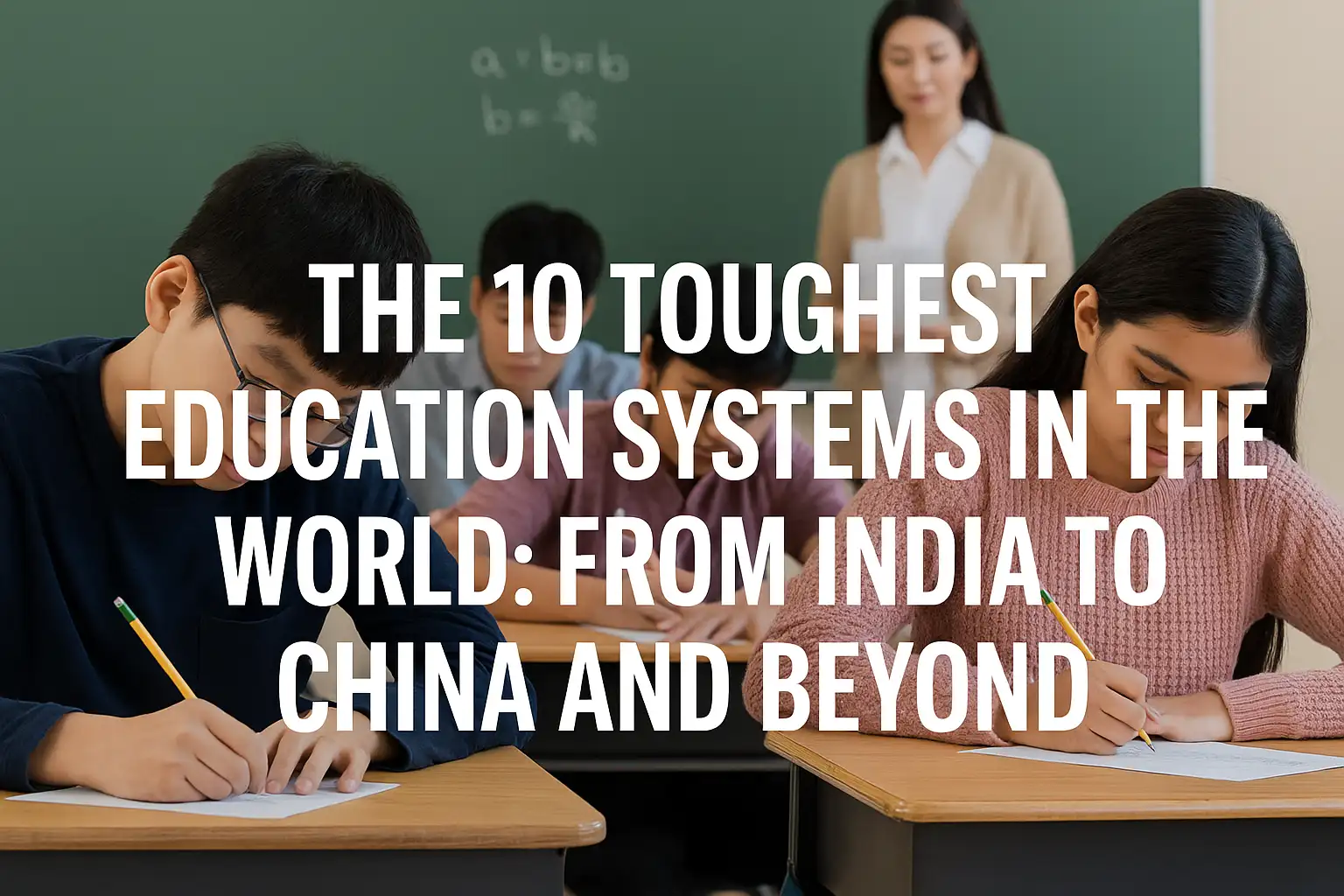
Education is often seen as a path to success, but in some countries, that path is far tougher than most can imagine. Students in these nations face long study hours, intense competition, frequent exams, and enormous societal pressure to perform well. From India’s gruelling board exams to China’s famously tough Gaokao, these systems test not just intelligence but also patience, endurance, and mental strength.
I chose to write about this topic because it highlights how education — though meant to empower — can also become a source of extreme stress when the pressure to succeed outweighs the joy of learning. Understanding which countries have the hardest education systems can help us reflect on the balance between discipline and well-being in our own schools. It’s also fascinating to see how different cultures define academic success — from exam-based evaluations in Asia to rigorous project work and research in Europe.
1. China – The Land of the Gaokao
China tops the list for its Gaokao, one of the most difficult entrance exams in the world. Students spend years preparing for this single test, which decides university placements and, in many cases, future careers. The exam is so intense that schools often function like military academies during the final year, with students studying for 12–14 hours a day. Success brings prestige, while failure can limit opportunities for years.
2. South Korea – Discipline Above All
South Korea’s education system is highly competitive, with students studying till late night in hagwons (private coaching centres). The Suneung exam is similar to the Gaokao and can determine a student’s social standing. The pressure is so immense that exam days are treated like national events — even flight schedules are adjusted to reduce noise during listening tests.
3. Japan – Hard Work and Consistency
Japan’s education system is known for its structure and high standards. While discipline and teamwork are major strengths, the entrance exams for high school and university are particularly tough. Students often attend juku (cram schools) after regular classes to prepare. Balancing school, extracurriculars, and social expectations is no easy task for Japanese students.
4. India – Exams at Every Step
India’s education system is vast and diverse but also one of the most demanding. Board exams, competitive entrance tests like JEE, NEET, and UPSC, and the constant race for top ranks create high academic pressure. While the system produces some of the world’s brightest minds, it also leaves students facing long hours of study and limited time for creative learning.
5. Singapore – Strict Standards and Smart Learning
Singapore is known for producing top-performing students in global assessments like PISA. The system focuses on maths and science excellence, but students face heavy workloads and strict assessments from an early age. The emphasis on high performance and logical reasoning can be overwhelming for some, though it builds strong analytical skills.
6. Russia – Focused on Rigor and Knowledge Depth
In Russia, education is considered a serious pursuit. Students are expected to master subjects in depth, particularly in mathematics, physics, and literature. The entrance exams for top universities, such as the Unified State Exam (EGE), are tough and highly competitive. Russian education emphasises theoretical knowledge over practical learning, making it mentally demanding.
7. United States – Continuous Assessment and Competition
While the U.S. system offers flexibility, it’s also challenging in its own way. Students are assessed continuously through assignments, projects, standardised tests like the SAT, and extracurricular participation. Competition for admission into Ivy League universities adds to the pressure. The system encourages critical thinking but demands consistent performance.
8. United Kingdom – Rigor and Reputation
The British education system, particularly GCSEs and A-levels, is known for its high standards and academic depth. Students are expected to specialise early, and university admissions depend heavily on these exams. The focus on analytical writing and independent research makes it one of the most intellectually demanding systems.
9. France – Heavy Curriculum and Critical Thinking
In France, education revolves around logic, philosophy, and strong academic discipline. The Baccalauréat exam at the end of high school is one of the hardest in Europe. French students are trained to think critically and express ideas with precision, but the pressure to perform can be mentally exhausting.
10. Finland – Balanced but Demanding in Its Own Way
While Finland is often praised for having the world’s best education system, it’s not “easy.” Students are expected to take responsibility for their learning, maintain high standards, and show consistent progress without rote memorisation. Teachers are highly qualified, and evaluations are designed to test understanding, not just memorisation. It’s tough but fair — focusing on depth and independence.
Why Education Pressure Differs Across Countries
The level of difficulty in an education system often reflects a country’s culture and economy. In many Asian nations, where education is viewed as the main path to success, competition is fierce. In contrast, Western countries focus more on creativity and problem-solving but still demand strong performance through projects and continuous evaluation.
A study by the OECD found that students in countries like China, South Korea, and Singapore spend up to 14 hours a day on schoolwork, compared to an average of 6 hours in Europe. This difference highlights how academic achievement is linked to social mobility and cultural expectations.