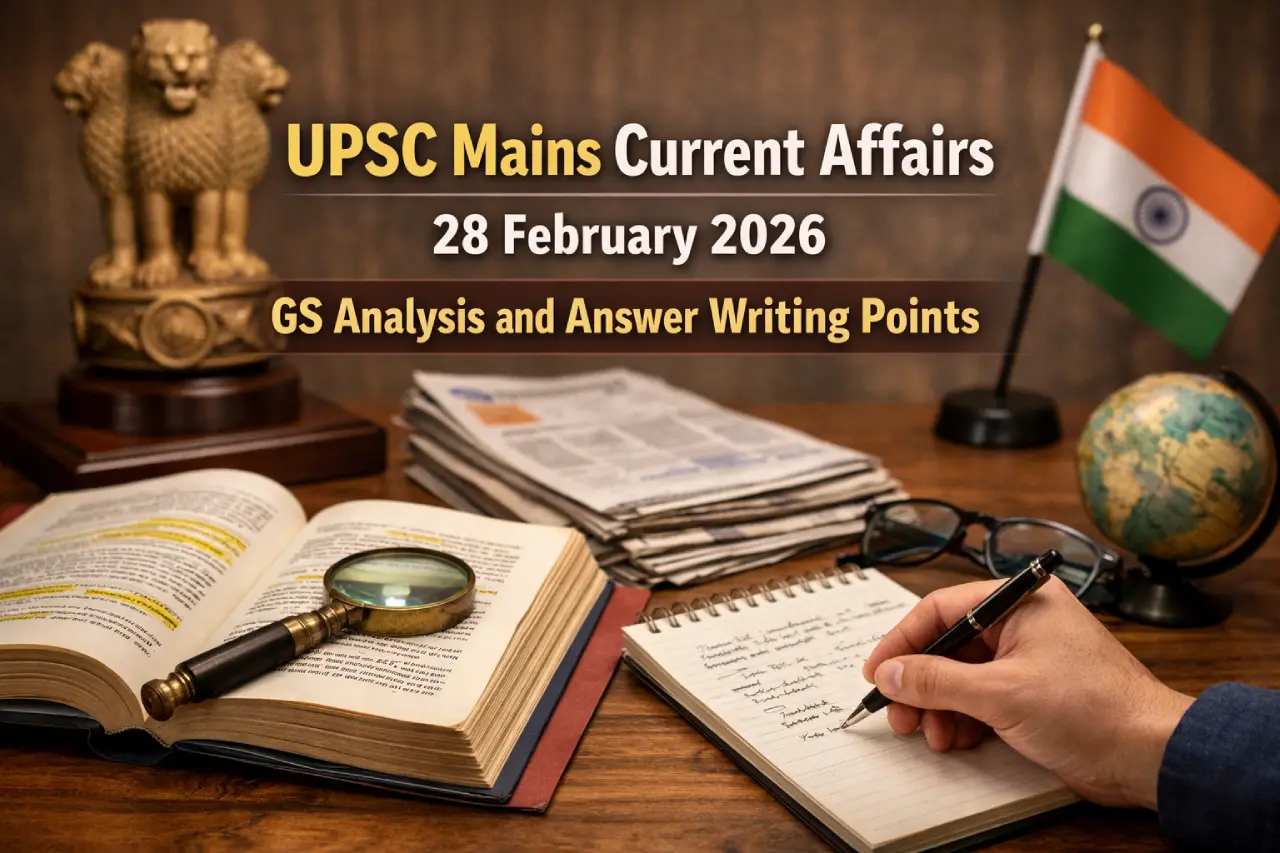
The UPSC Mains Current Affairs for 28 February 2026 covers important national and international developments relevant for General Studies papers. For serious civil services aspirants, daily current affairs analysis is not just about reading news but understanding the background, constitutional aspects and policy impact. Topics from governance, economy, international relations, environment and social issues are especially important from a Mains answer-writing perspective.
I am writing this because many aspirants read newspapers regularly but struggle to convert news into Mains-ready content. In my experience, simply knowing facts is not enough for the Civil Services Examination. You need to understand issues in depth, connect them with the syllabus and practise writing structured answers. That is why analysing current affairs of a particular date in a focused manner can strengthen preparation.
Why Daily Current Affairs Matter for UPSC Mains
The Union Public Service Commission conducts the Civil Services Examination in three stages: Prelims, Mains and Interview. Among these, the Mains examination demands analytical understanding and balanced viewpoints.
Daily current affairs help in:
- Building strong content for GS Paper I, II, III and IV
- Writing better introductions and conclusions in answers
- Linking static syllabus with dynamic developments
- Improving examples for essays and ethics papers
If you consistently revise daily issues, answer writing becomes more confident and structured.
Key Themes for 28 February 2026
While the exact topics may vary, the current affairs of 28 February 2026 broadly revolve around areas such as governance reforms, economic policy updates, international relations developments and environmental concerns.
Let us look at how such issues can be analysed for Mains.
Governance and Polity
If there are discussions related to new bills, Supreme Court judgments or administrative reforms, candidates should focus on:
- Constitutional provisions involved
- Federal structure implications
- Impact on citizens and institutions
- Way forward with balanced suggestions
Always try to mention relevant articles of the Constitution or landmark judgments where possible.
Economy and Development
Economic news often includes data releases, policy changes or sectoral reforms. For Mains, focus on:
- Causes behind the issue
- Impact on growth, inflation or employment
- Government initiatives linked to the topic
- Challenges and practical solutions
Link the issue to GS Paper III topics like inclusive growth, infrastructure, agriculture or fiscal policy.
International Relations
Developments in global diplomacy, trade agreements or regional conflicts are highly relevant.
For such topics, structure your answer as:
- Background of the issue
- India’s position and interests
- Global implications
- Strategic importance
- Way forward
Always try to connect with India’s foreign policy objectives.
Environment and Climate
Environmental issues may include biodiversity reports, climate commitments or conservation efforts.
For Mains answers:
- Mention international conventions if relevant
- Highlight India’s commitments and schemes
- Discuss environmental and economic balance
- Suggest sustainable policy measures
Quoting examples from recent reports strengthens your answer.
How to Convert Current Affairs into Mains Answers
Reading is not enough. You must practise writing.
Here is what I personally recommend:
- Make short notes topic-wise under GS headings
- Prepare 150-word and 250-word answer frameworks
- Add diagrams or flowcharts where suitable
- Write conclusions that are solution-oriented
When you revise, focus on clarity, structure and balanced viewpoints rather than memorising long paragraphs.
Common Mistakes Aspirants Should Avoid
Many aspirants make these mistakes:
- Writing only factual information without analysis
- Ignoring linkage with the syllabus
- Not mentioning constitutional or policy context
- Giving one-sided opinions
UPSC expects maturity and balance. Always provide pros and cons before concluding.