JOIN WHATSAPP
STORIES

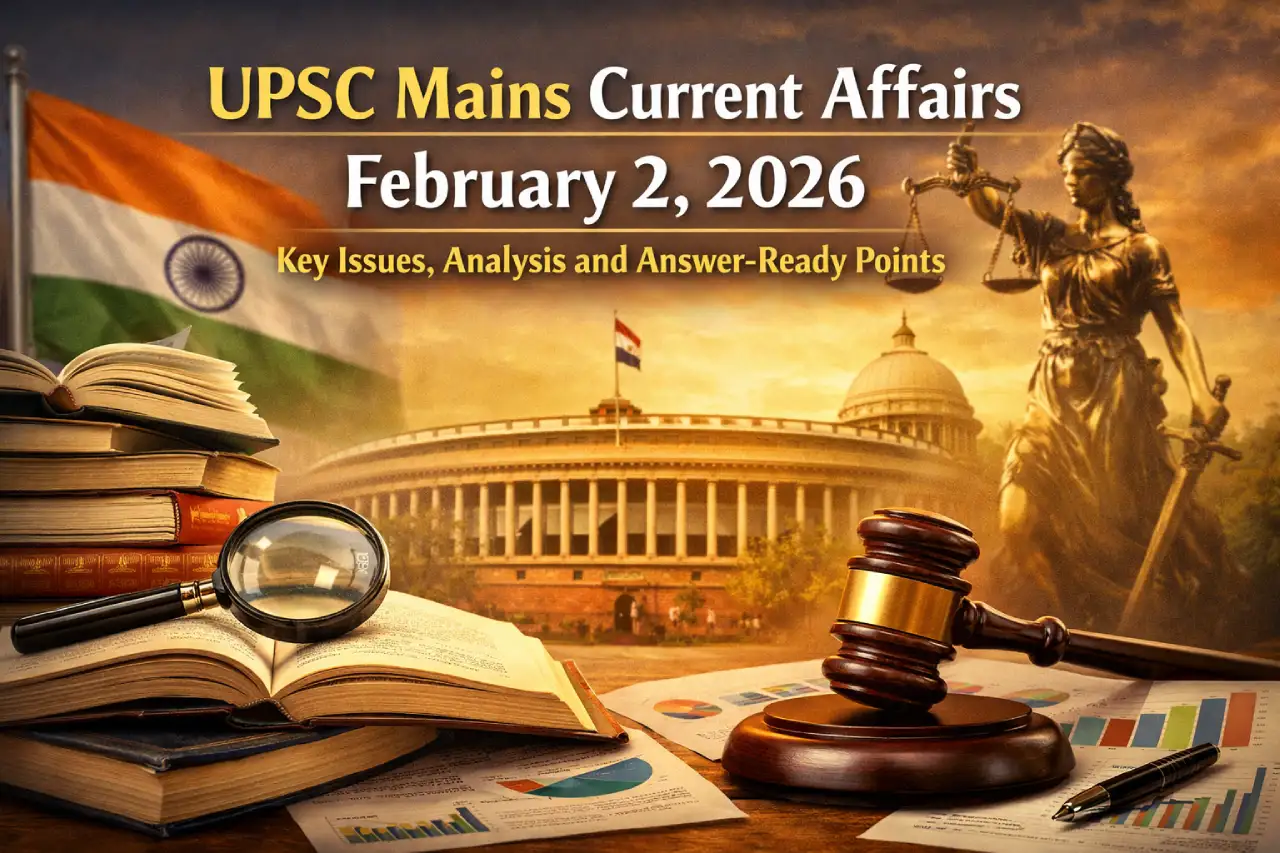
UPSC Mains Current Affairs for February 2, 2026: Key Issues, Analysis and Answer-Ready Points

UPSC Mains Current Affairs for February 2, 2026: Key Issues, Analysis and Answer-Ready Points

Current affairs for the UPSC Mains examination are not about headlines alone, but about understanding issues, linking them with the syllabus and forming balanced opinions. The news cycle around February 2, 2026, has been especially relevant for aspirants, with developments connected to the Union Budget, education, healthcare, governance and global affairs. These issues carry strong GS Paper II, III and Essay value and are already shaping probable Mains questions.

I am writing this article to help serious UPSC aspirants focus on what actually matters for Mains preparation today. Instead of scattered news consumption, this format highlights themes, background and analytical angles. If you are preparing answer-ready notes or revising for GS papers, these current affairs will help you connect daily news with syllabus topics and write more mature, structured answers.

Union Budget 2026 and Social Sector Priorities

One of the most important themes for UPSC Mains right now is the Union Budget 2026 and its emphasis on education, healthcare and employment linkage. The Budget has focused on expanding institutional capacity, improving access for women through district-level hostels, and strengthening medical and mental health infrastructure.

For Mains, aspirants should analyse:

  • How budgetary priorities reflect inclusive growth
  • Whether increased spending is matched with implementation capacity
  • The role of education and health in demographic dividend

This topic is relevant for GS Paper III and Essay, especially in questions related to human capital development.

Education to Employment Linkage

Another strong current affairs area is the push to align education with industry needs. Announcements around skill-linked universities, design and creative institutions, and healthcare training reflect a shift from degree-based education to employability-focused learning.

Mains-relevant angles include:

  • Challenges in implementing industry-linked education
  • Regional imbalance in higher education infrastructure
  • The role of public-private partnerships in skilling

This fits well under GS Paper II (education policy) and GS Paper III (employment and skills).

Healthcare and Mental Health as Governance Issues

Healthcare developments, especially related to medical education expansion and mental health services, are gaining attention. The focus on increasing medical seats, new institutions and mental health infrastructure highlights gaps exposed after the pandemic years.

For answer writing, candidates should connect:

  • Healthcare access with federal structure and state capacity
  • Mental health as a public policy and social issue
  • Preventive healthcare versus curative focus

This topic has strong GS II and GS III relevance.

Federalism and Centre–State Coordination

Recent policy announcements have once again highlighted the importance of Centre–State coordination, particularly in education, health and infrastructure delivery. While funding decisions are taken at the Centre, implementation depends heavily on states.

UPSC Mains questions often test:

  • Cooperative versus competitive federalism
  • Fiscal capacity of states
  • Role of centrally sponsored schemes

A balanced answer should highlight both constitutional ideals and ground realities.

Global Developments With Indian Implications

On the international front, global economic uncertainty, supply chain realignments and geopolitical tensions continue to affect India’s policy choices. Aspirants should track how India balances strategic autonomy with global partnerships.

Key Mains angles include:

  • Impact of global slowdown on India’s growth
  • India’s role in multilateral institutions
  • Strategic importance of Indo-Pacific stability

These issues are important for GS Paper II and Essay.

Environment, Sustainability and Development Balance

Environmental concerns remain central to governance debates. Infrastructure expansion, urbanisation and industrial growth continue to raise questions about sustainability, climate commitments and environmental clearances.

For UPSC Mains, focus on:

  • Development versus environment debates
  • India’s climate commitments and challenges
  • Community participation in conservation

This area frequently appears in GS Paper III.

How Aspirants Should Use Today’s Current Affairs

Instead of memorising facts, aspirants should:

  • Link news with static syllabus topics
  • Prepare 150–250 word answer frameworks
  • Add data, examples and constitutional references

From my experience, daily current affairs become useful only when converted into issue-based notes.


Leave a Comment

End of Article

Maharashtra to Recruit 5,500 Assistant Professors by June: Minister Chandrakant Patil Gives Timeline

Maharashtra to Recruit 5,500 Assistant Professors by June: Minister Chandrakant Patil Gives Timeline

Maharashtra’s Higher Education Minister Chandrakant Patil has assured that the long-awaited recruitment of 5,500 assistant professors across state universities will be completed by June 2026. This announcement comes after the initial deadline of March was missed due to administrative and procedural delays. The recruitment drive is aimed at filling vacant teaching positions in government and aided institutions, which have been affecting the quality of education and overall academic functioning in the state.

I am writing about this because faculty shortages have been a major concern in higher education for quite some time. From what I have seen, students often struggle due to a lack of permanent teachers, which directly impacts classroom learning and research opportunities. This update is important not just for job aspirants but also for students and institutions, as it promises to improve the student-teacher ratio and bring stability to the academic environment.

What the Minister Announced

Higher Education Minister Chandrakant Patil has clearly stated that the recruitment process is now on track.

Key points from the announcement:

  • 5,500 assistant professor posts to be filled
  • New deadline set for June 2026
  • Delay caused by administrative and procedural issues
  • Recruitment to cover multiple universities and colleges

The government has assured that efforts are being made to complete the process without further delay.

Why the Recruitment Was Delayed

The recruitment drive was initially expected to be completed by March but faced several challenges.

Some major reasons include:

  • Complexities in finalising eligibility criteria
  • Large number of applications to be reviewed
  • Scheduling of examinations and interviews
  • Inclusion of newly established colleges and institutions

From my understanding, these delays are common in large-scale recruitment, but they often create uncertainty among candidates.

Role of MPSC in the Recruitment Process

The Maharashtra Public Service Commission (MPSC) is handling the recruitment process.

  • Responsible for conducting exams and interviews
  • Ensures selection based on merit and transparency
  • Evaluates academic qualifications and performance

The commission is currently working to finalise the list of eligible candidates.

Selection Process Explained

The recruitment will follow a structured and rigorous selection process.

  • Screening of applications
  • Evaluation of academic credentials
  • Interviews conducted as per guidelines
  • Final selection based on merit

This process is aligned with University Grants Commission (UGC) norms.

Why This Recruitment is Important

Filling these vacancies is crucial for improving higher education in the state.

  • Helps improve student-teacher ratio
  • Ensures better classroom interaction and learning
  • Strengthens research and academic output
  • Provides stability in teaching staff

In my opinion, qualified faculty is the backbone of any strong education system.

Concerns Raised by Students and Academic Bodies

There have been growing concerns regarding the delay.

  • Student unions have highlighted lack of teachers
  • Academic bodies have raised issues about declining quality
  • Vacant posts affecting regular classes and research work

The latest assurance from the government is expected to address these concerns.

Government’s Broader Education Plan

The recruitment is part of a larger plan to improve higher education.

  • Focus on strengthening infrastructure and resources
  • Bringing in skilled and experienced faculty
  • Improving overall education standards
  • Aligning with future academic and industry needs

The government aims to create a more competitive and modern education system.

Key Highlights at a Glance

ParticularsDetails
Total Vacancies5,500 Assistant Professors
Revised DeadlineJune 2026
Conducting AuthorityMPSC
Recruitment TypeGovernment & Aided Institutions
Selection ProcessMerit-based with interviews

What This Means for Aspirants

For candidates waiting for these jobs, this update is quite important.

  • Recruitment process is moving forward
  • Clear timeline now available
  • Opportunity to secure teaching positions
  • Need to stay prepared for upcoming stages

From what I have seen, staying updated and prepared is key during such recruitment cycles.

Leave a Comment

End of Article

Loading more posts...