JOIN WHATSAPP
STORIES

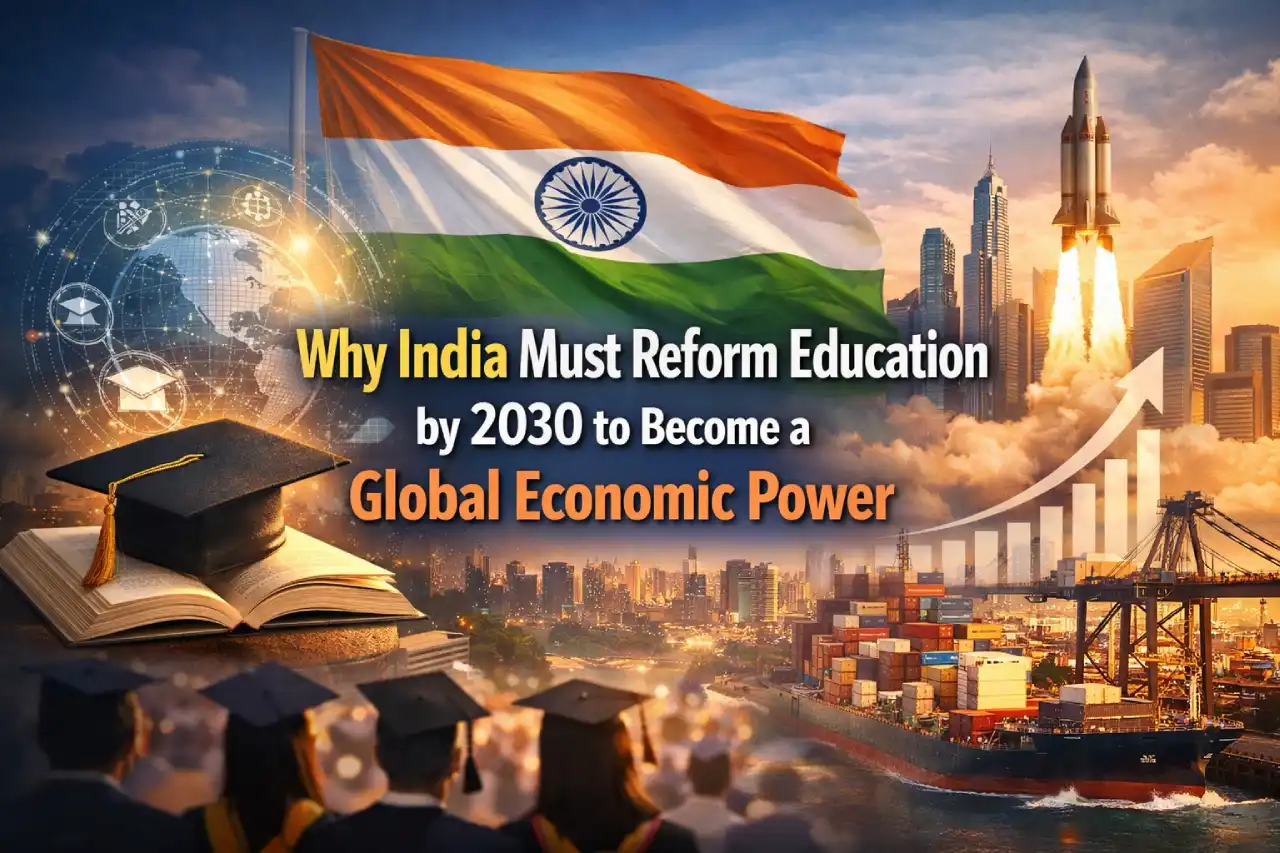
Why India Must Reform Education by 2030 to Become a Global Economic Power

Why India Must Reform Education by 2030 to Become a Global Economic Power

India has set itself an ambitious national goal. The country aims to become the second-largest economy in purchasing power parity (PPP) terms by 2050 and the largest economy in nominal terms by 2075. This vision of a Vikshit Bharat, or developed India, goes far beyond economic growth alone. It calls for a deep transformation of how Indians learn, think, innovate and contribute to society.

I am writing about this because every big economic dream rests on one fundamental pillar: education. Roads, factories and digital infrastructure matter, but without skilled, creative and confident people, no nation can truly progress. If India wants to move from economic aspiration to civilisational capability, education reform cannot be postponed. It must happen decisively by 2030.

From Growth Numbers to Human Capability

Economic targets are important, but they are only indicators. The real strength of a nation lies in its people. Countries that lead the world today have invested heavily in building human capital.

For India, this means:

  • Moving beyond rote learning
  • Encouraging critical thinking
  • Fostering creativity and problem-solving

A strong education system creates citizens who can adapt to change and drive innovation.

Why 2030 Is a Critical Deadline

The next five to seven years will shape India’s workforce for decades. Students currently in schools and colleges will be the professionals, entrepreneurs and leaders of 2040 and 2050.

If reforms are delayed:

  • Skill gaps will widen
  • Unemployment may rise
  • India may miss global opportunities

Reforming education by 2030 ensures India is ready for future challenges.

Aligning Education with a Changing Economy

The nature of work is changing rapidly. Automation, artificial intelligence and digital platforms are transforming industries.

Education must therefore:

  • Teach digital literacy from an early stage
  • Emphasise STEM and emerging technologies
  • Promote interdisciplinary learning

Students should be prepared for jobs that may not even exist today.

From Memorisation to Meaningful Learning

One of India’s biggest challenges is its exam-centric culture. Success is often measured by marks rather than understanding.

A reformed system should focus on:

  • Conceptual clarity
  • Application-based learning
  • Project work and experimentation

When students understand “why” and “how,” not just “what,” they become innovators.

Strengthening Teachers and Institutions

Teachers are at the heart of any education system. Without empowered and well-trained teachers, reforms remain on paper.

Key priorities include:

  • Continuous teacher training
  • Better pay and career progression
  • Freedom to innovate in classrooms

Institutions also need autonomy and accountability.

Bridging the Urban-Rural Education Gap

India cannot become a developed nation if quality education is limited to cities.

Reforms must ensure:

  • Digital connectivity in rural schools
  • Modern infrastructure
  • Access to trained teachers

Every child, regardless of location, deserves the same opportunity.

Integrating Indian Knowledge with Global Skills

India has a rich civilisational heritage in science, mathematics, philosophy and ethics. Modern education should blend this heritage with global best practices.

This approach builds:

  • Cultural confidence
  • Ethical grounding
  • Global competitiveness

A civilisation grows when it respects its roots while embracing the future.

Role of Higher Education and Research

Universities should become centres of research and innovation, not just degree factories.

Focus areas include:

  • Strong research funding
  • Industry-academia collaboration
  • Encouraging startups and patents

Knowledge creation is the foundation of long-term prosperity.

Why Education Reform Is Everyone’s Responsibility

Government policies are important, but families, teachers, institutions and industry must also play their part.

From my point of view, education reform is not a single project. It is a national movement that requires collective commitment.


Leave a Comment

End of Article

Maharashtra to Recruit 5,500 Assistant Professors by June: Minister Chandrakant Patil Gives Timeline

Maharashtra to Recruit 5,500 Assistant Professors by June: Minister Chandrakant Patil Gives Timeline

Maharashtra’s Higher Education Minister Chandrakant Patil has assured that the long-awaited recruitment of 5,500 assistant professors across state universities will be completed by June 2026. This announcement comes after the initial deadline of March was missed due to administrative and procedural delays. The recruitment drive is aimed at filling vacant teaching positions in government and aided institutions, which have been affecting the quality of education and overall academic functioning in the state.

I am writing about this because faculty shortages have been a major concern in higher education for quite some time. From what I have seen, students often struggle due to a lack of permanent teachers, which directly impacts classroom learning and research opportunities. This update is important not just for job aspirants but also for students and institutions, as it promises to improve the student-teacher ratio and bring stability to the academic environment.

What the Minister Announced

Higher Education Minister Chandrakant Patil has clearly stated that the recruitment process is now on track.

Key points from the announcement:

  • 5,500 assistant professor posts to be filled
  • New deadline set for June 2026
  • Delay caused by administrative and procedural issues
  • Recruitment to cover multiple universities and colleges

The government has assured that efforts are being made to complete the process without further delay.

Why the Recruitment Was Delayed

The recruitment drive was initially expected to be completed by March but faced several challenges.

Some major reasons include:

  • Complexities in finalising eligibility criteria
  • Large number of applications to be reviewed
  • Scheduling of examinations and interviews
  • Inclusion of newly established colleges and institutions

From my understanding, these delays are common in large-scale recruitment, but they often create uncertainty among candidates.

Role of MPSC in the Recruitment Process

The Maharashtra Public Service Commission (MPSC) is handling the recruitment process.

  • Responsible for conducting exams and interviews
  • Ensures selection based on merit and transparency
  • Evaluates academic qualifications and performance

The commission is currently working to finalise the list of eligible candidates.

Selection Process Explained

The recruitment will follow a structured and rigorous selection process.

  • Screening of applications
  • Evaluation of academic credentials
  • Interviews conducted as per guidelines
  • Final selection based on merit

This process is aligned with University Grants Commission (UGC) norms.

Why This Recruitment is Important

Filling these vacancies is crucial for improving higher education in the state.

  • Helps improve student-teacher ratio
  • Ensures better classroom interaction and learning
  • Strengthens research and academic output
  • Provides stability in teaching staff

In my opinion, qualified faculty is the backbone of any strong education system.

Concerns Raised by Students and Academic Bodies

There have been growing concerns regarding the delay.

  • Student unions have highlighted lack of teachers
  • Academic bodies have raised issues about declining quality
  • Vacant posts affecting regular classes and research work

The latest assurance from the government is expected to address these concerns.

Government’s Broader Education Plan

The recruitment is part of a larger plan to improve higher education.

  • Focus on strengthening infrastructure and resources
  • Bringing in skilled and experienced faculty
  • Improving overall education standards
  • Aligning with future academic and industry needs

The government aims to create a more competitive and modern education system.

Key Highlights at a Glance

ParticularsDetails
Total Vacancies5,500 Assistant Professors
Revised DeadlineJune 2026
Conducting AuthorityMPSC
Recruitment TypeGovernment & Aided Institutions
Selection ProcessMerit-based with interviews

What This Means for Aspirants

For candidates waiting for these jobs, this update is quite important.

  • Recruitment process is moving forward
  • Clear timeline now available
  • Opportunity to secure teaching positions
  • Need to stay prepared for upcoming stages

From what I have seen, staying updated and prepared is key during such recruitment cycles.

Leave a Comment

End of Article

Loading more posts...