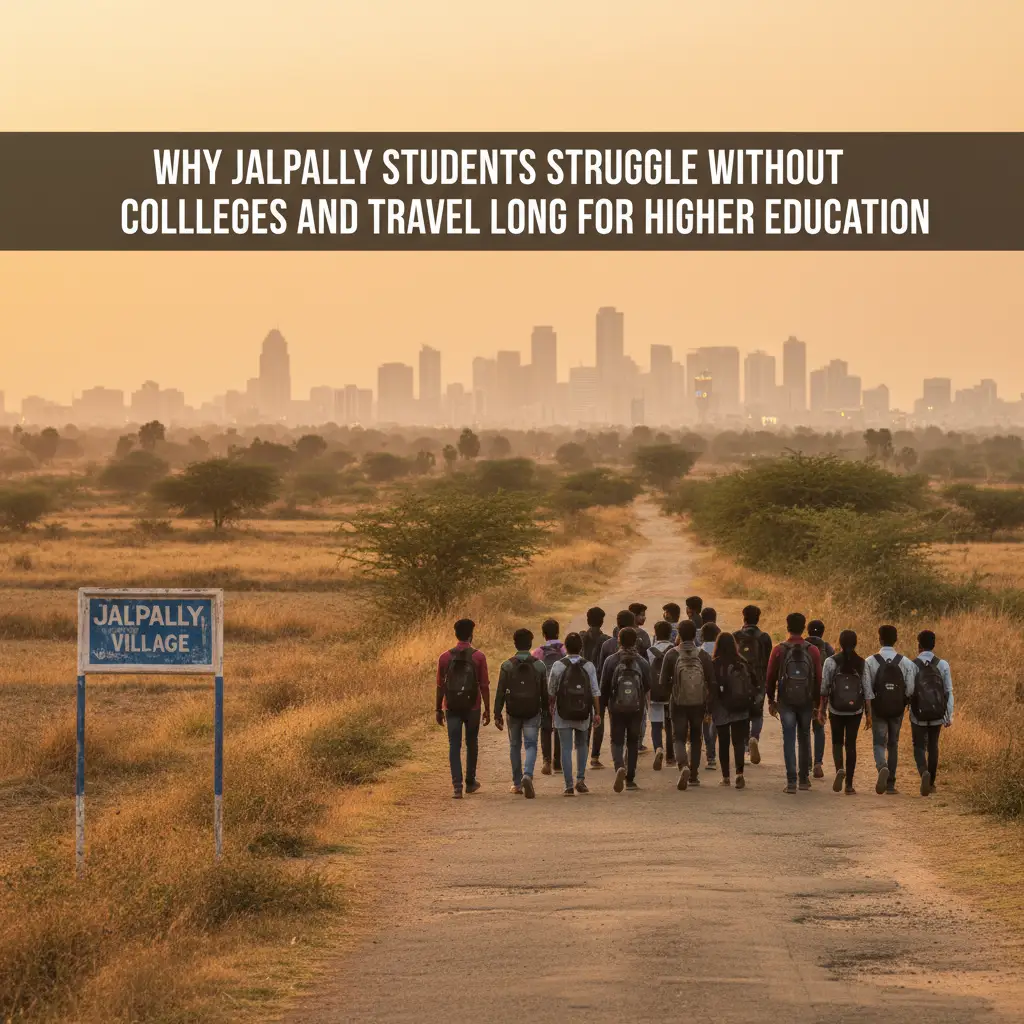
Students in Jalpally municipality continue to face difficulties in pursuing higher education as the area has no degree or junior colleges. With the absence of proper institutions, many youngsters are forced to travel long distances to nearby areas like Shastripuram, Falaknuma, or even into the city to continue their studies. This lack of local options is not only adding to financial and travel stress but is also pushing several students, especially girls, to discontinue their education.
I am writing about this issue because education is a basic need, and when an entire municipality like Jalpally is left out of higher education planning, it raises questions on regional development. For students from middle-class and low-income families, travelling daily to other parts of Hyderabad for studies becomes both expensive and tiring. Parents are also hesitant to send their daughters far away, leading to an increase in school dropouts after Class 10. Highlighting these gaps is important because it reflects how uneven educational infrastructure is across Telangana, despite rapid urbanisation. It also shows that unless local institutions are set up, students from such areas will continue to be denied equal opportunities.
No degree or junior colleges in Jalpally
At present, Jalpally does not have a single government or private junior or degree college. The nearest options are located at least 5 to 10 km away. For students without personal transport, this means depending on irregular public buses or expensive shared autos.
Impact on students and families
The absence of colleges in Jalpally creates multiple challenges:
- Daily travel increases both financial burden and stress
- Girls are more likely to drop out due to safety and distance concerns
- Families with limited income cannot afford private transport or hostel facilities
- Many students end up compromising on their choice of courses
Demand for better facilities
Locals and education activists have repeatedly requested the government to establish at least one junior college and one degree college in Jalpally. They argue that with a growing population and increasing number of students passing Class 10 every year, the demand is strong enough to justify new institutions.
Long-term consequences
Neglecting areas like Jalpally in higher education planning could worsen social inequality. When students are denied access to nearby institutions, their career prospects shrink, and the region’s overall development slows down. If the government takes up this demand, it will not only ease the pressure on students but also encourage more youngsters, especially girls, to pursue higher education.