JOIN WHATSAPP
STORIES

Biological Classification and Plant Kingdom Worksheet Analysis: Important MCQs, Concepts

Biological Classification and Plant Kingdom Worksheet Analysis: Important MCQs, Concepts

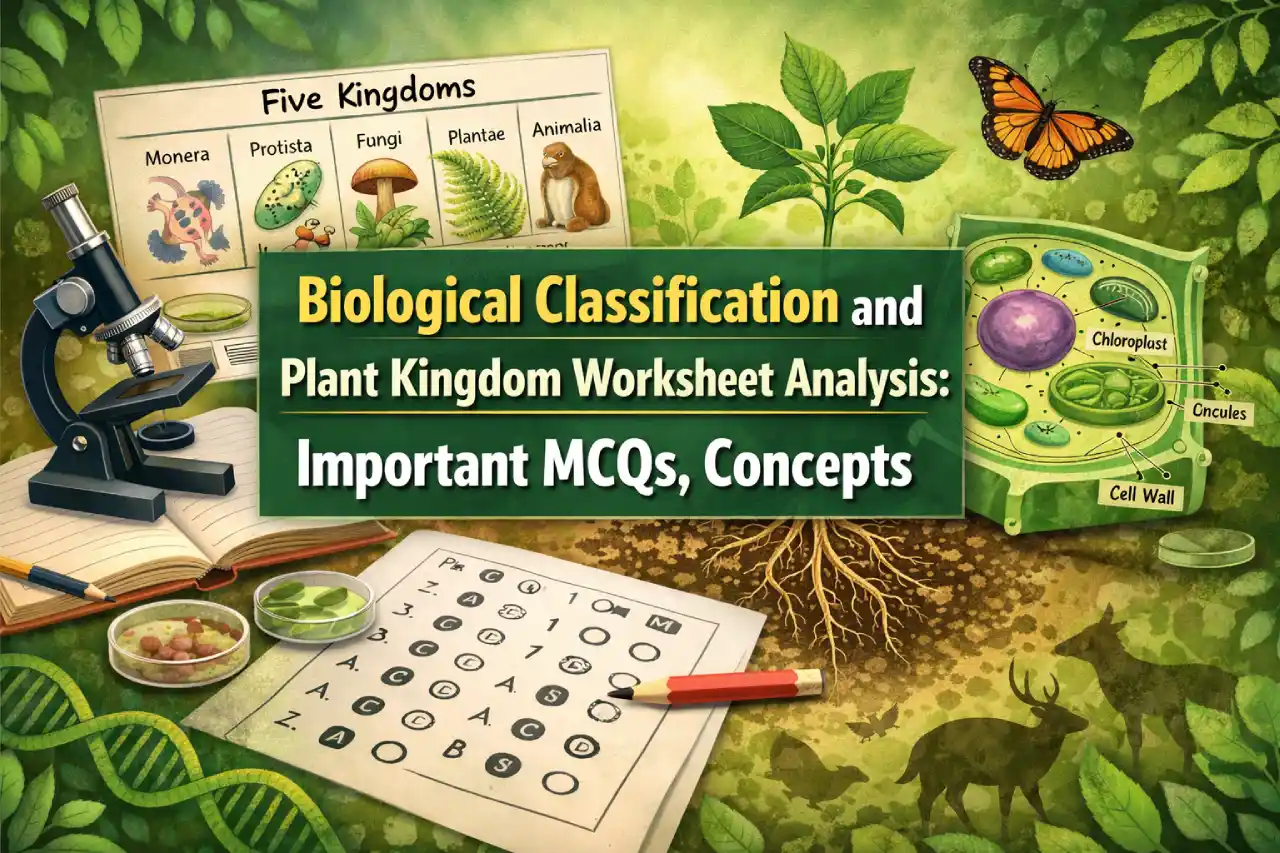
The uploaded PDF is a Class 11 Biology worksheet on Biological Classification and the Plant Kingdom, prepared strictly on NCERT lines. It contains 74 multiple-choice questions, each followed by a clear explanation. The questions cover Monera, Protista, Fungi, Lichens, Algae, Bryophytes, Pteridophytes, Gymnosperms, and basic evolutionary ideas, making it a strong NEET-oriented practice set. The worksheet is designed to test both factual recall and conceptual clarity across two high-weightage chapters.

I am writing about this worksheet because these two chapters together form the foundation of NEET Biology. Students often underestimate how scoring they can be if NCERT concepts are properly understood. By analysing this worksheet in detail, aspirants can clearly see which areas are repeatedly tested, how questions are framed from simple NCERT lines, and why understanding definitions and exceptions is more important than memorising random facts. This article explains only what is present in the uploaded worksheet Biological Classification and P….

Overview of the Worksheet Structure

The worksheet follows a question–answer with explanation format, making it ideal for self-study. Each MCQ includes:

  • One correct option
  • A short but direct explanation
  • NCERT-based terminology

The difficulty level ranges from basic recall to moderate application, closely matching what students face in NEET mock tests.

Biological Classification: Core Concepts Tested

A large portion of the worksheet focuses on biological classification, starting from early systems to modern kingdom-level grouping.

Key concepts covered include:

  • Reproduction in bacteria mainly by binary fission and spore formation
  • Prokaryotic nature of Monera and absence of membrane-bound organelles
  • Role of chemosynthetic autotrophic bacteria in nutrient recycling
  • Viruses having either DNA or RNA with a protein capsid
  • Bacteriophages as viruses that infect bacteria

The worksheet reinforces that classification questions often test basic definitions combined with small factual twists.

Fungi, Lichens, and Their Importance

Several MCQs focus on fungi and lichens, highlighting:

  • Mycelium as the vegetative body of fungi
  • Dikaryotic stage in Ascomycetes and Basidiomycetes
  • Basidiomycetes including mushrooms and bracket fungi
  • Lichens as symbiotic associations and indicators of air pollution

One important conceptual question explains that lichens represent a relationship where both partners benefit, though the fungal partner dominates. Such conceptual clarity is crucial for avoiding confusion in NEET.

Download this PDF File: Click Here

Plant Kingdom: Algae to Gymnosperms

The worksheet systematically moves through the plant kingdom hierarchy.

Algae

Questions explain:

  • Algae as thalloid, chlorophyll-bearing autotrophs
  • Aquatic nature of most algae
  • Holdfast structures in certain algae
  • Nutritional importance of Spirulina

Bryophytes

Key ideas tested include:

  • Bryophytes as amphibians of the plant kingdom
  • Dominant gametophytic phase
  • Protonema stage in mosses
  • Sphagnum as peat moss

Pteridophytes

The worksheet highlights:

  • Prothallus as the free-living gametophyte
  • Sporophylls bearing sporangia
  • Independent and dominant sporophyte phase

Gymnosperms

Important questions focus on:

  • Naked seeds as defining feature
  • Cones as reproductive organs
  • Wind pollination
  • Examples like Pinus, Cycas, Ginkgo, Cedrus, and Sequoia
  • Cycas having the largest sperms in the biological world

These MCQs clearly show how examples are repeatedly tested in NEET.

Reproduction, Life Cycles, and Special Structures

Many questions connect classification with reproduction:

  • Oogamy as a type of sexual reproduction
  • Ovule as megasporangium
  • Heterospory in Selaginella and Salvinia
  • Archegonia present in pteridophytes and gymnosperms

Such questions require students to link structure, function, and classification correctly.

What This Worksheet Teaches NEET Aspirants

From this worksheet, a few things become very clear:

  • NCERT is non-negotiable for these chapters
  • Definitions, examples, and exceptions carry equal weight
  • One-line facts can become full NEET questions
  • Understanding basic terminology prevents silly mistakes

Practising worksheets like this builds speed and accuracy in Biology.
Leave a Comment

End of Article

Class 11 Sets Question Worksheet: Concept Breakdown, Question Pattern and Why It Matters for Exams

Class 11 Sets Question Worksheet: Concept Breakdown, Question Pattern and Why It Matters for Exams

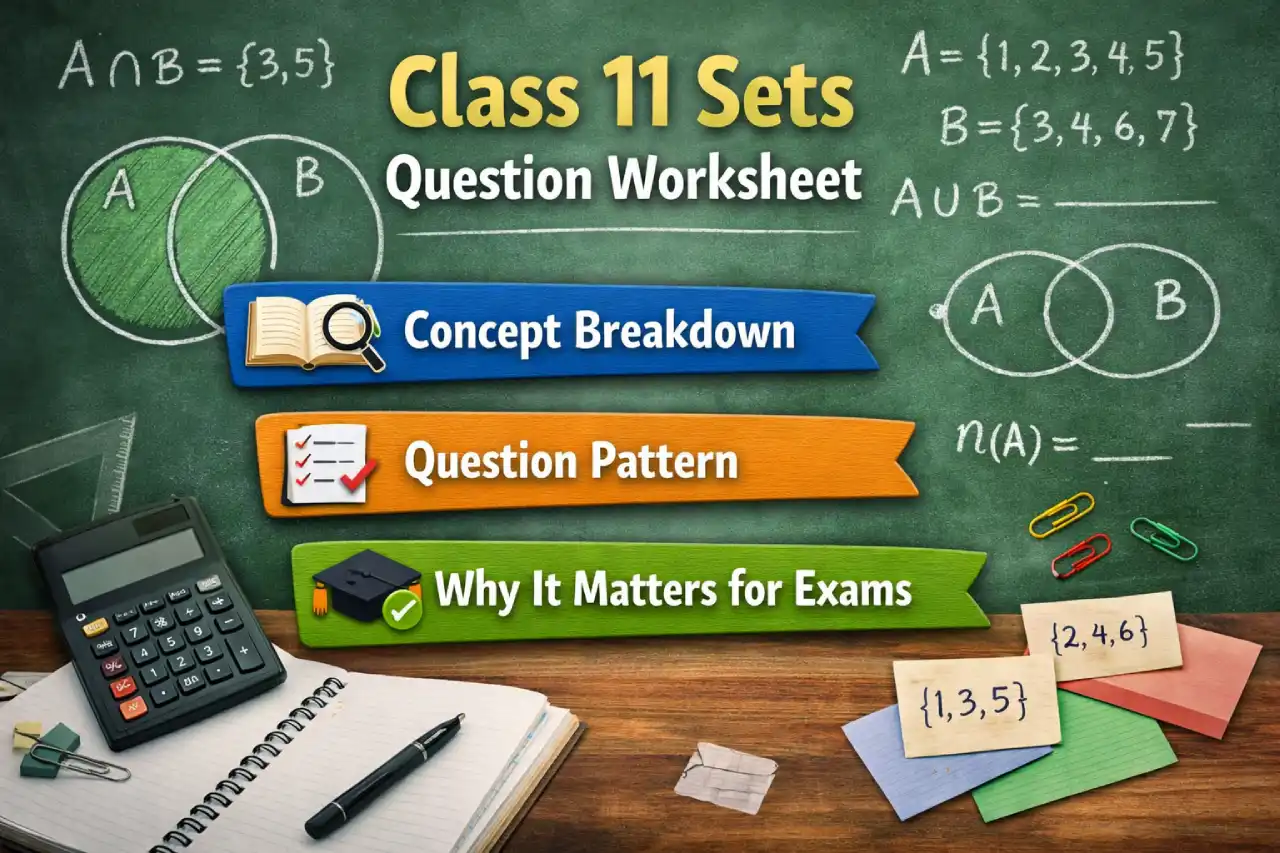
This mathematics worksheet on Sets, prepared for Class 11 CBSE students, is designed mainly for board exam preparation and for building a strong foundation for higher mathematics. It contains 50 multiple-choice questions, all framed directly from NCERT concepts. The worksheet covers basic ideas like representation of sets, subsets, power sets, operations on sets, complements, and Venn diagram logic. Overall, it reflects the kind of factual yet concept-based questions students regularly face in school examinations Sets WS.

I am writing about this worksheet because the chapter on Sets often feels simple at first but becomes tricky due to logical conditions, symbols, and formula-based questions. Many students lose easy marks due to confusion between subset relations, complements, and set operations. A structured worksheet like this helps convert theory into exam-ready understanding. By analysing the questions carefully, students can clearly identify which areas are repeatedly tested and how basic definitions are turned into scoring MCQs.

Structure of the Sets Worksheet

The worksheet consists of 50 MCQs, with each question carrying one mark. The questions are a mix of direct concept checks and logical application-based problems. While many questions look straightforward, the options are closely framed, which tests clarity and careful reading rather than guesswork.

The overall difficulty level ranges from easy to moderate, making this worksheet suitable for both revision and self-assessment before exams.

Basics of Sets and Representation

Several questions focus on the fundamentals of sets, including:

  • Well-defined collections
  • Roster form and set-builder form
  • Identification of valid and invalid sets
  • Null set and singleton set

These questions ensure that students clearly understand what qualifies as a set and how sets are represented mathematically, which is the starting point of the chapter Sets WS.

Subsets, Proper Subsets and Power Sets

A large part of the worksheet tests understanding of subsets and power sets. Questions include:

  • Finding the number of subsets of a given set
  • Identifying proper and improper subsets
  • Comparing number of subsets between two sets
  • Questions based on formulas like 2ⁿ and 2ⁿ − 1

These are high-scoring areas in exams but require clarity in applying formulas correctly.

Operations on Sets

The worksheet strongly focuses on operations on sets such as:

  • Union
  • Intersection
  • Difference of sets
  • Complement of a set

Many questions are based on standard identities like
A ∩ (A ∪ B) = A
and conditions such as A ∪ B = A or A ∩ B = B. These questions test whether students understand identities logically rather than memorising them.

Download this Sets Question PDF File: Click Here

Complement and Universal Set Concepts

Several MCQs involve complements of sets with respect to a universal set. Students are asked to evaluate expressions involving A′, (A′)′, and combined operations with complements.

Such questions are important because small mistakes in complement logic can lead to incorrect answers even when the concept is known.

Set-Builder Logic and Interval-Based Sets

The worksheet includes questions written in set-builder notation and interval form, especially involving real numbers. These questions test the ability to translate mathematical conditions into correct set notation and vice versa.

Understanding these problems is essential for later chapters involving relations, functions, and coordinate geometry.

Counting and Application-Based Questions

Some questions go beyond direct definitions and involve counting techniques, such as:

  • Comparing number of subsets of different sets
  • Finding values of variables based on subset conditions
  • Questions involving overlapping sets and element distribution

These problems improve logical reasoning and are often used to test deeper understanding in exams.

What Students Can Learn from This Worksheet

From this worksheet, it becomes clear that:

  • NCERT definitions are the backbone of exam questions
  • Set identities must be understood logically
  • Subset and power set formulas need careful application
  • Complement-based questions require attention to detail
  • Regular practice reduces silly mistakes in easy chapters

Overall, this Class 11 Sets worksheet is a strong practice resource that helps students secure marks from a scoring chapter. It builds clarity, confidence, and accuracy, which are essential for performing well in board examinations and future mathematical studies.

Leave a Comment

End of Article

Loading more posts...