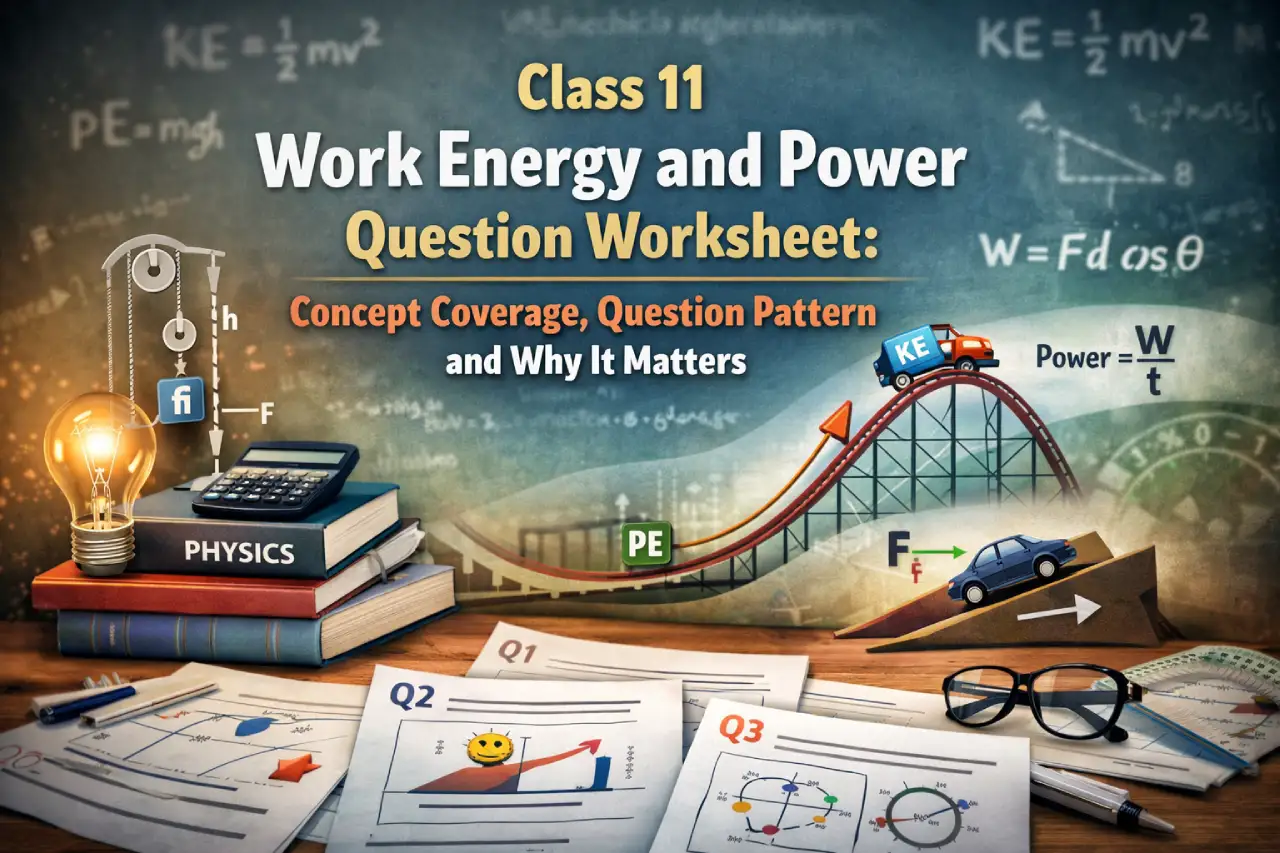
This physics worksheet on Work, Energy and Power, prepared for Class 11 CBSE students, is designed mainly for board exam preparation and concept strengthening. It contains 75 multiple-choice questions covering work done by constant and variable forces, kinetic and potential energy, work–energy theorem, conservative and non-conservative forces, spring systems, collisions, circular motion, power, efficiency, and real-life numerical applications. The questions are framed directly from NCERT concepts and closely reflect the calculation-heavy yet logic-based MCQs students regularly face in examinations Work Energy and Power WS 1.
I am writing about this worksheet because Work, Energy and Power is one chapter where formulas look simple but application becomes tricky under exam pressure. Students often get confused between work and energy, sign conventions, energy conservation conditions, and power-related calculations. A comprehensive worksheet like this helps bridge the gap between theory and numerical problem-solving. By analysing the questions carefully, students can clearly identify high-weight topics and understand how multiple concepts are blended into single MCQs.
Structure of the Work, Energy and Power Worksheet
The worksheet consists of 75 MCQs, with each question carrying one mark. The questions range from short conceptual checks to multi-step numerical problems involving forces, displacement, velocity, and time. Many problems are framed to test understanding of physical meaning rather than direct substitution into formulas.
The overall difficulty level ranges from moderate to high, making the worksheet suitable for revision as well as strengthening weak areas.
Work Done by Forces and Directional Analysis
Several questions focus on the definition of work and its dependence on force and displacement. Students are tested on:
- Work done by constant and variable forces
- Dot product interpretation of work
- Zero work cases when force is perpendicular to displacement
- Work done by friction, gravity, and applied forces
These questions ensure that students clearly understand when work is positive, negative, or zero Work Energy and Power WS 1.
Kinetic Energy and Work–Energy Theorem
A large portion of the worksheet is based on kinetic energy and its relationship with work. Topics covered include:
- Change in kinetic energy due to applied force
- Relation between momentum and kinetic energy
- Work–energy theorem applications
- Kinetic energy in collisions and explosions
Such questions test whether students can move beyond memorised formulas and apply energy concepts logically.
Potential Energy and Conservative Forces
The worksheet includes several MCQs on gravitational and spring potential energy. Students encounter questions related to:
- Gravitational potential energy near earth’s surface
- Spring compression and extension
- Conservative versus non-conservative forces
- Path independence of work done by conservative forces
These questions highlight the importance of understanding energy storage and energy transfer.
Download this Work Energy and Power PDF File: Click Here
Springs, Elastic Energy and Oscillatory Motion
Spring-based questions form a significant part of the worksheet. Topics tested include:
- Work done in stretching or compressing springs
- Relation between force constant and stored energy
- Maximum compression of springs due to falling masses
- Combination of springs and energy balance
These problems require careful application of energy conservation principles.
Collisions and Conservation Laws
Several questions deal with elastic and inelastic collisions. Students are tested on:
- Conservation of momentum
- Loss or conservation of kinetic energy
- Coefficient of restitution
- Head-on collision scenarios
Such questions are common in exams and require clarity in both momentum and energy concepts.
Circular Motion and Energy-Based Reasoning
The worksheet also includes questions combining circular motion with energy ideas, such as:
- Energy changes in vertical circular motion
- Loop-the-loop problems
- Motion of pendulums and particles on curved paths
These questions help students connect Work, Energy and Power with previous chapters like Laws of Motion.
Power, Efficiency and Real-Life Applications
Power-related MCQs form an important section of the worksheet. Topics include:
- Instantaneous and average power
- Power as dot product of force and velocity
- Efficiency of engines and pumps
- Real-life examples like heart pumping blood and machines lifting loads
These questions test understanding of how energy transfer occurs with time.
What Students Can Learn from This Worksheet
From analysing this worksheet, a few key points clearly emerge:
- Energy methods often simplify complex force problems
- Sign conventions in work and energy are crucial
- Spring and collision questions are high-weight areas
- Power questions require clarity of units and dimensions
- Regular MCQ practice improves speed and confidence
Overall, this Class 11 Work, Energy and Power worksheet is a strong practice resource that closely follows the CBSE syllabus. It helps students develop conceptual clarity, numerical accuracy, and exam confidence. Regular practice with such worksheets can significantly improve performance in physics examinations.