JOIN WHATSAPP
STORIES

Class 11 Geography Chapter 11 Hindi PDF: विश्व की जलवायु एवं जलवायु परिवर्तन

Class 11 Geography Chapter 11 Hindi PDF: विश्व की जलवायु एवं जलवायु परिवर्तन

NCERT Class 11 Geography Chapter 11, विश्व की जलवायु एवं जलवायु परिवर्तन, explains how climate patterns differ across the world and why climate change has become a serious global concern. This chapter introduces students to major climate types, their distribution, and the natural as well as human factors influencing climate. It also discusses long-term climate change, its causes, and its visible impacts on different regions of the world.

I am writing about this chapter because many students confuse weather with climate and struggle to link climate change with real-world events. Chapter 11 clears this confusion by explaining climate in a structured way, starting from global climate patterns and moving towards climate change. This chapter is extremely relevant today because issues like global warming, melting glaciers, rising sea levels, and extreme weather events are no longer theoretical. For Class 11 students, this topic is important not only for exams but also for building awareness about environmental challenges they hear about daily in news and discussions. A strong understanding here also helps later in topics related to Indian climate, geography of resources, and environmental studies.

What This Chapter Covers

Chapter 11 focuses on global climate systems and how they are changing over time. It explains why the Earth has different climate zones and what happens when these systems are disturbed.

Major Climate Types of the World

The chapter explains different climate regions of the world based on temperature and rainfall patterns. Some major climate types discussed include:

  • Equatorial climate
  • Tropical monsoon climate
  • Desert climate
  • Mediterranean climate
  • Temperate climate
  • Polar climate

Students are expected to understand their characteristics and locate them on a world map.

Factors Controlling World Climate

This section explains why climates differ from one place to another. Important controlling factors include:

  • Latitude
  • Altitude
  • Distance from the sea
  • Ocean currents
  • Pressure and wind systems

These factors are frequently asked in short and long answer questions.

Understanding Climate Change

One of the most important parts of this chapter is climate change. It explains how Earth’s climate changes over long periods and how recent changes are faster due to human activities. Key points covered include:

  • Greenhouse effect
  • Global warming
  • Role of carbon dioxide and other gases
  • Human activities like deforestation and industrialisation

This section helps students connect geography with environmental science.

Impacts of Climate Change

The chapter clearly links climate change with real-world impacts such as:

  • Rising global temperatures
  • Melting of glaciers and polar ice
  • Sea-level rise
  • Changes in rainfall patterns
  • Increase in floods, droughts, and cyclones

These examples are useful for writing well-structured answers in exams.

Why Chapter 11 Is Important for Exams

Questions from this chapter are often conceptual and analytical. Students are commonly asked about:

  • Difference between weather and climate
  • Factors affecting world climate
  • Causes and effects of climate change

Clear understanding and use of examples can easily fetch good marks.

How to Download NCERT Class 11 Geography Chapter 11 PDF (Hindi)

Students can download the official Hindi PDF by following these steps:

Always rely on the official NCERT PDF to ensure correct content and updated syllabus.
Leave a Comment

End of Article

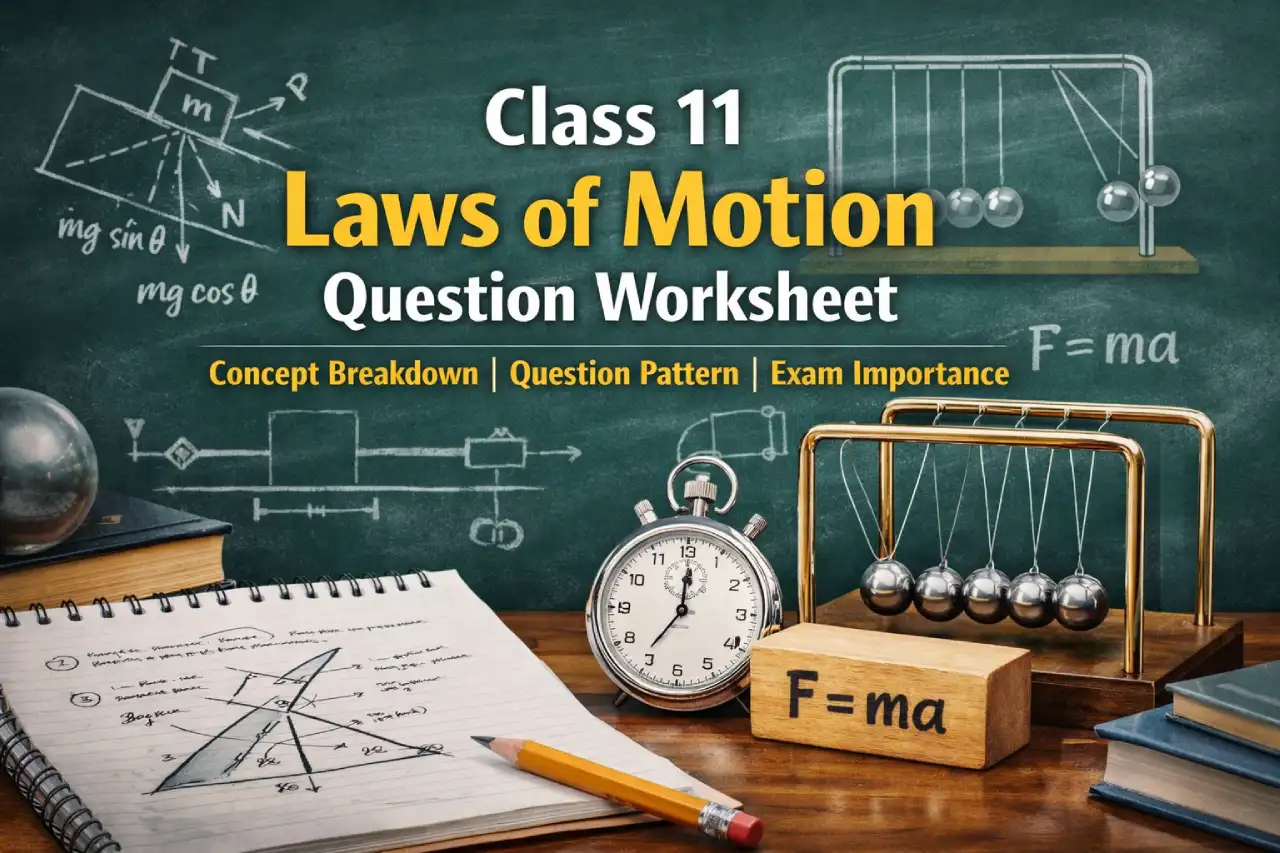
Class 11 Laws of Motion Worksheet (With Solutions): Concept Coverage, Question Pattern and Exam Focus

Class 11 Laws of Motion Worksheet (With Solutions): Concept Coverage, Question Pattern and Exam Focus

This physics worksheet on Laws of Motion, along with its detailed solution set, is prepared for Class 11 CBSE students and is mainly aimed at board exam preparation and concept clarity. The worksheet contains 75 multiple-choice questions, each followed by a clear explanation in the solution PDF. It covers Newton’s laws of motion, momentum, impulse, friction, circular motion, lifts and elevators, rockets, banking of roads, and force analysis in real-life situations. The questions are strictly framed from NCERT concepts and match the difficulty and style seen in school examinations Laws of Motion WS 1 (1).

I am writing about this worksheet because Laws of Motion is one chapter where students often feel confident after reading theory, but lose marks due to weak application. Errors usually happen in identifying forces, choosing correct directions, or misunderstanding situations like lifts, recoil, or circular motion. A worksheet with properly explained solutions helps students understand not just the correct answer, but also the logic behind it. Going through these explanations makes exam preparation more systematic and reliable.

Structure of the Laws of Motion Worksheet

The worksheet consists of 75 MCQs, with each question carrying one mark, followed by a complete solution section. The solutions explain the formulas used, the reasoning applied, and the physics behind each answer. This makes the worksheet useful for both practice and revision.

The overall difficulty level ranges from moderate to high, especially in questions involving multiple concepts such as friction with acceleration, circular motion, and momentum conservation.

Newton’s Laws and Momentum Concepts

A large number of questions are based directly on Newton’s three laws of motion. The worksheet tests:

  • Vector nature of momentum
  • Application of the first law in everyday situations
  • Second law as a component-wise equation
  • Conservation of momentum in recoil and explosion problems

The solution explanations clearly show how forces and acceleration are connected, helping students avoid common conceptual mistakes Laws of Motion WS 1 (1).

Force Identification and Free-Body Analysis

Several MCQs focus on identifying correct forces acting on bodies. These include problems related to:

  • Vehicles moving on roads
  • Objects on planks and inclined planes
  • Internal and external forces
  • Equilibrium conditions

The solutions emphasise correct force diagrams, which is crucial for solving numerical problems accurately.

Friction and Motion on Inclined Planes

Friction-based questions form an important part of the worksheet. Topics covered include:

  • Static and kinetic friction
  • Limiting friction
  • Motion on rough inclined planes
  • Effect of friction on stopping distance

The solutions clearly explain when friction acts and in which direction, helping students develop better physical intuition.

Circular Motion and Centripetal Force

The worksheet includes many questions related to circular motion, such as:

  • Centripetal force and acceleration
  • Motion of objects tied to strings
  • Vehicles taking turns on curved roads
  • Banking of roads and safe speed

These questions test understanding of direction and magnitude rather than just formula substitution.

Download this Laws of Motion PDF File: Click Here

Lift, Elevator and Apparent Weight Problems

Several questions are based on motion in lifts and elevators. Students are tested on:

  • Apparent weight during upward and downward motion
  • Motion with uniform speed
  • Special cases like free fall

The solutions clearly explain why apparent weight changes, which is a frequently tested concept.

Impulse, Rocket Motion and Conservation Laws

Impulse-based problems and rocket motion questions appear regularly in the worksheet. These include:

  • Change in momentum during collision
  • Force acting for a short duration
  • Rocket propulsion based on momentum conservation

The explanations help students connect mathematical expressions with physical meaning.

Conceptual and Real-Life Reasoning Questions

The worksheet also includes conceptual questions such as:

  • Motion without force
  • Inertial and non-inertial frames
  • Behaviour of objects if gravity suddenly disappears
  • Conservation laws in daily-life situations

These questions are scoring if concepts are clearly understood.

What Students Can Learn from This Worksheet

From analysing this worksheet and its solutions, a few clear takeaways emerge:

  • Free-body diagrams are essential for accuracy
  • Direction of force and acceleration matters as much as magnitude
  • Laws of motion apply across many physical situations
  • Friction and circular motion are high-weight areas
  • Studying solutions improves confidence and problem-solving speed

Overall, this Class 11 Laws of Motion worksheet with solutions is a strong learning resource. It closely follows the CBSE syllabus and helps students build conceptual clarity, numerical accuracy, and exam confidence. Regular practice with such worksheets can make a noticeable difference in physics performance.

Leave a Comment

End of Article

Loading more posts...