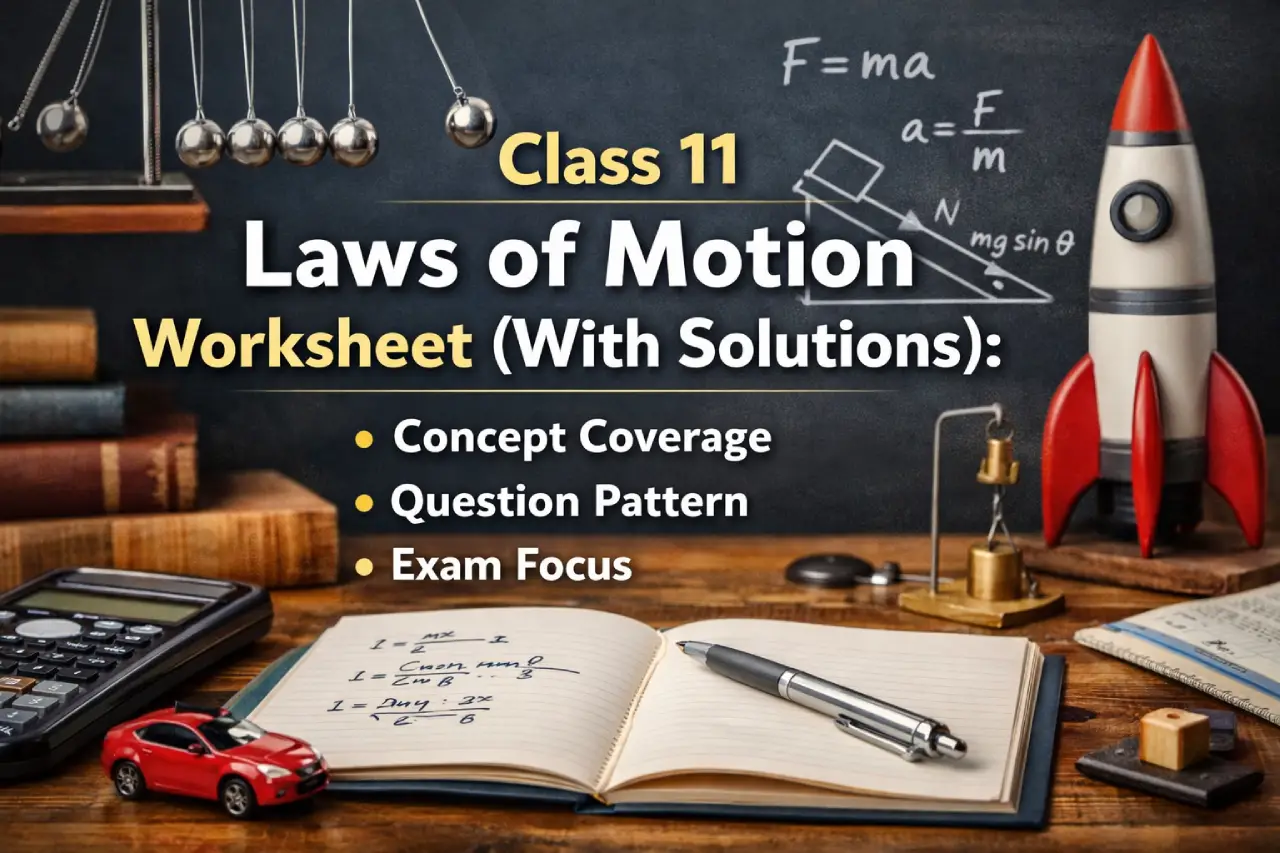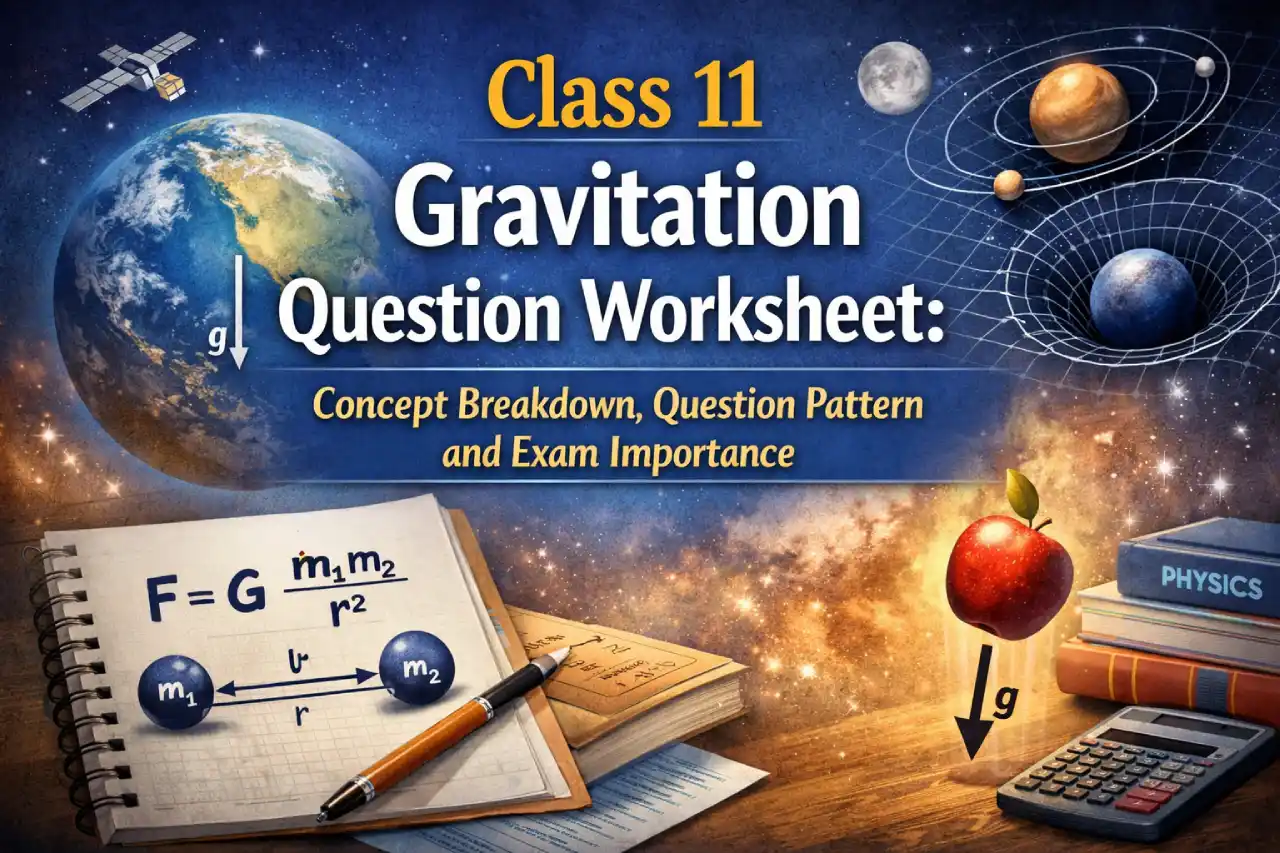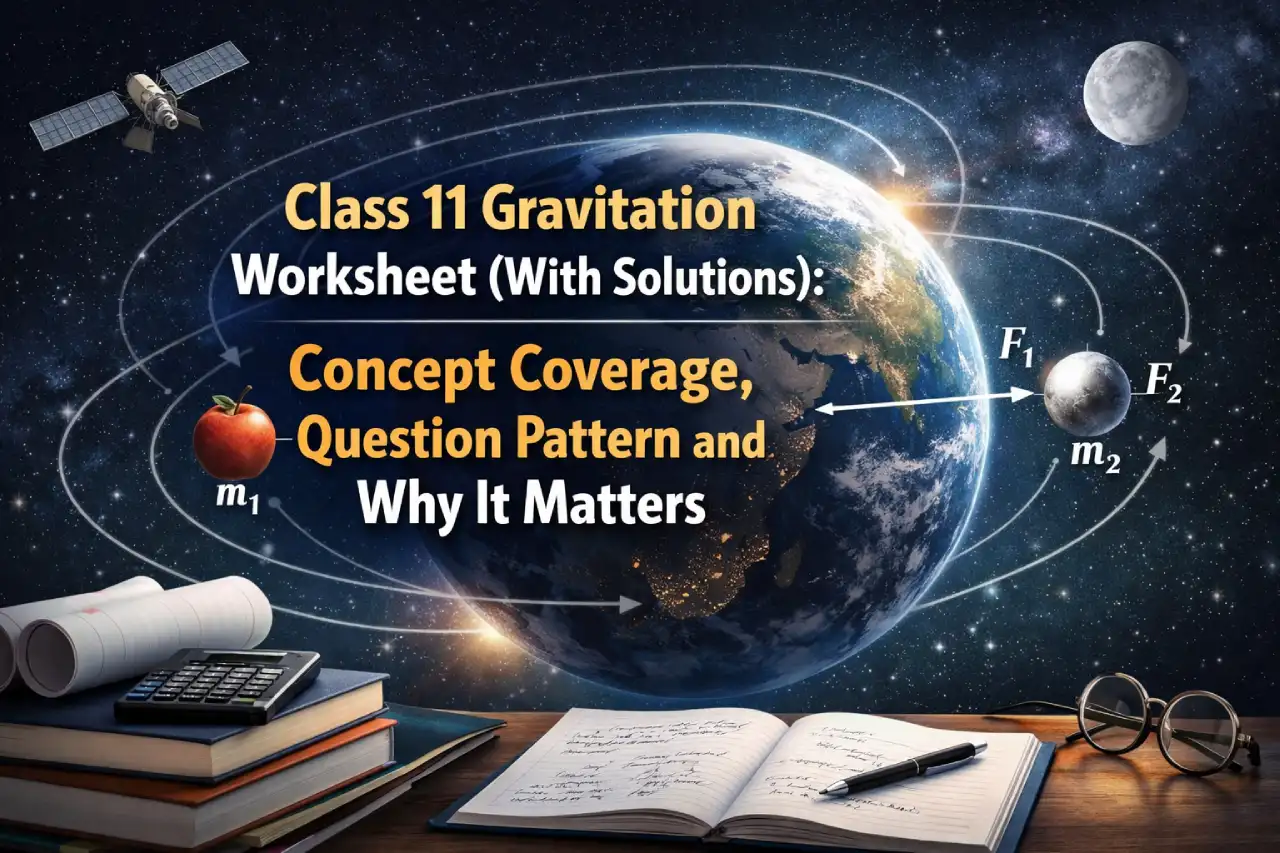
This physics worksheet on Gravitation, along with its detailed solutions, is prepared for Class 11 CBSE students and is aimed at strengthening both numerical skills and conceptual understanding. The worksheet contains 75 multiple-choice questions, each supported by step-by-step explanations in the solution PDF. It covers all major NCERT topics such as Newton’s law of gravitation, acceleration due to gravity, variation of g, escape velocity, orbital motion, satellites, Kepler’s laws, gravitational potential energy, and real-world applications involving planets, moons, asteroids, and rockets Gravitation WS 1 (1).
I am writing about this worksheet because Gravitation is one chapter where students often memorise formulas but struggle to apply them correctly in exams. Small confusion about radius, height, depth, or energy conditions can easily lead to wrong answers. A worksheet with worked-out solutions helps bridge this gap. By studying not just the questions but also the explanations, students can clearly understand how examiners expect answers to be approached and why certain options are correct while others are not.
Structure of the Gravitation Worksheet and Solutions
The worksheet consists of 75 MCQs, each carrying one mark, followed by a comprehensive solution section. The solutions are not limited to final answers but include proper reasoning, formulas used, and physical interpretation. This makes the worksheet useful not only for practice but also for concept revision.
The overall difficulty level ranges from moderate to high, especially due to multi-concept questions involving energy, circular motion, and satellite dynamics.
Newton’s Law of Gravitation and Force-Based Concepts
Several questions focus on Newton’s universal law of gravitation. The solutions clearly explain:
- Independence of gravitational force from the medium
- Force between extended bodies like rings and spheres
- Application of inverse square law
- Superposition principle for multiple masses
These explanations help students understand gravitation beyond simple two-body problems Gravitation WS 1 (1).
Acceleration Due to Gravity and Its Variations
A major portion of the worksheet deals with acceleration due to gravity. The solved questions cover:
- Variation of g with height and depth
- Change in g due to earth’s rotation
- Comparison of g at poles and equator
- Acceleration due to gravity on moon and other planets
The solutions clearly derive results instead of directly stating formulas, which helps in concept retention.
Escape Velocity and Orbital Velocity
Escape velocity is one of the most frequently tested areas in this worksheet. The solutions explain:
- Why escape velocity is independent of mass
- Relationship between escape velocity and orbital velocity
- Escape velocity from different planets and heights
- Energy-based derivation of escape speed
These explanations make it easier to tackle tricky MCQs based on energy conditions.
Satellites, Circular Motion and Energy
Several questions deal with satellites revolving around earth. The worksheet tests:
- Time period of satellites
- Effect of orbital radius on speed and time period
- Energy of satellites in low and high orbits
- Transfer of satellites between orbits
The solutions neatly connect gravitation with circular motion and conservation of energy.
Download this Gravitation PDF File: Click Here
Kepler’s Laws and Planetary Motion
Kepler’s laws are tested through both direct and application-based questions. The solution section explains:
- Law of areas as a result of angular momentum conservation
- Relationship between orbital radius and time period
- Motion of planets, moons, and asteroids
- Why orbits deviate from perfect ellipses in real systems
These explanations help students see the physics behind the laws, not just the statements.
Application-Based and Conceptual Questions
The worksheet includes many real-life and reasoning-based questions, such as:
- Apparent weight in lifts
- Motion on moon and asteroids
- Behaviour of satellites if gravitational force vanishes
- Cavendish experiment and measurement of G
- Nature and formation of black holes
The solution PDF provides logical explanations, making these questions less intimidating.
What Students Can Learn from This Worksheet
From analysing this worksheet and its solutions, a few clear points stand out:
- NCERT theory is the backbone of all questions
- Energy-based reasoning is crucial in gravitation
- Escape velocity and satellite motion are high-weight topics
- Understanding derivations reduces memorisation
- Solution analysis improves accuracy and confidence
Overall, this Class 11 Gravitation worksheet with solutions is a very strong learning resource. It not only prepares students for board exams but also builds a solid conceptual foundation required for advanced physics topics in Class 12. Regular practice with such worksheets can significantly improve both problem-solving ability and exam performance.