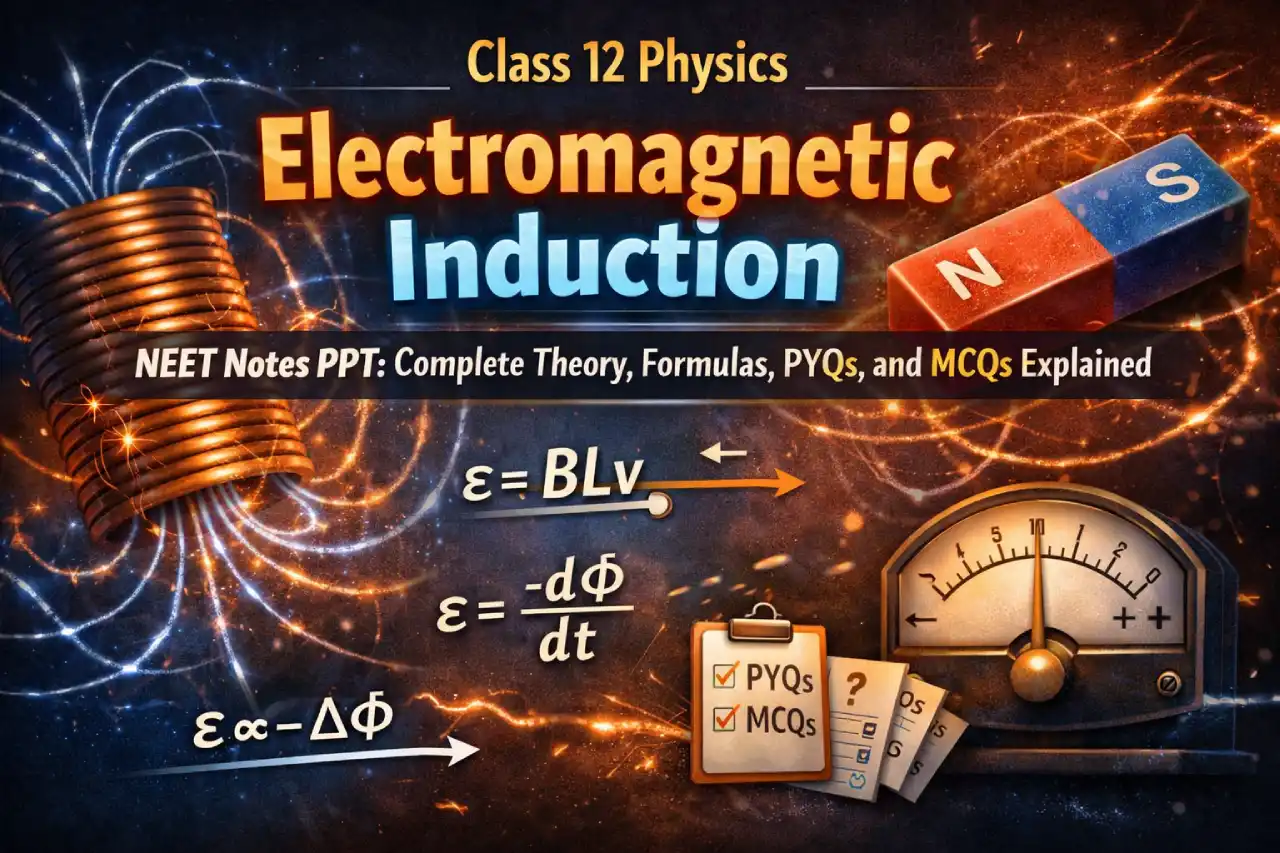
Electromagnetic Induction is one of the most important and high-weightage chapters in Class 12 Physics for NEET aspirants. The uploaded PPT titled PPT 01/02 – Electromagnetic Induction (Class 12 NEET) is a comprehensive classroom presentation that covers magnetic flux, Faraday’s laws, Lenz’s law, motional emf, rotational emf, AC generator, eddy currents, and induced electric field. It also contains a large number of NEET, NCERT, and previous year objective questions with correct answers, making it a strong concept-plus-practice resource. PPT_1_Electromagnetic Induction
I am writing about this PPT because many students understand formulas but struggle to visualise how electromagnetic induction actually works in real situations. This presentation explains concepts using diagrams, step-by-step reasoning, and exam-level questions. If used properly, it can help students build strong conceptual clarity, improve numerical skills, and score better in NEET and board examinations.
What This Electromagnetic Induction PPT Covers
The PPT is organised into topic-wise sections, starting from basic definitions and gradually moving to advanced applications.
Major topics included are:
- Magnetic flux
- Faraday’s laws of electromagnetic induction
- Lenz’s law
- Motional emf
- Rotational emf
- Induced emf due to rotation
- AC generator
- Eddy currents
- Induced electric field
Each section contains theory points followed by multiple-choice questions.
Magnetic Flux
Magnetic flux is defined as the total number of magnetic field lines passing through a given area.
The PPT explains that when magnetic flux linked with a loop changes with time, an emf is induced in the loop. If the circuit is closed, an induced current flows.
Formula used:
Φ = B A cosθ
Several numerical questions are included where flux is calculated for circular discs, square loops, and planes placed in different orientations.
Faraday’s Laws of Electromagnetic Induction
The first law states that whenever the magnetic flux linked with a circuit changes, an emf is induced.
The second law states that the magnitude of induced emf is equal to the rate of change of magnetic flux:
e = − dΦ / dt
The negative sign represents Lenz’s law.
Questions in the PPT test calculation of emf, total charge induced, and time taken for flux change.
Lenz’s Law
According to Lenz’s law, the direction of induced current is such that it opposes the cause producing it.
This law is shown to be a consequence of conservation of energy.
Several diagram-based questions in the PPT ask students to predict the direction of induced current in loops when magnets move or when current in nearby wires changes.
Motional EMF
Motional emf is produced when a conductor moves in a magnetic field and cuts magnetic field lines.
The PPT explains that free electrons experience magnetic force, leading to charge separation and potential difference.
Important relation:
e = B l v
Many problems involve rods sliding on rails, rectangular frames moving in magnetic fields, and falling conducting rings.
Download this PPT File: Click Here
Rotational EMF
When a conducting rod or loop rotates in a magnetic field, an emf is induced between its ends.
The PPT includes questions on rods rotating about one end, semi-circular loops, and bicycle wheels rotating in magnetic fields.
These problems are common in NEET.
AC Generator
The PPT explains that the working of an AC generator is based on electromagnetic induction.
It converts mechanical energy into electrical energy.
Questions test how emf changes when rotational speed of the coil is changed.
Eddy Currents
Eddy currents are circulating currents induced in bulk conductors when placed in a changing magnetic field.
The PPT explains that eddy currents cause heating and energy loss, which is reduced by laminating the core.
Applications listed include:
- Electric braking
- Induction furnace
- Energy meter
- Speedometer
Questions check understanding of where eddy current effect is used and where it is not.
Induced Electric Field
When a magnetic field changes with time, an electric field is induced in space.
The PPT explains properties of this field:
- It is non-conservative
- Field lines form closed loops
- Potential around a closed loop is not zero
Questions involve finding induced electric field inside and outside cylindrical regions.
Why This PPT Is Useful for Students
- Covers complete Electromagnetic Induction syllabus
- Explains concepts with diagrams
- Includes many NEET and NCERT-based MCQs
- Helps in quick revision
- Strengthens numerical problem-solving skills