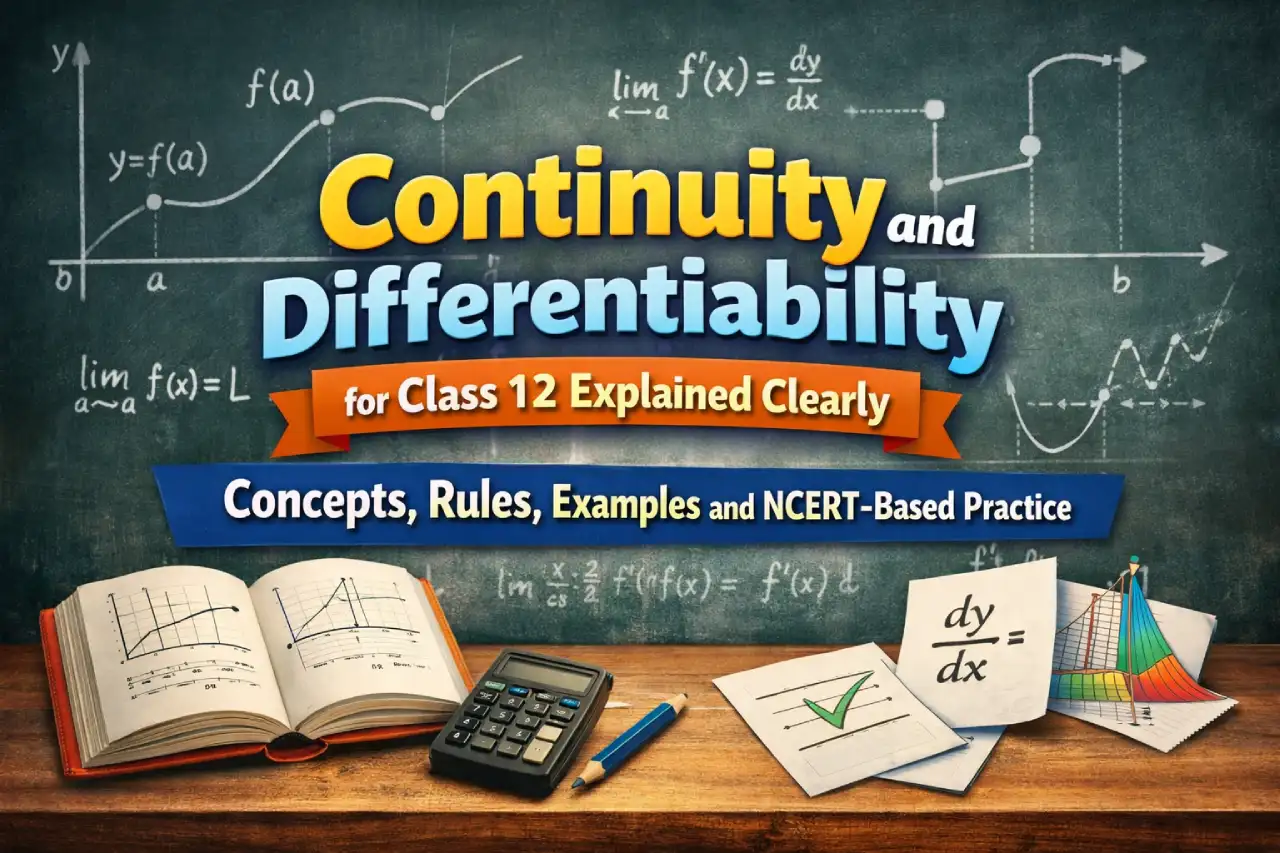
Continuity and Differentiability is a core calculus chapter in Class 12 Mathematics that builds a strong bridge between limits and applications of derivatives. The uploaded PDF is a detailed NCERT-aligned study resource covering continuity of functions at a point and in intervals, differentiability, left-hand and right-hand derivatives, relationship between continuity and differentiability, standard derivatives, rules of differentiation, and advanced techniques such as chain rule, implicit differentiation, logarithmic differentiation, and parametric differentiation. It also includes a large collection of solved NCERT exercise questions and examples for exam practice.
I am writing about this topic because students often understand differentiation formulas but struggle when questions combine continuity, limits, and differentiability. This chapter demands conceptual clarity more than rote learning. By presenting the key ideas from the PDF in a simple, structured, and practical manner, I aim to help students strengthen their fundamentals and approach board and competitive exam questions with confidence.
What Is Continuity of a Function?
A function f(x) is said to be continuous at x = a if:
- f(a) is defined
- lim x→a⁻ f(x) exists
- lim x→a⁺ f(x) exists
- lim x→a f(x) = f(a)
If any of these conditions fail, the function is discontinuous at that point.
The PDF also explains that:
- A function is continuous on (a, b) if it is continuous at every point in that interval
- A function is continuous on [a, b] if it is continuous in (a, b), right continuous at a, and left continuous at b
Polynomial, exponential, and trigonometric functions are continuous over their domains.
Algebra of Continuous Functions
If f(x) and g(x) are continuous at x = a, then:
- f(x) + g(x)
- f(x) − g(x)
- f(x)g(x)
- f(x)/g(x), where g(a) ≠ 0
are also continuous at x = a.
This result is frequently used in solving continuity problems.
Differentiability of a Function
A function f(x) is differentiable at x = a if:
lim h→0 [f(a + h) − f(a)] / h exists
This limit is called the derivative of f(x) at x = a and is denoted by f′(a).
The PDF defines:
- Left Hand Derivative (LHD)
- Right Hand Derivative (RHD)
For differentiability at a point:
LHD = RHD
If LHD ≠ RHD, the function is not differentiable at that point.
Relationship Between Continuity and Differentiability
Important results from the PDF:
- If a function is differentiable at a point, it is continuous at that point
- A function can be continuous but not differentiable
- If a function is discontinuous at a point, it is not differentiable there
A common example is f(x) = |x|, which is continuous at x = 0 but not differentiable at x = 0.
Download this CLASS 12 – CONTINUITY AND DIFFERENTIABILITY PDF File: Click Here
Standard Derivatives
Some frequently used derivatives:
| Function | Derivative |
|---|---|
| k | 0 |
| xⁿ | nxⁿ⁻¹ |
| sin x | cos x |
| cos x | −sin x |
| tan x | sec²x |
| eˣ | eˣ |
| aˣ | aˣ ln a |
| log x | 1/x |
| sin⁻¹x | 1/√(1 − x²) |
| cos⁻¹x | −1/√(1 − x²) |
These are repeatedly used throughout the PDF.
Rules of Differentiation
Sum Rule
d/dx [f(x) ± g(x)] = f′(x) ± g′(x)
Product Rule
d/dx [f(x)g(x)] = f(x)g′(x) + g(x)f′(x)
Quotient Rule
d/dx [f(x)/g(x)] = [g(x)f′(x) − f(x)g′(x)] / [g(x)]²
These rules form the foundation of most differentiation problems.
Chain Rule
If y = f(u) and u = g(x), then:
dy/dx = (dy/du)(du/dx)
Used when functions are composed.
Implicit Differentiation
When y is not expressed directly in terms of x, both sides of the equation are differentiated with respect to x.
Example:
x² + y² = 25
Differentiate both sides to find dy/dx.
Logarithmic Differentiation
Used when functions involve powers and products.
Example:
y = (x² + 1)³ (x − 1)²
Take log on both sides, then differentiate.
Differentiation of Parametric Functions
If:
x = f(t)
y = g(t)
Then:
dy/dx = (dy/dt) / (dx/dt)
Importance of This Chapter in Exams
- High weightage in CBSE boards
- Foundation for Applications of Derivatives
- Many MCQs and case-study questions are based on this chapter
Practising NCERT examples and exercises is essential.
How to Study This Chapter Effectively
- Revise standard derivatives daily
- Practise continuity problems using limits
- Focus on LHD and RHD for differentiability
- Solve NCERT exercise questions thoroughly