The concept of increasing and decreasing functions is one of the most important topics in the Application of Derivatives chapter in Class 12 Mathematics. The worksheet analysed here focuses on understanding how derivatives help determine whether a function increases or decreases within a specific interval. The questions include a variety of problems based on algebraic functions, trigonometric functions, logarithmic expressions and polynomial equations. Students are asked to identify intervals of increase and decrease, prove monotonic behaviour of functions and analyse real-life situations using derivatives.
I am writing about this topic because students often memorise derivative formulas but struggle when they have to interpret what the derivative actually tells us about a function. In my experience, once you understand the relationship between derivatives and monotonic behaviour, this entire topic becomes logical rather than mechanical. Practising structured worksheets like this helps students develop confidence in solving exam-style questions and improves their conceptual clarity about how functions behave on different intervals.
What Are Increasing and Decreasing Functions?
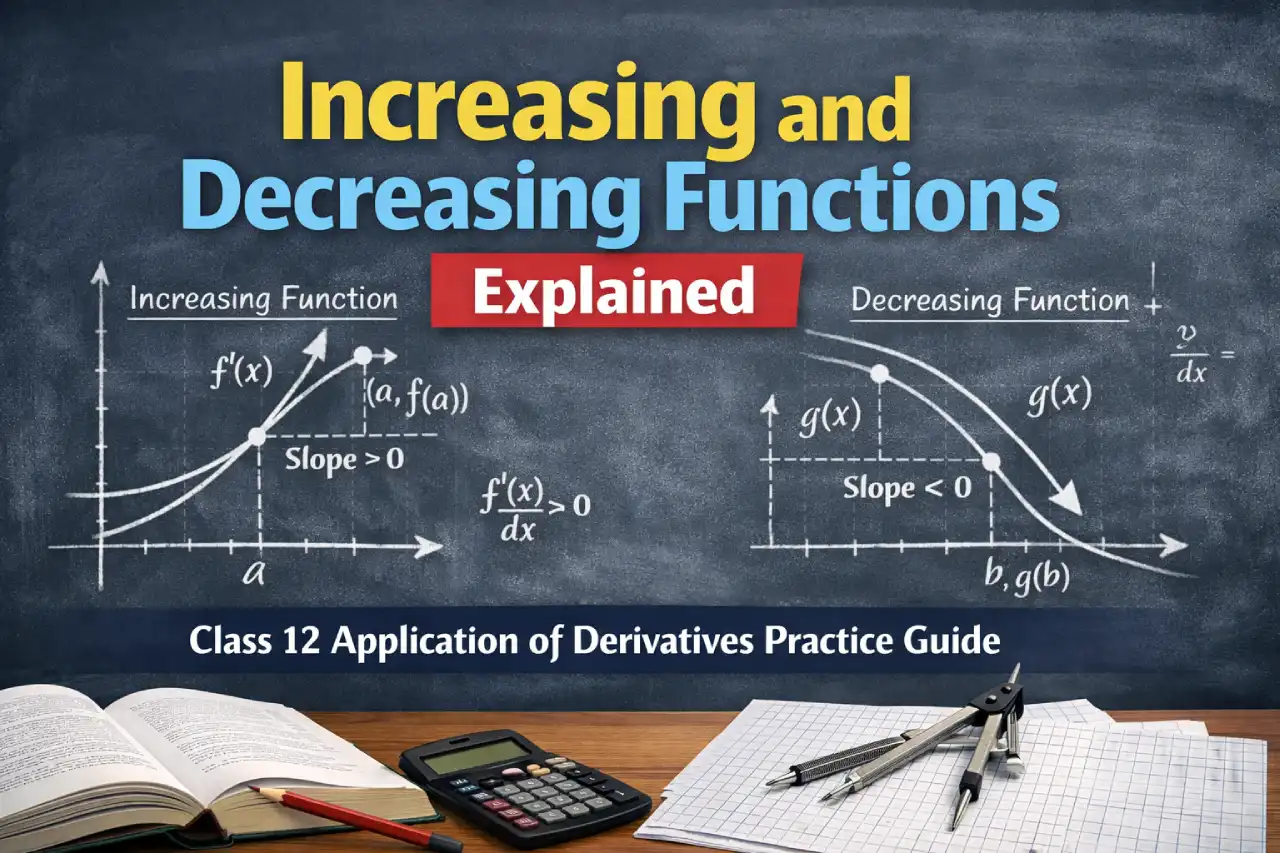
A function is called increasing in an interval if its value increases as the value of x increases within that interval. Similarly, a function is decreasing if its value reduces when x increases.
The derivative of a function helps us determine this behaviour.
If
f′(x) > 0, the function is increasing.
If
f′(x) < 0, the function is decreasing.
If
f′(x) = 0 at certain points, those points may represent turning points where the behaviour of the function changes.
Understanding this basic rule is essential because every problem related to increasing or decreasing functions depends on analysing the sign of the derivative.
Determining Intervals of Increase and Decrease
Many questions in the worksheet involve finding intervals where polynomial functions increase or decrease. For example, functions such as cubic or quartic expressions are given, and students must differentiate them and analyse the sign of the derivative.
The typical method used is:
- Differentiate the function f(x)
- Solve f′(x) = 0 to find critical points
- Divide the number line into intervals
- Check the sign of the derivative in each interval
This process clearly shows where the function is increasing and where it is decreasing.
Such questions help students practise both differentiation and logical reasoning.
Monotonic Behaviour of Functions
Some questions require proving that a function is increasing or decreasing on the entire real line.
For example, certain cubic functions are shown to be increasing for all real values of x. This happens when the derivative remains positive for every value of x.
Similarly, some functions are strictly decreasing when the derivative remains negative throughout the interval.
These types of questions test whether students understand the meaning of “strictly increasing” and “strictly decreasing.”
Download this Application of Derivatives WS 2 PDF File: Click Here
Trigonometric Functions and Derivatives
The worksheet also includes several trigonometric functions. Students must analyse expressions involving sine, cosine and tangent.
For example, functions like:
- tan x − 4x
- sin 3x − cos 3x
- sin x + cos x
are analysed to determine whether they increase or decrease within a given interval.
Trigonometric functions are interesting because their derivatives involve other trigonometric expressions, which often change sign within different intervals.
This requires careful observation and understanding of trigonometric identities.
Logarithmic and Exponential Functions
Another category of questions involves logarithmic expressions. These problems test whether students can apply derivative rules to functions involving logarithms and exponential expressions.
For instance, functions like log(1 + x) or expressions combining logarithmic and algebraic terms are analysed to determine monotonic behaviour.
Such problems strengthen students’ ability to handle different types of functions using the same derivative principles.
Real-Life Application Through Case Study
One of the most interesting sections of the worksheet includes a case study related to rainwater harvesting. In this problem, a water tank with a square base must be constructed to collect rainwater. The tank has a fixed capacity, and the cost of land and digging depends on its dimensions.
Students must:
- Express the total cost of constructing the tank as a function of the base dimension
- Differentiate the cost function
- Determine the value that minimises the cost
- Analyse whether the cost function is increasing
This real-life application demonstrates how derivatives are used in optimisation problems and cost analysis.
Importance of Practising Such Worksheets
From my experience, practising worksheets like this is extremely useful for mastering application-based calculus problems.
These exercises help students:
- Understand the relationship between derivatives and function behaviour
- Practise solving algebraic and trigonometric derivative problems
- Learn how to analyse intervals logically
- Apply mathematics to practical situations such as optimisation and cost calculation
Regular practice improves both speed and accuracy in examinations.