Understanding increasing and decreasing functions is a key concept in the Application of Derivatives chapter in Class 12 Mathematics. The worksheet analysed here focuses on how derivatives help determine whether a function increases or decreases in a given interval. It includes a wide range of problems involving algebraic, logarithmic, exponential and trigonometric functions. By differentiating the given functions and analysing the sign of the derivative, students learn how to identify intervals where functions rise or fall. This approach builds a strong foundation in calculus and helps students interpret the behaviour of functions more clearly.
I decided to write about this topic because many students find derivatives manageable when solving direct differentiation problems but struggle when applying them to analyse function behaviour. In my experience, this topic becomes much easier once students understand the link between derivatives and monotonicity. Practising structured worksheets like this helps learners recognise patterns, understand critical points and gain confidence in solving exam-level problems. For students preparing for board examinations or competitive tests, mastering these concepts is extremely important.
What Is an Increasing or Decreasing Function?
A function is said to be increasing on an interval if the value of the function increases when the value of x increases. In simple terms, as x moves forward, the function value also rises.
Similarly, a function is decreasing if the function value becomes smaller as x increases.
Derivatives provide the mathematical tool to determine this behaviour.
Key rules include:
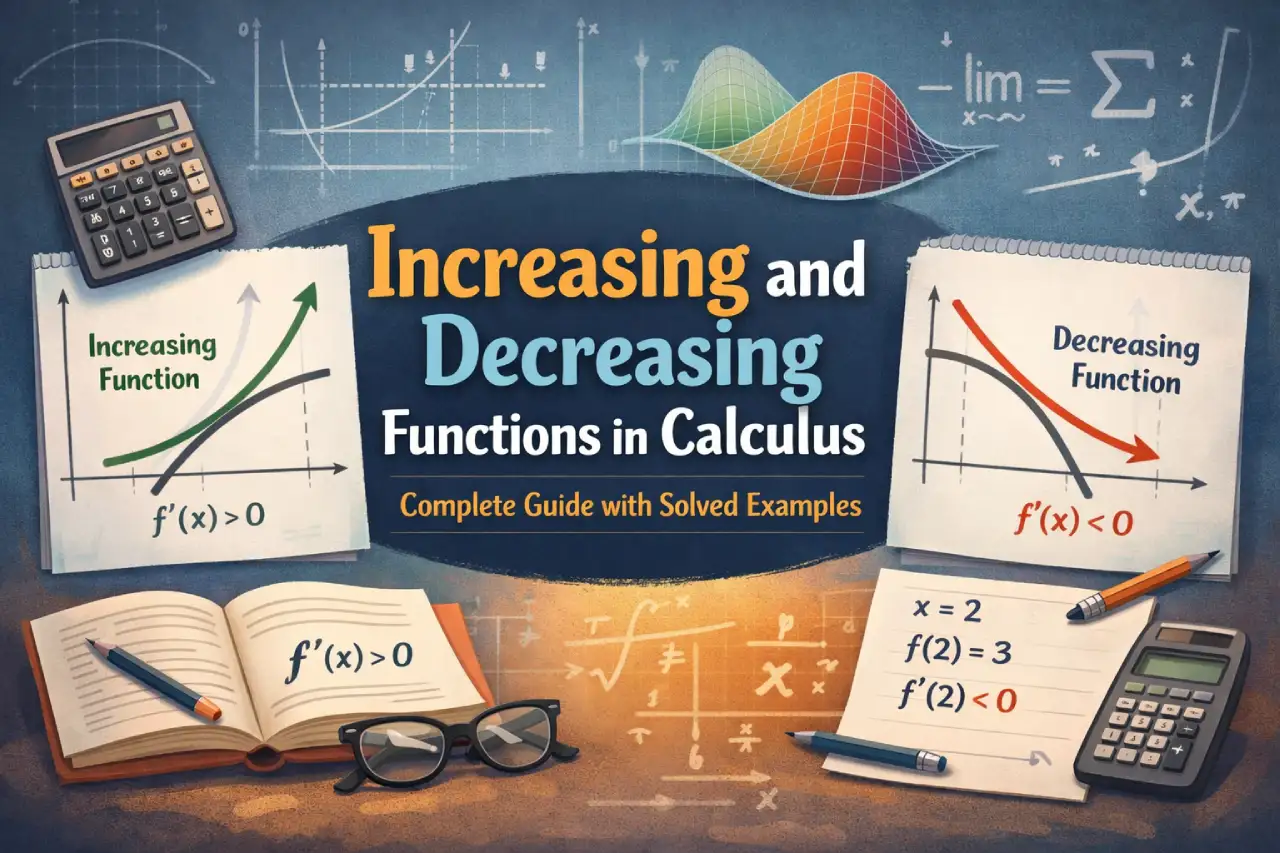
- If f′(x) > 0, the function is increasing.
- If f′(x) < 0, the function is decreasing.
- If f′(x) = 0, the point may represent a critical point where the behaviour changes.
These principles form the base for solving most problems related to monotonic behaviour of functions.
Finding Critical Points Using Derivatives
Many problems in the worksheet involve finding the critical points of functions. A critical point occurs when the derivative of a function becomes zero.
For example, a polynomial function may be differentiated and the equation f′(x) = 0 solved to identify the points where the slope becomes zero. These points divide the number line into intervals.
After identifying these intervals, students check the sign of the derivative in each region.
Typical steps include:
- Differentiate the function
- Solve the equation f′(x) = 0
- Divide the real line using these critical points
- Test the derivative sign in each interval
This method allows students to clearly determine where the function increases or decreases.
Behaviour of Polynomial Functions
A large portion of the problems focus on polynomial functions, such as cubic and quartic expressions.
For instance, when a cubic function is differentiated, the derivative becomes a quadratic equation. By analysing the roots of that equation, students determine where the function changes its direction.
Some examples in the worksheet show functions that increase on certain intervals and decrease on others. In some cases, the derivative remains positive for all values of x, meaning the function is increasing throughout the entire domain. Application of Derivatives WS 2…
This teaches students how the sign of the derivative directly controls the shape of the graph.
Trigonometric Functions and Monotonic Behaviour
The worksheet also includes several problems based on trigonometric functions such as sine, cosine and tangent.
For example, expressions like:
- sin x
- cos 3x
- tan x – 4x
are analysed using derivatives to determine increasing and decreasing intervals.
Because trigonometric functions change sign within different quadrants, these questions require careful observation of intervals and trigonometric identities.
Students learn how the behaviour of trigonometric functions changes across different ranges such as:
- 0 to π/2
- π/2 to π
- −π/2 to π/2
Such problems strengthen both calculus understanding and trigonometric reasoning.
Download this PDF File: Click Here
Logarithmic and Exponential Function Analysis
Another important section involves logarithmic and exponential expressions.
Functions like:
- log(1 + x) − x
- log sin x
- exponential expressions involving e^x
are analysed using derivative rules.
These questions demonstrate how derivatives can prove inequalities or determine monotonic behaviour of functions. For instance, some problems show that certain logarithmic expressions remain decreasing for specific values of x.
Such exercises are particularly useful because they combine calculus with algebraic reasoning.
Determining Intervals of Increase and Decrease
To determine intervals where a function increases or decreases, students must carefully check the sign of the derivative across intervals.
The process generally involves:
- Differentiating the function
- Finding critical points
- Dividing the domain into intervals
- Checking whether the derivative is positive or negative in each interval
Based on this analysis:
- Positive derivative → increasing function
- Negative derivative → decreasing function
This systematic approach helps students solve even complex problems with clarity.
Why Practising Such Worksheets Is Important
From my perspective, worksheets like this play a major role in strengthening conceptual understanding.
They help students:
- Develop a deeper understanding of derivatives
- Learn how to analyse function behaviour
- Practise solving algebraic and trigonometric problems
- Improve logical reasoning in calculus
Regular practice also prepares students for board examinations and competitive tests, where similar questions frequently appear.