JOIN WHATSAPP
STORIES

Logistic Regression Models in Regression Analysis – Download PDF Notes

Logistic Regression Models in Regression Analysis

Logistic regression is one of the most important tools in statistics and data science when the outcome is categorical. It helps us model the relationship between one or more independent variables and a binary or multinomial outcome. Unlike linear regression, which predicts continuous outcomes, logistic regression is used when we want to predict outcomes like yes/no, success/failure, or pass/fail. In this article, I’ll explain the concept of logistic regression models, give examples, and share a PDF that covers all the key points in a structured way.

I chose to write about logistic regression because it often confuses beginners. I remember learning linear regression quite easily, but logistic regression took a while to sink in. It uses a different approach since the outcome is not numerical in the usual sense. Understanding it is crucial for those working in fields like medical studies, marketing, banking, or any domain where classification problems exist. This article is written in simple language so that even someone with a basic knowledge of mathematics and statistics can follow along and understand how to apply logistic regression to real-world problems.

What is Logistic Regression?

Logistic regression is a type of regression analysis used when the dependent variable is categorical. The most common type is binary logistic regression, where the outcome has only two possible values (e.g., 0 and 1, true or false).

Unlike linear regression, which predicts values along a continuous scale, logistic regression predicts the probability that a given input point belongs to a certain class. It uses the logit function to map predicted values to probabilities.

Types of Logistic Regression

  1. Binary Logistic Regression – Used when the outcome has two categories (e.g., yes/no)
  2. Multinomial Logistic Regression – For more than two unordered outcomes (e.g., cat, dog, bird)
  3. Ordinal Logistic Regression – When the categories are ordered (e.g., low, medium, high)

Applications of Logistic Regression

Logistic regression is widely used in many fields:

  • Healthcare – Predicting whether a patient has a disease or not
  • Finance – Determining if a customer is likely to default on a loan
  • Marketing – Classifying whether a user will click on an ad or not
  • Education – Predicting if a student will pass or fail

Advantages of Logistic Regression

  • Works well with categorical outcomes
  • Easy to implement and interpret
  • Doesn’t require large datasets to begin with
  • Provides probability outputs

Limitations

  • Assumes linear relationship between independent variables and the log odds
  • Doesn’t handle missing data well
  • Sensitive to outliers and multicollinearity
  • Not suitable for complex relationships unless transformed

Download PDF – Logistic Regression Notes

Download Link: [Click here to download PDF] (Insert actual PDF download link)

Contents of the PDF:

  • Introduction to logistic regression
  • Differences from linear regression
  • Mathematical derivations
  • Types of logistic regression
  • Real-world examples
  • Sample solved problems
  • Python and R code snippets
Leave a Comment

End of Article

Class 11 Sanskrit Shashwati Chapter 11 PDF: नवद्रव्याणि Explained

Class 11 Sanskrit Shashwati Chapter 11 PDF: नवद्रव्याणि Explained

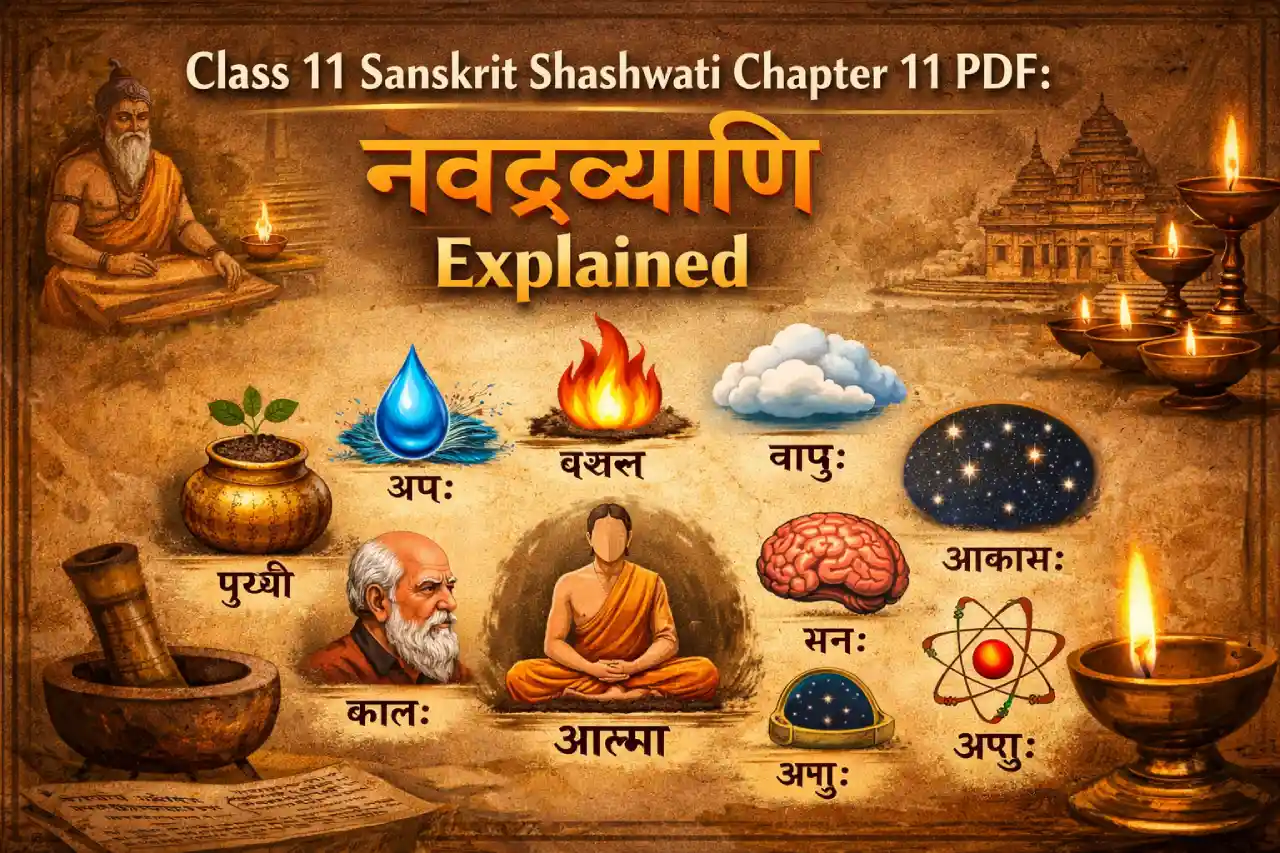
NCERT Class 11 Sanskrit Shashwati Chapter 11, titled “नवद्रव्याणि”, introduces students to an important concept from Indian philosophy—the nine fundamental substances that make up the universe. The chapter explains these elements in a simple and structured way, helping students understand how ancient thinkers tried to explain the nature of reality through observation and logic.

I am writing about this chapter because many students search for the official NCERT PDF along with a simple explanation before exams. In my experience, topics like “नवद्रव्याणि” may feel slightly abstract at first, but once you understand the list and their meanings, it becomes quite easy to remember and revise. This chapter is important not only for Sanskrit exams but also for gaining a basic idea of traditional Indian philosophy. It helps students connect language learning with deeper concepts. Studying from the official NCERT book and revising regularly can make this chapter scoring and easy to handle.

About the Chapter: नवद्रव्याणि

The term “नवद्रव्याणि” means “nine substances.” These are considered the basic elements that exist in the universe according to classical Indian thought.

The chapter explains each of these substances and their role in the functioning of the world.

The Nine Substances Explained

Here is a simple table to understand the nine dravyas:

Sanskrit TermMeaning (Simple English)
पृथ्वी (Prithvi)Earth
आपः (Apah)Water
तेजः (Tejas)Fire
वायु (Vayu)Air
आकाश (Akasha)Space
काल (Kala)Time
दिशा (Disha)Direction
आत्मा (Atma)Soul
मनः (Manas)Mind

These elements together explain the physical and non-physical aspects of existence.

Key Ideas in the Chapter

1. Understanding the Universe

The chapter explains how everything in the world is made up of basic substances.

2. Physical and Non-Physical Elements

Some substances like earth and water are physical, while others like time and soul are abstract.

3. Connection Between Mind and Body

The inclusion of “मनः” (mind) and “आत्मा” (soul) shows the importance of inner consciousness.

Why This Chapter Is Important for Students

  • Helps understand basic philosophical concepts
  • Improves Sanskrit reading and comprehension
  • Important for exam questions and explanations
  • Builds logical and conceptual thinking

Students who understand the list properly can easily score marks.

Study Tips for Chapter 11

  • Memorise the nine dravyas and their meanings
  • Understand the difference between physical and abstract elements
  • Practise writing short explanations
  • Revise regularly using a table format

This makes the chapter easier to revise before exams.

How to Download NCERT Class 11 Sanskrit Shashwati Chapter 11 PDF

Students can download the official chapter PDF from the National Council of Educational Research and Training website by following these steps:

Always use the official NCERT website to ensure you get the correct and updated version.

Leave a Comment

End of Article

Loading more posts...