


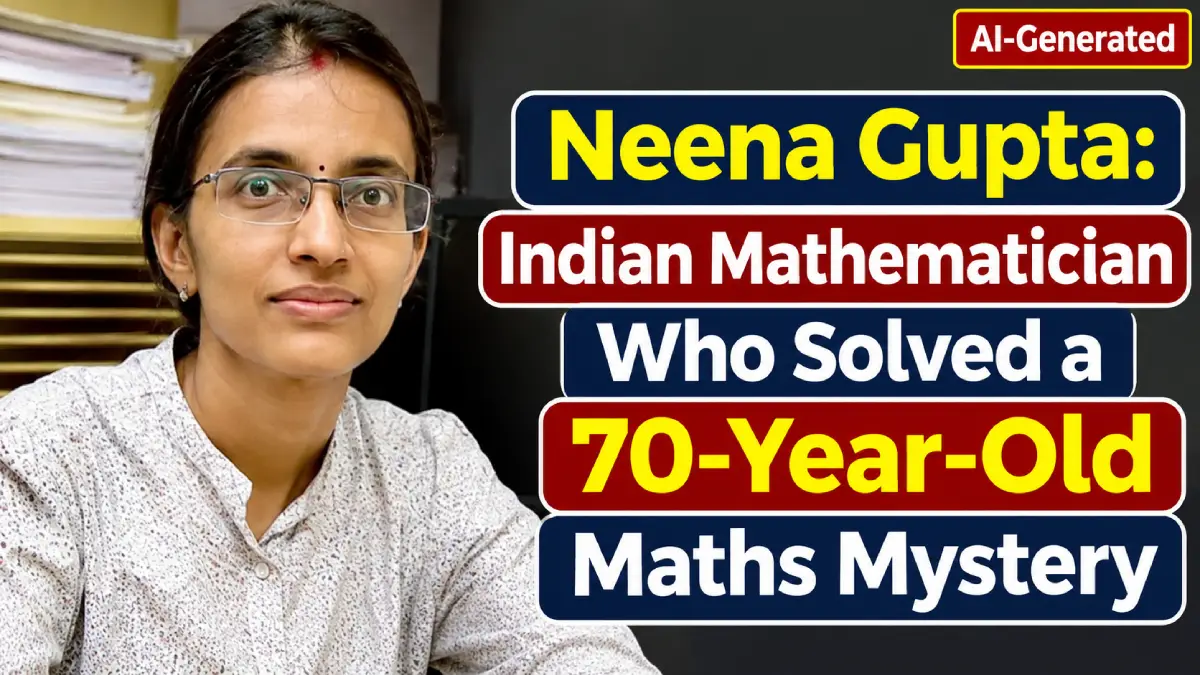
For decades, a mathematical question proposed by one of the pioneers of modern algebraic geometry remained a challenge for researchers. Then came Neena Gupta, an Indian mathematician from Kolkata, whose work offered a breakthrough in the long-standing Zariski Cancellation Problem.
Her research attracted international attention and established her as one of India's notable voices in advanced mathematical research. Today, as a professor at the Indian Statistical Institute (ISI), Kolkata, Gupta's journey is drawing fresh attention to the achievements of Indian women in science and mathematics.
What makes her story particularly interesting is that her achievement did not come from working in a famous international laboratory or moving abroad to pursue research. She built her academic career in India and went on to receive some of the country's and the world's most respected scientific honours.
At a time when women continue to seek greater representation in science, technology, engineering and mathematics (STEM), her journey offers a meaningful example of what dedication to research can accomplish.
The mathematical challenge that brought Gupta international recognition dates back to 1949, when mathematician Oscar Zariski introduced the cancellation problem. In simple terms, it asks whether two mathematical spaces that become equivalent after adding another dimension must necessarily have been equivalent before that addition.
Gupta demonstrated that the answer is not always yes in positive characteristic. Using a three-dimensional affine variety previously constructed by Japanese mathematician Takanori Asanuma, she developed a counterexample that addressed the problem. Her work became a significant contribution to affine algebraic geometry and commutative algebra.
Her academic journey began in Kolkata. She completed her BSc in Mathematics from Bethune College in 2006 before joining the Indian Statistical Institute for postgraduate studies. She earned her master's degree in 2008 and completed her PhD in 2011 under the supervision of Professor Amartya Kumar Dutta.
Recognition followed her research breakthrough. In 2014, she received the Indian National Science Academy's Young Scientist Award. Five years later, she was awarded the prestigious Shanti Swarup Bhatnagar Prize in Mathematical Sciences.
In 2021, Gupta received the DST-ICTP-IMU Ramanujan Prize for Young Mathematicians from Developing Countries, becoming the third woman to receive the honour. She was also conferred the Nari Shakti Puraskar for her contribution to mathematics. Her achievements continued with the Infosys Prize in Mathematical Sciences in 2024.
In 2025, she was selected to deliver the prestigious Emmy Noether Lecture, an honour recognising the contributions of women mathematicians. More recently, her inclusion in TIME's 2026 TIME100 Next India list has brought renewed attention to her work and influence.
Neena Gupta's achievement is not simply about answering a difficult mathematical question. It is also about showing that important scientific discoveries can emerge from research institutions in India. For young students, particularly girls considering careers in mathematics and other STEM subjects, her story sends a powerful message: curiosity, patience and serious academic work can take you much further than you might imagine.



Comments ( 0)
Leave a Comment
No comments yet. Be the first to comment!