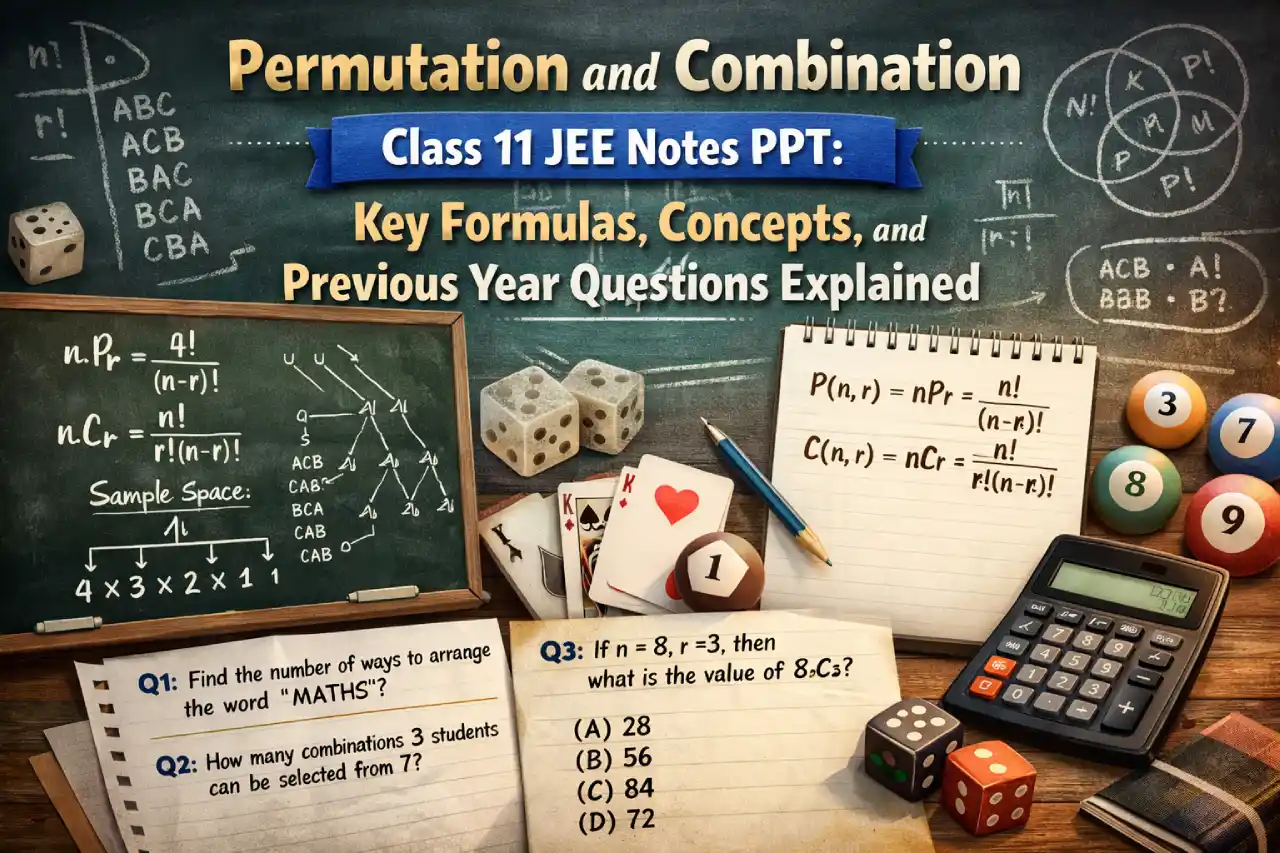
Permutation and Combination is one of the most important chapters in Class 11 Mathematics, especially for students preparing for JEE. It builds the foundation for probability, counting techniques, and many advanced problem-solving strategies. The uploaded PPT-based PDF is part of a structured Maths JEE series (PPT No. 03/06) and focuses entirely on Combination, Conditional Combination, Notable Points, and Previous Year Questions. It presents formulas, concepts, and solved examples in a crisp, exam-oriented format that is ideal for quick learning and revision.
I am writing about this PDF because many students find counting problems confusing due to a lack of clear approach. Permutation and Combination is not about memorising many formulas, but about understanding when and how to apply them. This document simplifies the chapter by breaking it into logical sections and supporting each concept with questions asked in JEE Main and other entrance exams. Knowing what this PDF contains and how to use it can make your preparation more focused and effective.
What This Permutation and Combination PPT Covers
The PPT is divided into four major parts:
- Combination
- Conditional Combination
- Notable Points
- Previous Year Questions
Each section builds step by step from basic formula to exam-level application.
Combination – Basic Concept
Combination deals with selection where order does not matter.
The PDF states the standard formula:
Number of ways of selecting r objects out of n different objects = nCr
For example, the number of ways of selecting 3 objects out of 5 different objects is:
5C3 = 10
The relationship between permutation and combination is also highlighted:
nPr = nCr × r!
This relation helps in converting permutation-based expressions into combination form and vice versa.
Conditional Combination
This section explains selection when certain conditions are imposed.
If k particular objects are:
- Always selected
Number of ways = (n − k)C(r − k) - Never selected
Number of ways = (n − k)Cr
These results are extremely useful in team selection and restricted choice problems.
Examples in the PDF include selecting teams with boys and girls, choosing students from different classes, and selecting objects when some items are fixed or forbidden.
Notable Points and Important Results
The PDF lists several important counting results, such as:
- Number of ways of selecting r objects out of n identical objects = 1
- Number of ways of selecting at least r objects out of n different objects
= nCr + nC(r+1) + … + nCn - Number of ways of selecting at least r objects out of n identical objects
= n − r + 1 - Total number of selections from n different objects while selecting at least one object
= 2ⁿ − 1
These points help in solving conceptual MCQs quickly.
Geometry-Based Combination Problems
Several questions in the PDF involve combinations applied to geometry, such as:
- Number of diagonals in an n-sided polygon
= nC2 − n - Number of triangles formed by joining four points on a circle
= 4C3 - Number of parallelograms formed by two sets of parallel lines
= mC2 × nC2
These types of questions are common in JEE Main.
Download this PPT File: Click Here
Word and Digit Arrangement Problems
The PDF includes problems like:
- Finding the alphabetical position of a word formed by rearranging letters of a given word
- Counting how many times a digit appears while writing numbers from 1 to 1000
- Finding number of ascending and descending digit numbers
These problems strengthen logical thinking and systematic counting.
Team Selection and Distribution Problems
Examples include:
- Selecting teams of boys and girls under given conditions
- Distributing identical balls into distinct boxes with restrictions
- Selecting players from different categories such as bowlers, batsmen, and wicketkeepers
Such questions train students to break complex conditions into simpler cases.
Previous Year JEE Questions
The PPT contains multiple questions from JEE Main, JEE Advanced, AIEEE, and other exams, along with correct options and final answers.
Practising these problems gives students a clear idea of the exam pattern and difficulty level.
How Students Can Use This PPT
- Revise formulas before practice
- Learn conditional combination cases carefully
- Solve previous year questions without looking at answers
- Analyse mistakes and reattempt