


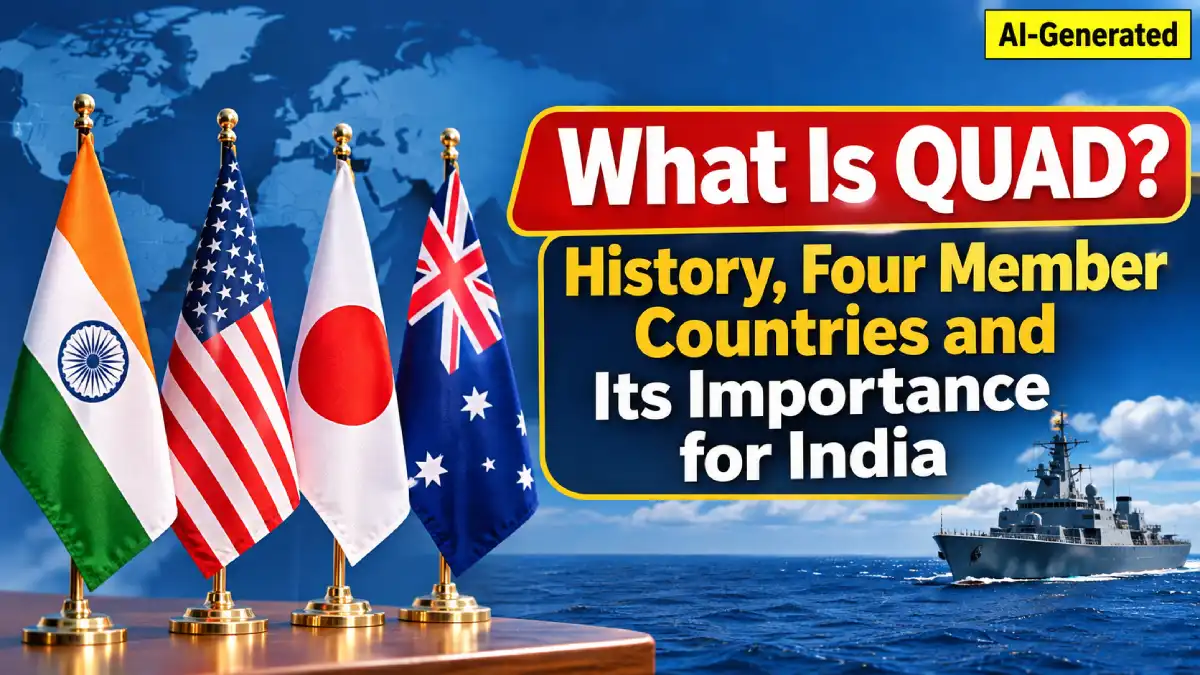
The Quadrilateral Security Dialogue, popularly known as QUAD, has become an important part of discussions on the Indo-Pacific region. It brings together four countries – India, the United States, Japan and Australia – to work on shared concerns involving maritime security, regional stability, economic cooperation and emerging challenges. Although QUAD is not a formal military alliance, its growing diplomatic engagement has attracted attention, particularly as strategic competition and security concerns continue to shape the region.
For India, QUAD is more than a meeting of four governments. It provides a platform to work with important partners on issues such as a free and open Indo-Pacific, secure sea routes, technology and disaster response. Its activities also extend beyond defence-related discussions. Understanding how the grouping started, why it became active again and what its members are trying to achieve helps explain its growing relevance in international relations.
The roots of QUAD go back to December 2004, when India, Australia, Japan and the US worked together to provide relief after the Indian Ocean tsunami. Their cooperation during the disaster created the basis for further discussions. The four countries began a more formal dialogue in 2007, but the initiative did not remain consistently active in the following years.
The grouping gained fresh momentum in 2017, when officials from the four countries revived discussions on regional cooperation. Meetings and consultations gradually became more regular. In 2021, the leaders held their first summit through a virtual meeting, giving the partnership a stronger political profile. Subsequent discussions expanded the agenda beyond traditional security concerns.
One important area of cooperation emerged during the COVID-19 pandemic. QUAD members worked on a vaccine partnership aimed at improving vaccine production and distribution, particularly across the Indo-Pacific. The initiative reflected the grouping's interest in practical cooperation on public health rather than limiting its work to strategic matters.
A meeting of QUAD leaders was held in Manila, the capital of the Philippines, on November 17, 2026, according to the uploaded report. The Philippines also hosted ASEAN-related diplomatic engagements during November, bringing regional cooperation and security issues into focus.
ASEAN, or the Association of Southeast Asian Nations, is a separate regional organisation established in 1967. It includes countries such as Indonesia, Malaysia, Singapore, Thailand, Vietnam and the Philippines, among others. QUAD and ASEAN are not the same organisation, but both are important to discussions about stability, economic development and cooperation in the Indo-Pacific.
The larger purpose of QUAD is to strengthen coordination among its four members while supporting a stable and open regional order. Its work includes maritime security, infrastructure, technology, disaster management, health cooperation and economic resilience. The grouping's future influence will depend on how effectively its members turn shared commitments into practical results.
QUAD is therefore best understood as a strategic partnership rather than a military bloc. Its importance lies in bringing four major Indo-Pacific countries together to discuss common challenges and coordinate their responses.




Comments ( 0)
Leave a Comment
No comments yet. Be the first to comment!