
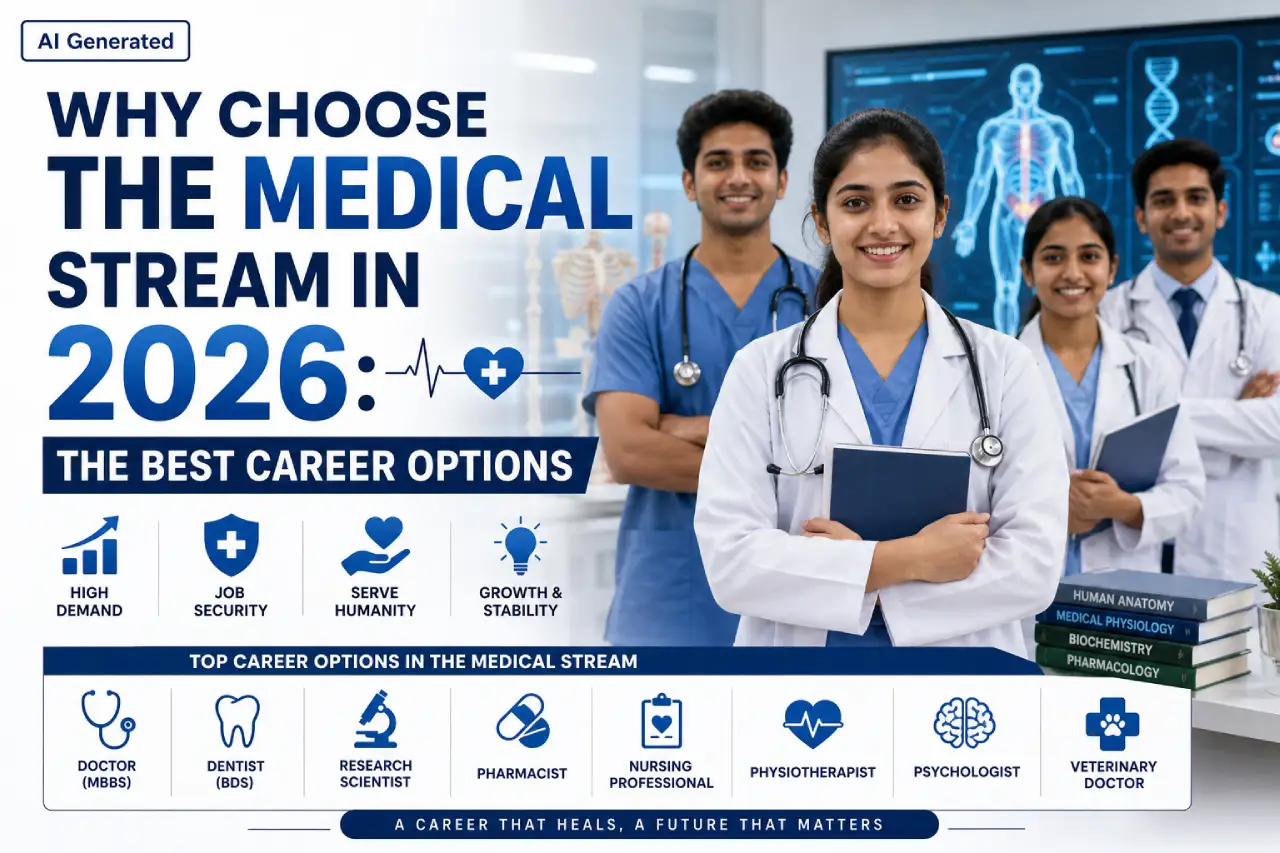
In today's competitive landscape, one of the most significant questions students face after completing Class 10 or 12 is: "Which stream should I choose? Science, Commerce, or Arts?" Among these options, the Medical stream remains, even in 2026, one of the most popular and stable career paths available. This is because the opportunities within this stream extend far beyond simply becoming a doctor; it encompasses a vast array of fields, including research, biotechnology, pharmacy, and public health.
We have personally observed that many students select a stream solely due to external pressure or by blindly following the choices of others. However, failing to make the right decision often leads to regret later on. Therefore, it is crucial to clearly understand why the Medical stream continues to be a robust choice, enabling you to make a well-informed decision regarding your own future.
In today's world, the healthcare sector is growing at a rapid pace. In the post-COVID era, we have all come to realise just how vital healthcare services are. The demand for doctors, nurses, and lab technicians has surged; new hospitals, clinics, and diagnostic centres are being established; and alongside this, telemedicine and digital healthcare are also on the rise. Consequently, students pursuing a medical stream enjoy a significantly higher level of job security.
The Medical stream primarily refers to that branch of the Science stream where Biology serves as the core subject. Typically, the subjects included are Physics, Chemistry, and Biology. This specific combination is known as PCB. By choosing this stream, you become eligible for medical-related career paths.
Many people assume that the "medical stream" suggests nothing other than an MBBS degree. In reality, however, that is far from the truth. Within the medical stream, you can pursue careers as a Doctor (MBBS, BDS, BHMS), Pharmacist, Physiotherapist, Microbiologist, Biotechnologist, Nutritionist, or Public Health Expert. In other words, the range of options is quite wide and flexible.
In today's world, the healthcare sector is growing at a rapid pace. In the post-COVID era, we have all come to realise just how vital healthcare services are. (I) The demand for doctors, nurses, and lab technicians has surged; (II) new hospitals, clinics, and diagnostic centres are being established; and (III) telemedicine and digital healthcare services are also on the rise. Therefore, students pursuing a medical stream enjoy a significantly higher level of job security.
If you intend to pursue the medical stream, there are certain things you need to understand beforehand: you must have a genuine interest in Biology, possess the mindset to work hard, and be prepared for long-term study. This is because success in the medical field does not happen overnight; it takes time.
It is not the case that everyone must pursue a medical career. However, for those who are interested in the human body and health, love studying Biology, wish to help others, and are seeking a stable career, this is an excellent option.
Like any other field, this stream presents its own set of challenges: the academic workload is heavy, competition is intense, and the course duration is extensive. Therefore, these factors must be taken into consideration before making a decision. The healthcare sector is projected to continue growing in 2026 and beyond, particularly in areas such as AI in healthcare, genetic research, and biotechnology innovations. Possessing a medical background opens up significant opportunities in these fields as well.




Comments ( 0)
Leave a Comment
No comments yet. Be the first to comment!