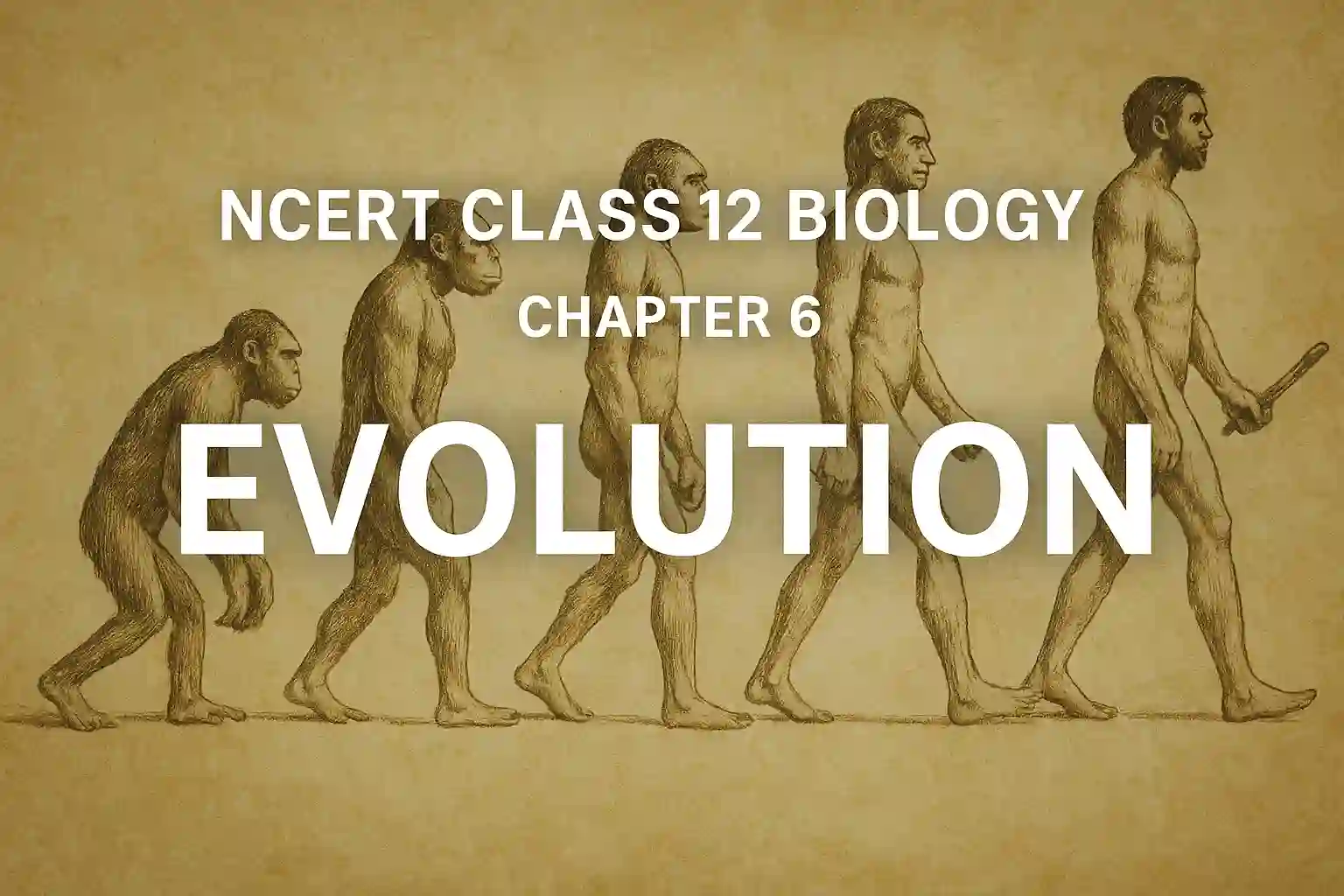
Chapter 6 of Class 12 Biology, titled Evolution, deals with the origin of life, the development of different life forms over millions of years, and the various theories and evidence supporting this process. It explains concepts like natural selection, speciation, adaptive radiation, and human evolution. Students often find this chapter both interesting and a bit philosophical because it touches upon how life began and how we, as humans, came into existence.
I am writing about this topic because it’s one of the most thought-provoking chapters in the NCERT Class 12 Biology book. Evolution is not just theory-based, it connects biology with history, geography and even geology. Many students prepare this chapter lightly, thinking it’s all theory, but it often has tricky conceptual questions in board exams and NEET. Understanding Darwin’s natural selection, differences between Lamarckism and Darwinism, and how fossils and molecular evidence support evolution is important to answer those questions confidently. That’s why I’ve explained the chapter in a simple way and also shared how to download the official NCERT PDF so you can study directly from the source.
Key Concepts of Evolution – Class 12 Biology
Let’s go through the main ideas and topics covered in Chapter 6 of the NCERT textbook.
Origin of Life
- The Earth formed around 4.5 billion years ago
- First life forms appeared nearly 500 million years later
- Early atmosphere had methane, ammonia, hydrogen and water vapour
- Oparin-Haldane theory: life originated from organic molecules in a “primordial soup”
- Miller-Urey experiment (1953) supported this theory by creating amino acids in lab conditions
Theories of Evolution
- Lamarckism: Proposed by Jean-Baptiste Lamarck. He believed that traits acquired during life could be inherited
- Darwinism (Natural Selection): Proposed by Charles Darwin. Only those organisms which are better adapted survive and reproduce
- Mutation Theory: Hugo de Vries said that mutations, not gradual changes, are responsible for evolution
Evidence of Evolution
- Fossils: Help track changes in species over time (e.g. Archaeopteryx – link between reptiles and birds)
- Homologous organs: Same structure, different function (e.g. forelimbs of humans and whales)
- Analogous organs: Different structure, same function (e.g. wings of birds and insects)
- Vestigial organs: Organs that no longer serve a function (e.g. human appendix)
- Molecular Evidence: Similarity in DNA, RNA and proteins among different species
Mechanism of Evolution
- Variation: Exists in every population
- Mutation: Sudden change in genes
- Genetic Drift: Random change in gene frequency
- Gene Flow: Movement of genes between populations
- Natural Selection: Favouring of traits that increase survival
- Speciation: Formation of new species from existing ones
Adaptive Radiation
- When a common ancestor gives rise to different species in different environments
- Example: Darwin’s finches in Galapagos Islands with different beak shapes for different diets
Human Evolution
- Humans and chimpanzees share a common ancestor
- First human-like ancestors (e.g. Australopithecus) appeared about 4 million years ago in Africa
- Modern humans (Homo sapiens) evolved about 200,000 years ago
- Evolution involved changes in posture (bipedalism), brain size, tool use, and culture
Important Table – Differences in Evolution Theories
| Feature | Lamarckism | Darwinism |
|---|---|---|
| Type of Change | Acquired traits | Inherited traits |
| Mechanism | Use and disuse of organs | Natural selection |
| Example | Giraffe’s neck growing longer | Giraffes with long necks survived |
| Acceptance | Discarded | Widely accepted |
Download PDF – NCERT Class 12 Biology Chapter 6
To download the official and updated NCERT PDF for Chapter 6, follow the steps below: