
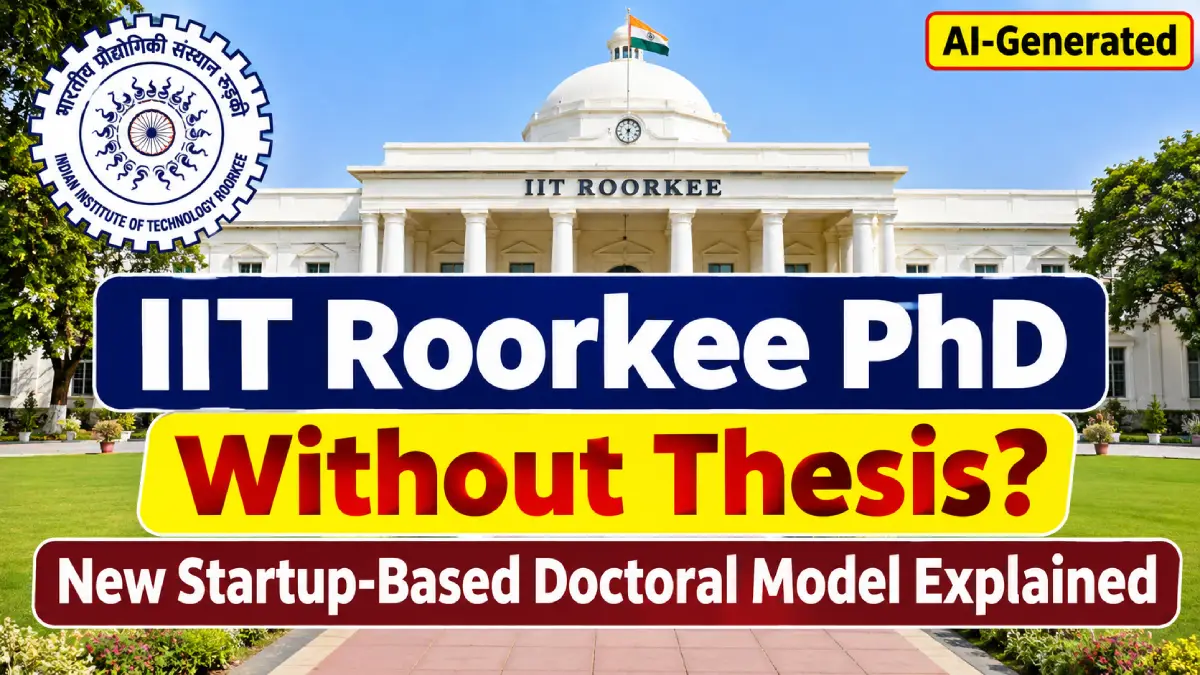
The Indian Institute of Technology (IIT) Roorkee has reportedly introduced a new approach to doctoral education that could change how students pursue a PhD. Under the proposed startup-based model, research scholars may be able to complete their doctoral studies by developing a product and demonstrating its commercial potential instead of relying solely on a conventional thesis. The model places greater emphasis on innovation, entrepreneurship and practical problem-solving, with students expected to generate revenue of up to ₹10 lakh through their product.
The development could be particularly interesting for students who want to turn their research ideas into real-world products rather than limiting their work to academic publications. By connecting doctoral research with entrepreneurship, the model aims to encourage innovation and help students develop solutions that can be used in the market. It also highlights a growing discussion within higher education about whether research should be evaluated only through written dissertations or through practical achievements and measurable impact.
According to the information shared in the report, the new model offers students three possible routes to complete their PhD. One option involves developing a product or technological innovation that addresses a real-world problem and has the potential for commercial use. Students would need to demonstrate the value of their innovation and its relevance to the market.
Another route focuses on research-based innovation, where students can use their technical work to develop a product, technology or solution with practical applications. The model is expected to encourage scholars to work on projects that can benefit industries, businesses or society.
The third option reportedly allows students to develop a startup around their research idea. Through this route, scholars would be encouraged to build a business model, develop their product and demonstrate its potential for generating revenue.
The report suggests that students following the startup-based approach may need to generate approximately ₹10 lakh through their product or innovation as part of the proposed doctoral requirements. This could make the programme different from traditional PhD pathways, where the main focus is generally on research papers, a thesis and academic evaluation.
The idea behind the initiative is to bring academic research closer to entrepreneurship. Students could gain experience in product development, business planning, innovation and commercialisation while pursuing their doctoral degree.
However, students interested in this model should carefully check the official IIT Roorkee guidelines regarding eligibility, evaluation criteria, research requirements and the exact conditions for completing the PhD. The details of the programme and its implementation will be important for understanding how the new system works in practice.
If implemented as described, the initiative could provide a new direction for doctoral education in India, particularly for students who want to combine research with entrepreneurship and develop innovations that have practical value.


Comments ( 0)
Leave a Comment
No comments yet. Be the first to comment!