
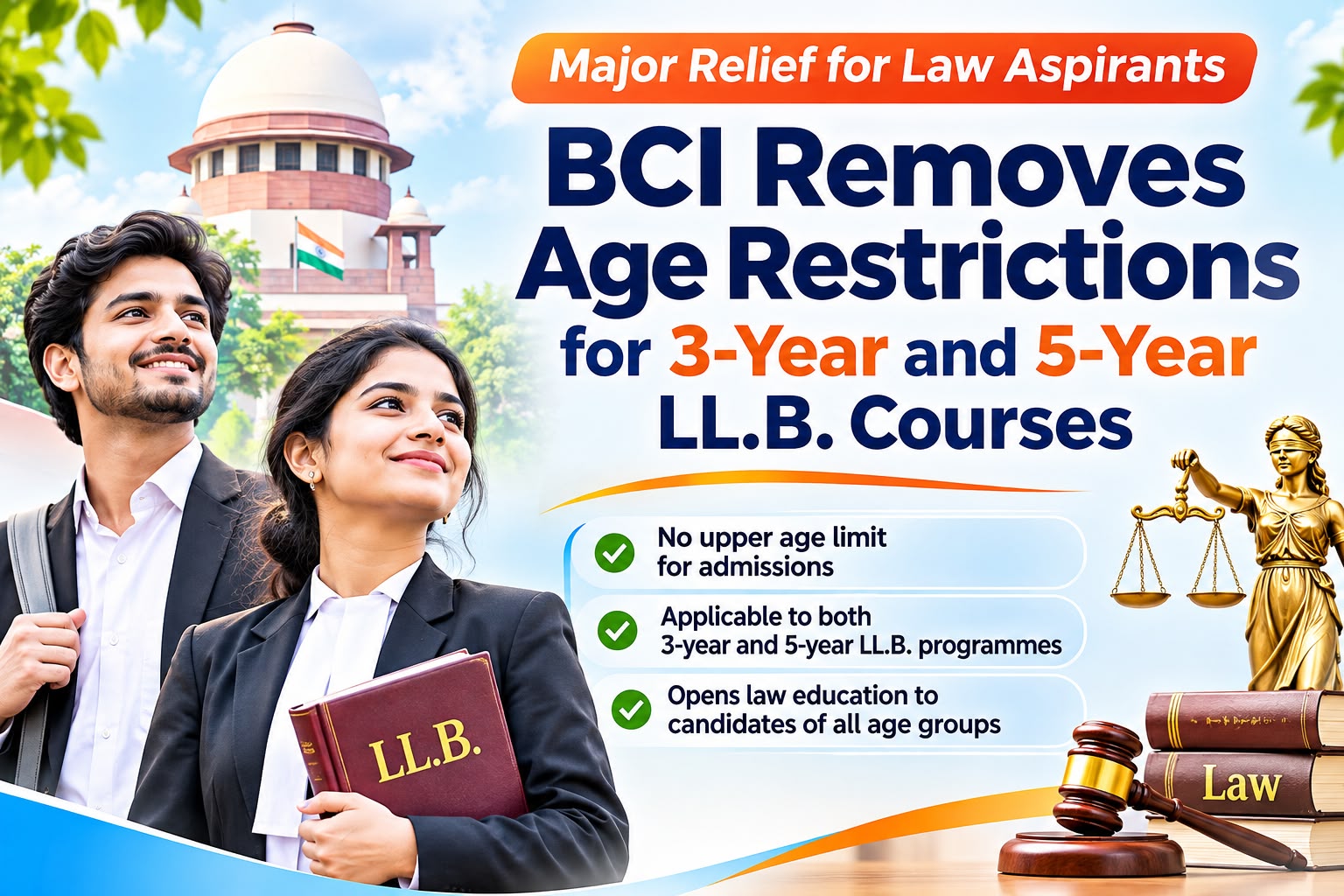
The Bar Council of India (BCI) has withdrawn the upper age restrictions for admission to three-year and five-year Bachelor of Laws (LL.B.) programmes, removing an important barrier for candidates who wish to pursue legal education later in life.
The decision allows aspiring law students to seek admission regardless of their age, provided they fulfil the other academic and admission requirements prescribed by the relevant universities and institutions.
The development was formally brought before the Supreme Court of India on November 6, 2026, following a resolution passed by the BCI General Council on November 5, 2026.
Supreme Court takes more of BCI's decision
The development came during the hearing of a long-pending petition challenging the age restrictions imposed under the BCI’s Rules of Legal Education, 2008.
The matter, titled Rishabh Duggal v. Bar Council of India, was heard by a three-judge Bench comprising Chief Justice of India Surya Kant, Justice Joymalya Bagchi and Justice V. Mohana.
During the proceedings, the BCI informed the Court that its General Council had resolved to withdraw the upper age restrictions. Taking the decision on record, the Supreme Court disposed of the petition as having become infructuous.
The Court’s action followed the regulatory body’s decision to withdraw the disputed restrictions. The petition was not decided on its constitutional merits.
What has chayfor law aspirants?
The withdrawal covers both major undergraduate law education pathways in India:
1. Three-year LL.B. programme
The three-year LL.B. course is designed for candidates who have already completed their undergraduate education in any discipline.
Previously, age-related restrictions under the BCI framework had created difficulties for graduates who wanted to enter the legal profession after pursuing other careers or taking a break from education.
With the withdrawal of the upper age restriction, older graduates can also consider applying for the programme, subject to the applicable admission requirements.
2. Five-year integrated LL.B. programme
The five-year integrated law programme is generally pursued after Class 12. Popular options include BA LL.B. and BBA LL.B.
The removal of the age restriction also opens this pathway to candidates who may have completed their school education several years earlier but now wish to study law.
Why were the age restriction controversial?
The issue has remained contentious for several years.
The BCI’s Rules of Legal Education, 2008, included age-related provisions under Clause 28 of Schedule III. These provisions prescribed maximum admission ages for candidates applying to integrated and three-year law programmes.
The restrictions were withdrawn in 2013 but subsequently reinstated through a BCI circular issued in September 2016.
The move led to legal challenges and proceedings before different courts, creating uncertainty for aspiring law students.
The latest resolution represents a significant change in the BCI’s regulatory position on the issue.
Who stands to benefit?
The decision could benefit several groups of prospective students, including:
* Working professionals interested in changing their careers and entering the legal field.
* Graduates who could not pursue law immediately after completing their first degree.
* Women returning to higher education after family or career responsibilities.
* Individuals interested in developing expertise in constitutional law, corporate law, criminal law and other legal specialisations.
* Candidates who were previously unable to apply because they exceeded the prescribed age limits.
It also provides an opportunity for people who want to pursue legal education as a second academic qualification.
What eligibility conditions remain applicable?
The withdrawal of the upper age limit does not mean that admission to LL.B. programmes is automatic. Candidates must continue to satisfy the academic and other eligibility conditions applicable to their chosen institutions.
The basic distinction between the two courses remains:
Admission requirement Three-year LL.B. Five-year integrated LL.B.
Basic qualification Bachelor’s degree Class 12 or equivalent
Course duration 3 years 5 years
Course structure Standalone law degree Integrated undergraduate and law degree
Upper age restriction Withdrawn Withdrawn
Candidates must also check minimum qualifying marks, entrance examination requirements, reservation provisions and university-specific admission rules.
Depending on the institution, admission may involve examinations such as CLAT, AILET or state-level law entrance tests.
Applicants should carefully read the latest admission notifications and prospectuses before submitting applications.
A significant opportunity for aspiring law students
The withdrawal of the age restrictions marks an important development in access to legal education in India. It provides greater flexibility to people who wish to enter the legal field without being restricted by the number of years since completing their school or undergraduate education.
For working professionals, graduates and individuals considering a second career, pursuing an LL.B. is now a more accessible option from an age-eligibility perspective.
The change also reinforces the importance of academic qualifications, professional training and institutional standards rather than treating age alone as a barrier to beginning legal studies.
Aspiring candidates should follow the forthcoming admission notifications issued by universities, state admission authorities and recognised law institutions to understand how the revised position will be implemented for their respective admission cycles.




Comments ( 0)
Leave a Comment
No comments yet. Be the first to comment!