
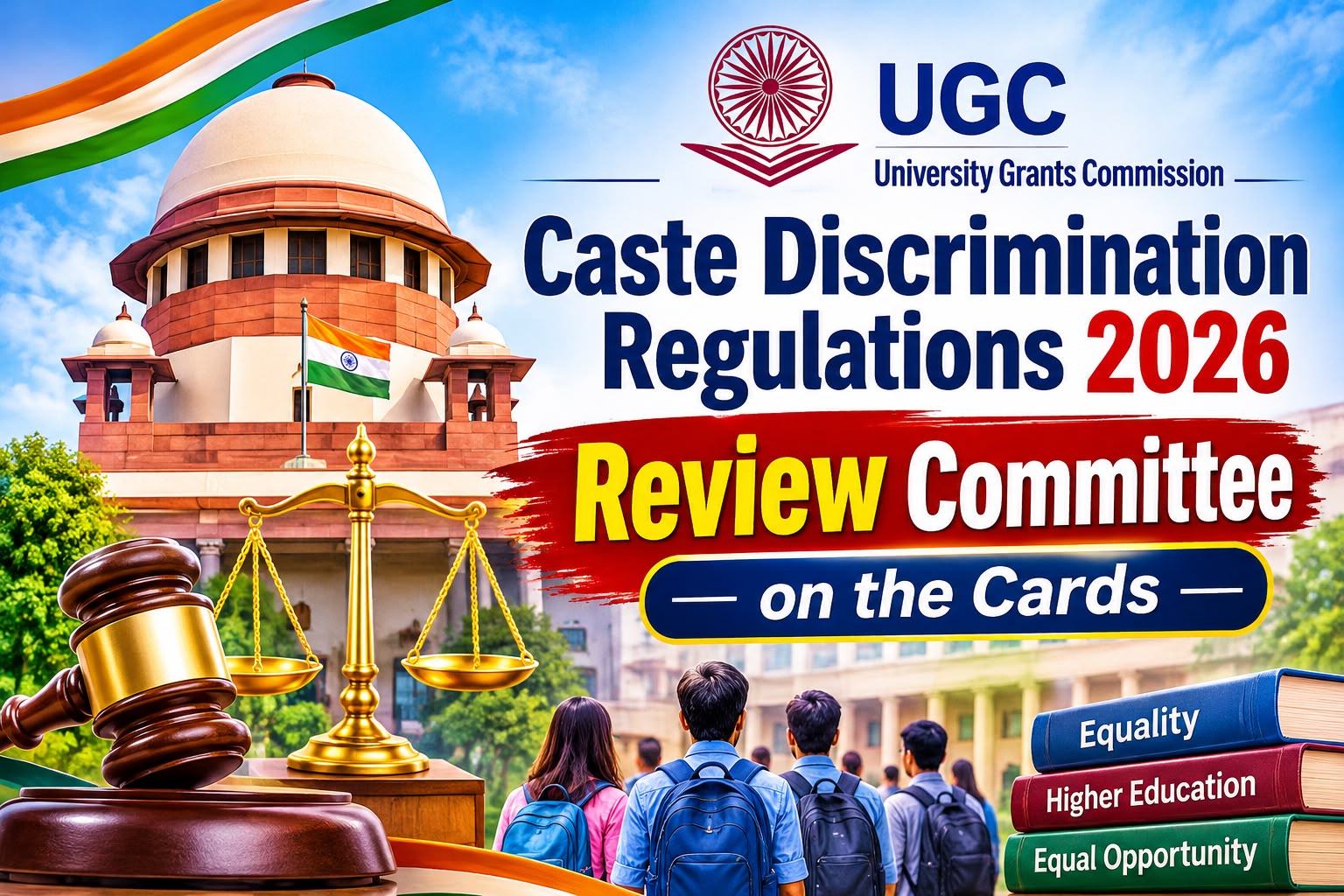
The Union Government is considering the formation of a committee to review the University Grants Commission's 2026 regulations on caste discrimination in higher educational institutions. The development emerged during proceedings before the Supreme Court of India, where several petitions have challenged the framework of the new rules.
Solicitor General Tushar Mehta, representing the Central Government, informed a bench headed by Chief Justice of India Surya Kant and comprising Justice Joymalya Bagchi that the government was examining the possibility of setting up a committee to reconsider the regulations.
The government's position is that the concerns of all students must be addressed and that no section of the student community should feel excluded or apprehensive.
Supreme Court stresses protection of all students
During the hearing, the Supreme Court emphasised the importance of ensuring that the interests of every student are protected. The bench also raised the possibility of revisiting the regulations to address concerns surrounding their implementation.
Responding to the Court, Mehta indicated that the government was contemplating a committee to examine the matter.
The proceedings were part of a batch of petitions challenging the University Grants Commission (Promotion of Equity in Higher Education Institutions) Regulations, 2026.
Following the government's submission, the Supreme Court deferred further consideration of the matter.
Why are the UGC regulations facing legal challenges?
The regulations were notified on January 13, 2026, and apply to higher educational institutions across India.
They were introduced to strengthen institutional mechanisms for preventing discrimination and promoting equity in higher education.
Under the framework, universities and other covered institutions are required to establish:
Equal Opportunity Centres: To support policies and programmes aimed at disadvantaged groups.
Equity Committees: To examine complaints relating to discrimination and facilitate institutional action.
However, the provisions concerning eligibility to access the grievance redressal mechanism have become a major point of legal disagreement.
The petitioners have argued that the framework excludes students belonging to the general category from filing complaints under the specified mechanism, while providing protections linked to particular social categories, including Scheduled Castes (SC), Scheduled Tribes (ST) and Other Backward Classes (OBC).
They have questioned whether access to institutional protection and complaint mechanisms can be restricted on the basis of caste identity.
The petitioners have also sought directions preventing the implementation of the regulations in their existing form.
Regulation remain on hold pending further proceedings
The controversy has extended beyond the courtroom, with protests and objections being raised over the potential impact of the regulations on students from different social backgrounds.
The Supreme Court had earlier directed that the 2026 regulations be kept in abeyance. Consequently, the rules have not proceeded with implementation under the original framework.
The latest submission by the Centre indicates that the government is considering a further examination of the disputed provisions rather than treating the existing framework as final.
What happens next?
The proposed committee is still under consideration. Its constitution, composition, terms of reference and timeline have not been formally established in the proceedings described.
The central issue remains how to create an effective system against caste-based discrimination while ensuring that grievance redressal mechanisms are accessible and fair to all students.
Any revision of the regulations could have implications for universities, colleges, students and institutional authorities across the country.
The next steps will depend on the Central Government's decision regarding the proposed committee and the hu subsequent proceedings before the Supreme Court.




Comments ( 0)
Leave a Comment
No comments yet. Be the first to comment!