
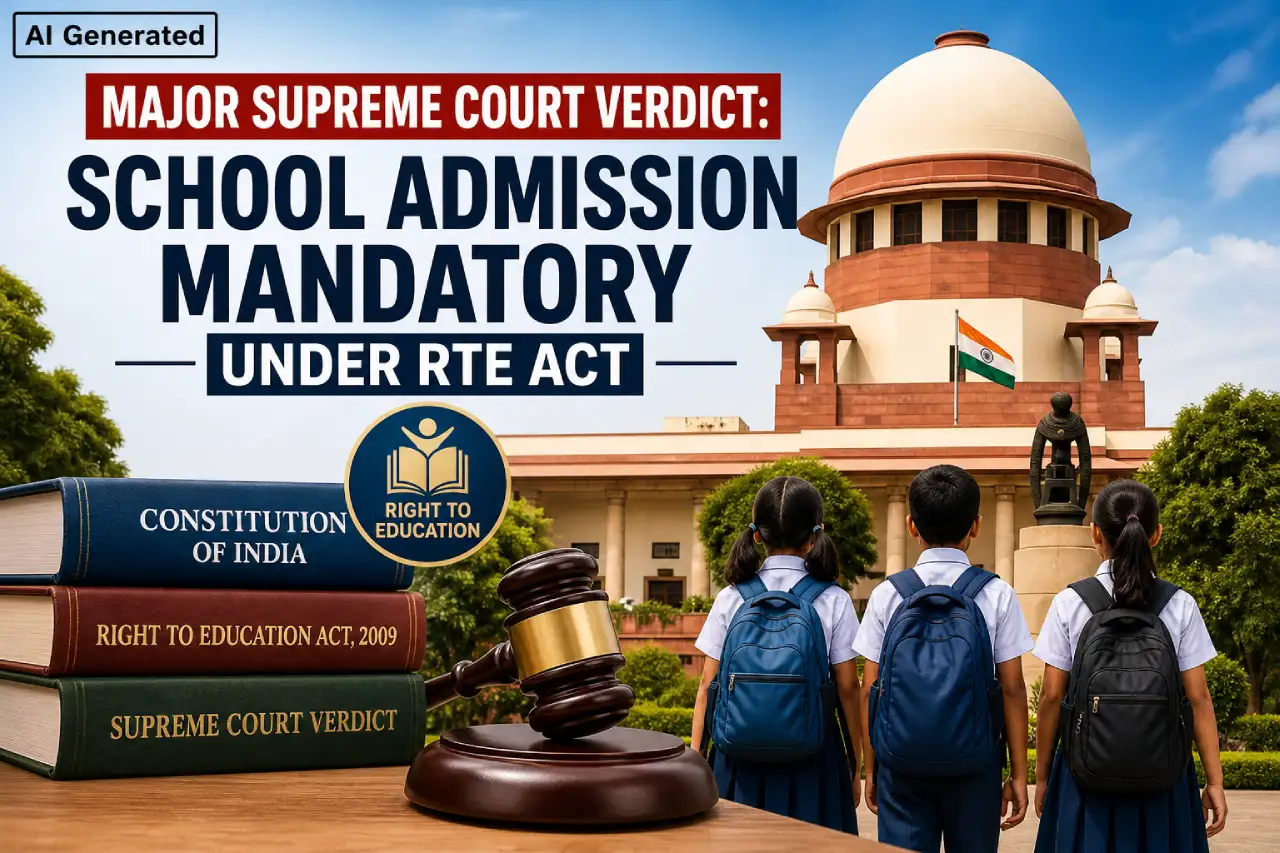
A significant ruling regarding the Right to Education has appeared today. The Supreme Court of India has clearly stated that, under the Right to Education (RTE) Act, schools are required to admit students appointed to them. In this verdict, the Court characterised this task as a "national mission," declaring that no school, whether private or government-run, may disregard the list of students forwarded by the State authorities. As a result of this decision, the path to education has become significantly clearer for millions of students across the country.
This is not only a legal ruling; rather, it is a matter directly tied to the lives of the common people. This verdict holds particular significance for those belonging to economically disadvantaged sections of society. It is often observed that many students, despite being eligible, are unable to secure admission to schools. This ruling marks a major stride toward resolving this issue—a development that is essential for everyone to be aware of.
A bench comprising Justice PS Narasimha and Justice Alok Aradhe observed that the Right to Education is enshrined under Article 21A of the Constitution; denying admission to students belonging to weaker and disadvantaged sections amounts to a violation of their fundamental rights, and this legislation serves as a vital instrument for helping equality within society. The Court further stated that if this provision is not effectively implemented, the Right to Education will remain confined merely to paper.
The Court explicitly clarified that, under the Right to Education Act, the reservation of 25 per cent of seats is not only a formal rule but a mandatory requirement. Schools are bound to admit students in agreement with the lists provided by the State Government; they are neither allowed to question this decision nor to effect any changes to their own advantage.
This order is of immense significance for several reasons: private schools have been brought under the range of accountability; opportunities for students from underprivileged families will expand; equity and inclusivity in education will be ensured; and the social fabric will be strengthened. We believe that such decisions will, in the long run, further reinforce the country's education system.
This case centred on a private school in Lucknow that had refused to admit a student selected under the provisions of the RTE Act. The court dismissed the school's plea, ruling that once the government selects a student, the school has no alternative—it is bound to grant admission.


Comments ( 0)
Leave a Comment
No comments yet. Be the first to comment!