

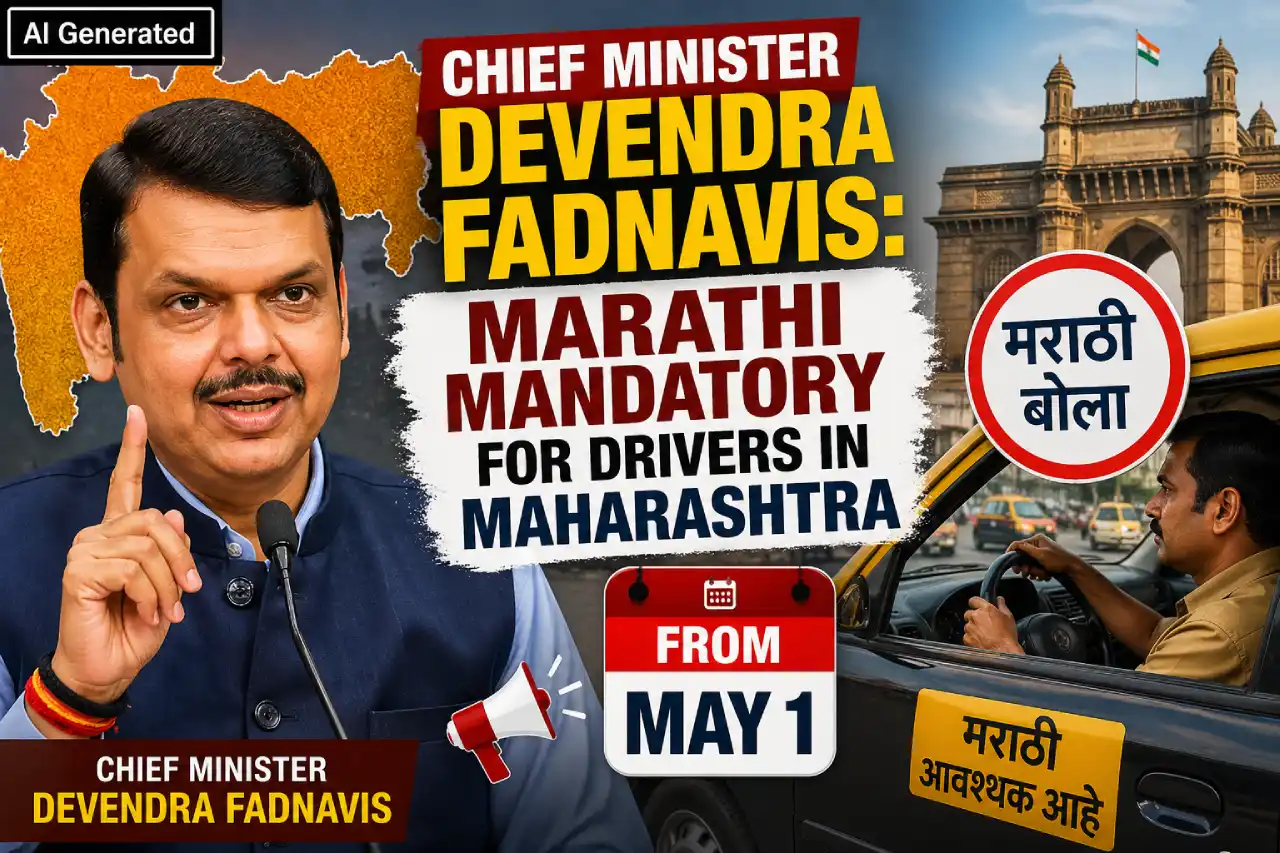
It has recently come to light that political and social talk is reaching a fever pitch in Maharashtra following a decision to make a basic command of the Marathi language mandatory for auto-rickshaw and taxi drivers, effective May 1, 2026. Among this controversy, Chief Minister Devendra Fadnavis has publicly approved the government's decision. He claimed that requiring those who reside and work in Maharashtra to possess knowledge of the local language is not an unreasonable demand. However, he also issued a clear warning that no violence committed in the name of language would be tolerated.
In the current context, this decision raises three distinct issues: language, employment, and regional identity. On one hand lies the essential need to uphold the self-respect of the local language; on the other, the livelihoods of a vast number of working-class people welcoming from other states. In my view, this issue rises above only politics; it constitutes an intense question concerning real life.
According to a government decision, this rule is scheduled to come into effect on May 1, 2026. The matter has garnered increased attention as it happens with Maharashtra Day. The State Transport Department has announced that auto-rickshaw and taxi drivers operating within Maharashtra must be able to speak basic Marathi. Those unable to do so may face difficulties during the renewal of their licenses.
Chief Minister Fadnavis stated that it is not an unreasonable demand for residents of Maharashtra to know the local language; he urged people not to be nervous, assuring them that the government would facilitate language learning and that violence in the name of language would not be tolerated. In my opinion, he has attempted to strike a balance between acknowledging local sentiments on one hand and carrying a message of peace on the other.
This decision has been supported by the Maharashtra Navnirman Sena and the Shiv Sena (UBT). Additionally, Transport Minister Pratap Sarnaik is in favour of this policy. On the other hand, however, Sanjay Nirupam has opposed this decision. According to him, this could badly affect the livelihoods of many non-Marathi-speaking drivers. He believes it would be better not to make this mandatory.
The government has announced that training programs will be introduced for those who cannot speak Marathi. Marathi litterateurs, language organisations, and teams of trainers have been engaged for this ambition. Furthermore, easy-to-learn study materials will also be developed.


Comments ( 0)
Leave a Comment
No comments yet. Be the first to comment!