


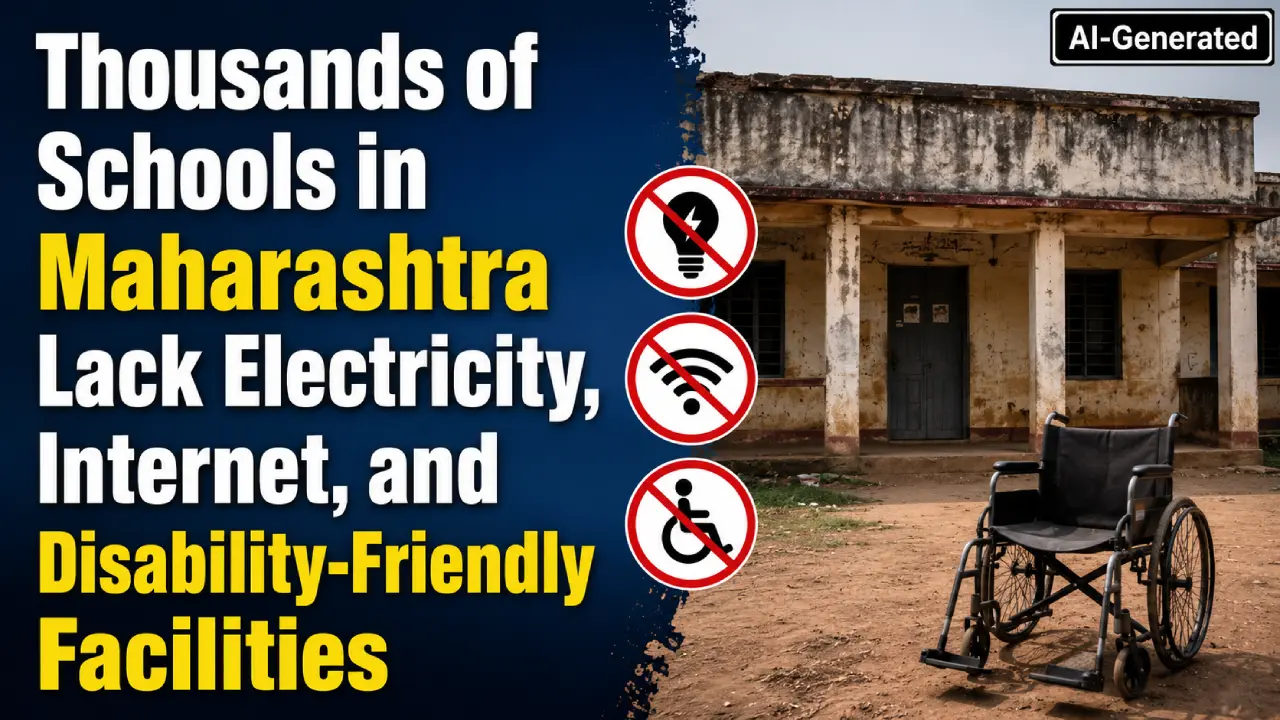
With the expansion of education in Maharashtra, thousands of government and private schools still lack basic infrastructure. The UDISE+ 2025–26 report, released by the Union Ministry of Education, reveals that many schools in the state still lack electricity, internet connectivity, functional computers, playgrounds, libraries, and necessary facilities for students with disabilities. These statistics have raised fresh questions regarding the quality of education and the overall school environment.
According to the Union Ministry of Education's Unified District Information System for Education Plus (UDISE+) 2025–26 report, Maharashtra currently has a total of 108,139 schools, over 2 crore 16 lakhs students, and more than 7,50,000 teachers. The report indicates a total student population of 21,632,669, comprising 11,162,457 boys (51.6%) and 10,470,212 girls (48.4%). Additionally, there are 750,272 teachers in total; this translates to an average of approximately 200 students and 7 teachers per school.
One of the major concerns highlighted in the report is the lack of good infrastructure for students with disabilities; specifically, 32,228 schools lack separate toilets for these students, and 16,341 schools do not have ramps equipped with handrails. So, students with physical disabilities often face significant difficulties in commuting to school and accessing classrooms.
Although the importance of digital education is regularly increasing, many schools remain poor in this facility. While 90,419 schools have computers, only 84,530 have functional ones; this means that 23,609 schools lack usable computers. Furthermore, 23,855 schools still lack internet connectivity. So, many students are being deprived of opportunities for online and digital education.
Although many schools have electricity connections, in many places these are not functional. Reports indicate that 93,999 schools have functional electricity connections, while 3,201 schools lack any connection at all; meanwhile, 10,938 schools have connections that are not functional.
Reports further reveal that 2,019 girls' toilets are unusable, while 3,280 boys' toilets are in a non-functional state. There are no playgrounds in 3,932 schools, and 1,099 schools lack libraries or book banks. Only 13,550 schools have digital libraries, whereas 94,589 schools lack this facility.
Many schools in Maharashtra still lag behind in the adoption of solar energy; while 23,822 schools have solar power systems, 84,317 schools have yet to start using solar energy. Additionally, 65,591 schools have kitchen gardens, whereas 42,548 do not.
Not all the information is concerning; there has been significant improvement in some areas. For instance, all 108,139 schools have drinking water facilities; 107,409 schools have hand-washing facilities; and 102,866 schools conduct annual health check-ups for students.
I am highlighting these facts because an increase in school enrollment alone does not compare to improved educational quality; a safe, modern, and inclusive learning environment is essential.
Access to electricity, digital facilities, clean restrooms, and disability-friendly infrastructure is crucial for ensuring that every student can pursue their education with equal opportunities. Therefore, the data presented in the UDISE+ report is equally significant for parents, teachers, students, and educational administrators.


Comments ( 0)
Leave a Comment
No comments yet. Be the first to comment!