
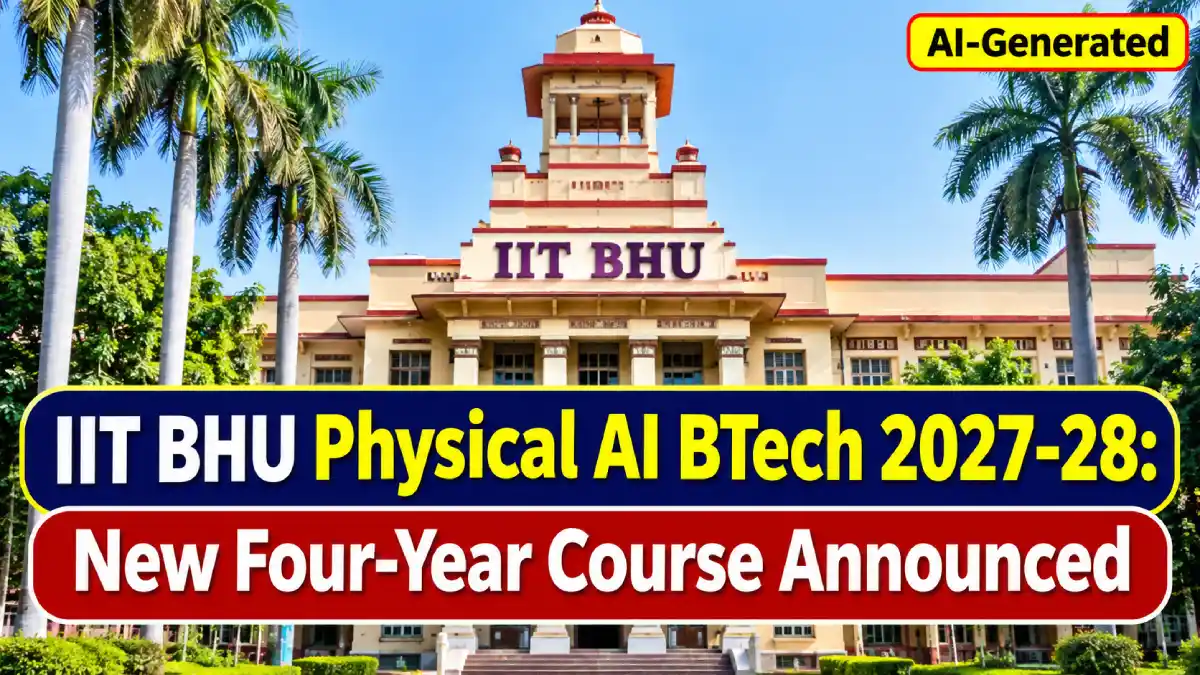
The Indian Institute of Technology (BHU), Varanasi, is preparing to introduce a four-year BTech programme in Physical Artificial Intelligence (AI) from the 2027-28 academic session. The institute has approved the establishment of a School of Physical AI, marking a new step in its efforts to expand technology-focused education.
Unlike conventional AI courses that largely deal with software and computer-based applications, the proposed programme will focus on combining artificial intelligence with physical machines, robotics, sensors and intelligent systems.
The new programme could attract students interested in working with technologies that connect digital intelligence with the real world. As AI becomes increasingly important in manufacturing, healthcare, agriculture and space research, the ability to develop machines that can sense their surroundings and act independently is gaining importance.
IIT BHU plans to build the course around practical learning, giving students opportunities to understand not only how AI software works but also how intelligent machines are designed, tested and operated.
The institute's Senate approved the proposal at its meeting on October 17, after which preparations for the new school began. An eight-member coordination committee has also been formed under the leadership of IIT BHU Director Professor Amit Patra to oversee the establishment and functioning of the school. Professor Rajesh Kumar will serve as its vice-chairman. The institute has also started work on arranging the academic and administrative support required for the programme.
A dedicated team of 27 faculty members has been put together to develop the teaching framework. The institute is also planning to strengthen its academic resources and infrastructure before the course begins. According to the report, the establishment of the School of Physical AI will involve an estimated investment of ₹35 crore.
Physical AI is different from the software-based AI applications people commonly use today. It brings artificial intelligence into machines and physical systems, allowing them to understand their surroundings through sensors, process information and respond through physical actions. Robots, autonomous vehicles and intelligent industrial equipment are examples of technologies that can use this approach.
The proposed four-year BTech curriculum will cover areas such as robotics, autonomous systems, machine control, sensor-based technologies and practical applications of AI. Students will be expected to gain experience beyond programming, including the design, construction and testing of intelligent machines. The programme will also explore how these technologies can address real-world challenges across different industries.
The School of Physical AI will become the fifth school at IIT BHU, adding to its existing academic schools in Biomedical Engineering, Biochemical Engineering, Decision Sciences and Material Science. The institute is preparing the new programme as part of its wider effort to strengthen interdisciplinary education and research.
With the proposed launch scheduled for 2027-28, IIT BHU's Physical AI programme could open a new academic pathway for students interested in the next generation of intelligent machines. Further details about admission eligibility, entrance requirements, seat availability and the application process are yet to be announced. Prospective applicants should wait for the institute's official admission notification before making plans.
Official Website: Click Here



Comments ( 0)
Leave a Comment
No comments yet. Be the first to comment!