A renewed national debate regarding equity within India's higher education system has recently came out. The publication of the University Grants Commission's new "Promotion of Equity in Higher Education Institutions Regulations, 2026" has sparked intense discussion among teachers, students, and the general public. While some view these regulations as a positive step, others deem them vague and fraught with the potential for misuse. The Supreme Court of India has already issued a stay order on the implementation of these regulations.
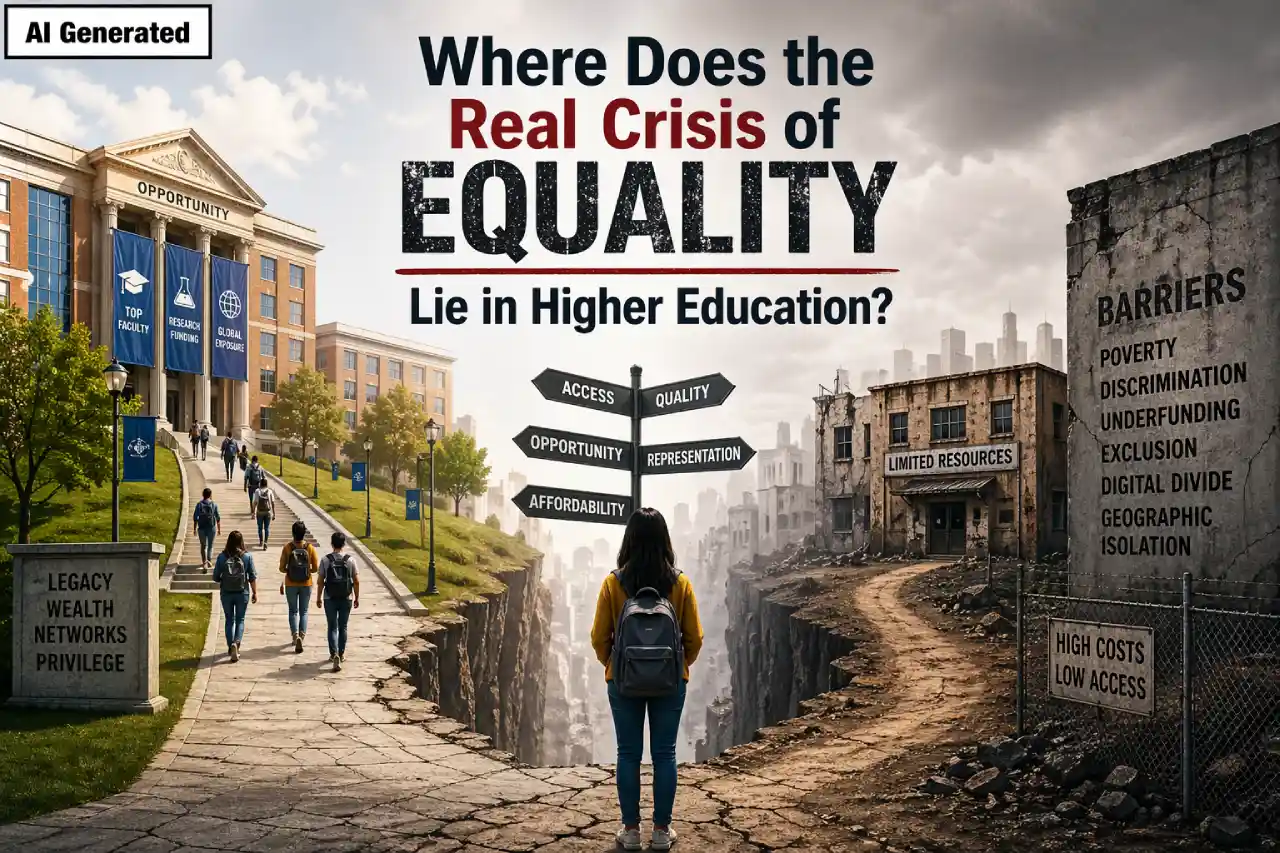
Equity in higher education entails more than only formulating rules; it is crucial to understand in practical terms who is actually gaining access to opportunities, who is being left behind, and where disparities still continue. In my view, discussions on this subject should be grounded not only in slogans but in data and ground realities. This ongoing debate has provided us with such an opportunity.
The objective of the UGC's new regulations was to enhance equity and reduce discrimination within higher education institutions. However, many have alleged that the language of the regulations lacks clarity and could be subject to misuse in the future. It is for this very reason that the matter has reached the courts.
Equity is not achieved merely by formulating regulations. The most critical method for assessing equity is to examine the extent of representation across various social groups—specifically, who gains opportunities in faculty recruitment, who lags behind in student admissions, and the degree of presence of different social classes in administrative positions. In my view, data constitutes the ultimate truth in this context.
Students often face various challenges even after securing admission, such as financial strain, language barriers, social discrimination, psychological stress, a lack of a supportive environment, and other related issues. Consequently, many are unable to complete their courses.
According to the UGC Annual Report 2023, discussions have highlighted several significant trends observed within Central Universities. Generally, it is observed that: representation in senior positions is unequal; certain social groups remain underrepresented; discrimination is more pronounced in employment opportunities than in student admissions; and diversity is limited at the administrative level. These findings indicate that the challenges lie not merely in access to education, but also in the pathways toward advancement.
Teacher recruitment plays a vital role in discussions about equity. If the teaching community lacks diversity, students may fail to feel suitably represented. In my view, a diverse faculty is essential for bringing a multidimensional range of experiences into the classroom.
Is caste-based discrimination still a reality? While this question may be uncomfortable, the answer is undeniably yes. Allegations of caste-based discrimination, exclusion, and humiliation continue to surface in various educational institutions across the country. Therefore, discussions regarding equity are not only theoretical exercises; they represent a pressing practical requirement.


Comments ( 0)
Leave a Comment
No comments yet. Be the first to comment!