
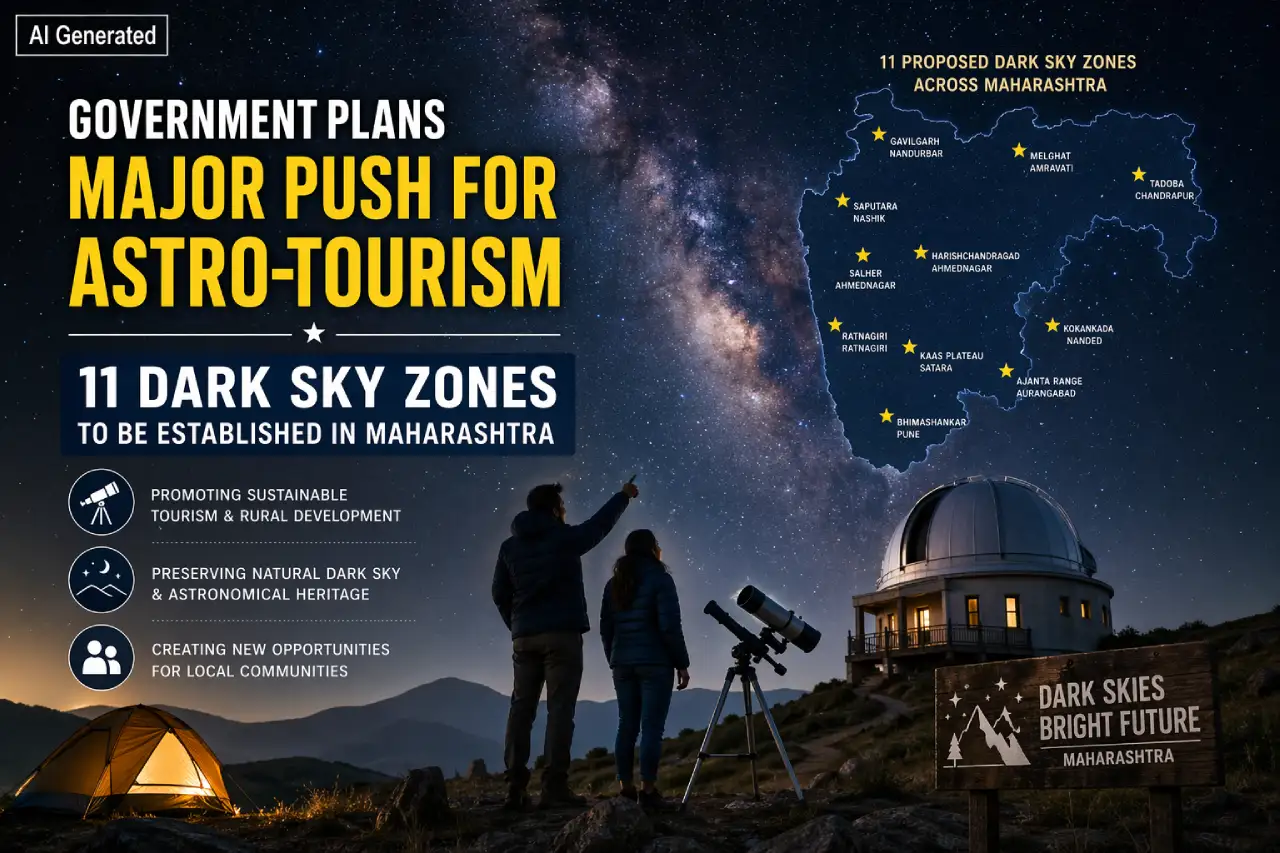
It has recently come to light that the Maharashtra government is set to chart a new course in the tourism sector. Plans are underway to select 11 ‘Dark Sky’ Zones across the state—locations where the night sky will be clearly visible and light pollution will be minimal. The primary objective of this initiative is to popularise ‘astro-tourism’ (astronomy-based tourism), while simultaneously fostering stargazing, astronomy education, and eco-tourism. According to the government, this project holds the potential to attract both domestic and international tourists in the future.
Modern tourism is no longer limited only to visiting mountains and beaches; people are now seeking novel skills. Looking at a star-studded sky, witnessing a meteor shower, or observing planets through a telescope—such activities are emerging as major attractions. In my view, if Maharashtra successfully implements this plan, it could unlock an entirely new market within the tourism industry.
You may be wondering: what is a Dark Sky Zone? A "Dark Sky Zone" refers to a location where artificial light is minimal and the night sky is clearly visible. In such places, one can observe countless stars, the Milky Way, planets and celestial bodies, meteor showers, and deep-sky objects. These types of locations are highly fascinating to astronomy enthusiasts.
The Government of Maharashtra has identified 11 potential sites. These locations are primarily situated within the Sahyadri mountain range, forested regions, and remote areas. Some notable sites include the vicinity of the Pench Tiger Reserve, the region adjacent to the Tadoba Andhari Tiger Reserve, the Lonar Crater, and Bhandardara.
According to the government's plan, these locations could feature observatories, telescope viewing stations, astronomy interpretation centres, eco-friendly accommodation facilities, guided stargazing sessions, and night-sky photography workshops. In my opinion, this initiative will create opportunities not only for travel but also for learning.
This initiative is viewed as an integral part of the state's 'Vikasit Maharashtra 2047' roadmap. The government has set a target of transforming Maharashtra into a $3.5 trillion economy by 2047, and the tourism sector is poised to play a pivotal role in achieving this objective. Through this project, Maharashtra aims to transition from conventional sightseeing tourism to an experience-based tourism model.
Maharashtra retain distinct geographical advantages. Its combination of mountains, forests, remote rural landscapes, and clear open skies makes it an ideal state for astro-tourism. In my view, with proper planning, Maharashtra has the potential to emerge as India's leading destination for dark sky tourism.


Comments ( 0)
Leave a Comment
No comments yet. Be the first to comment!