
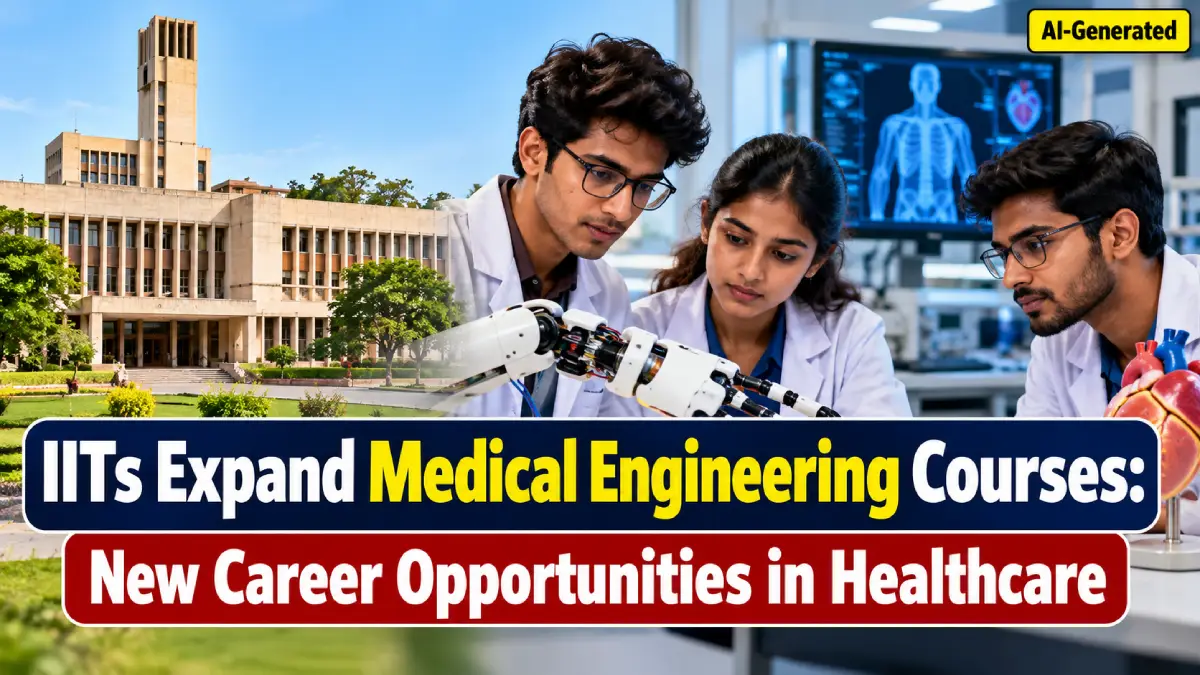
India's leading Indian Institutes of Technology (IITs) are expanding their presence in medical education and healthcare research, opening up opportunities for students interested in the connection between engineering and medicine. Institutions such as IIT Kharagpur, IIT Madras, IIT Mandi and IIT Kanpur are developing programmes and research facilities focused on medical sciences, biomedical engineering and healthcare technology.
The idea is to prepare specialists who can design medical equipment, develop diagnostic tools, use artificial intelligence in healthcare and create innovative solutions for modern medical challenges.
This shift is important because healthcare increasingly depends on technology, from advanced medical imaging and robotic surgery to smart diagnostic devices and computer-based treatment systems. Doctors play a central role in treating patients, but engineers and researchers are equally important in developing the tools used in modern hospitals.
These interdisciplinary courses could open a different career path for science and engineering students who want to contribute to healthcare without necessarily becoming medical practitioners. It is also an indication of how India's technical institutions are responding to changing healthcare needs.
IIT Kharagpur has been among the early institutions to establish a dedicated School of Medical Science and Technology. The school began in 2001 and introduced its three-year Master of Medical Science and Technology (MMST) programme for MBBS graduates. The course helps medical professionals develop scientific and engineering skills so they can participate in advanced medical research.
The institute also offers programmes in areas such as biomedical engineering, medical imaging and informatics, nuclear medicine and medical physics. Research activities cover cancer studies, medical instrumentation, biomaterials, tissue engineering, medical imaging and other specialised fields. These programmes aim to bring medical professionals and engineers together to work on practical healthcare problems.
IIT Madras has also taken a significant step through its Department of Medical Sciences and Technology, established in 2023. The department offers a four-year BS programme in Medical Sciences and Engineering. Unlike a conventional medical degree, the course combines engineering principles with human physiology, medical science and technology.
Students study areas such as anatomy, physiology, mathematical modelling, medical imaging and machine learning. The programme also includes hospital internships, allowing students to connect classroom learning with clinical practice. Its broader focus includes medical device development, artificial intelligence in healthcare, drug discovery and medical image analysis.
IIT Mandi is another institution developing its academic and research activities around biomedical and medical engineering. Such interdisciplinary work brings together engineering, biological sciences and healthcare to address problems involving medical devices, diagnostics and treatment technologies.
IIT Kanpur is also strengthening its work in biomedical engineering and medical technology. Its engineering and biological sciences research provides opportunities to explore areas such as healthcare devices, medical imaging, diagnostics and technology-assisted treatment.
The main objective behind these initiatives is not to replace doctors or turn every engineering student into a medical practitioner. Instead, the programmes aim to develop professionals who understand both technology and healthcare. Their work may involve designing better diagnostic machines, developing affordable medical equipment, improving imaging systems or creating AI-based tools that support clinical decisions.
This growing focus on medical engineering could create new career opportunities in hospitals, medical device companies, healthcare technology firms, research laboratories and biotechnology industries. As India continues to invest in healthcare infrastructure and innovation, professionals who can connect engineering with medical science are likely to play an increasingly important role.
The expansion of these programmes marks an interesting change in higher education. Medical innovation will increasingly depend on collaboration between doctors, engineers and researchers, and IITs are positioning themselves to contribute to that future.



Comments ( 0)
Leave a Comment
No comments yet. Be the first to comment!