
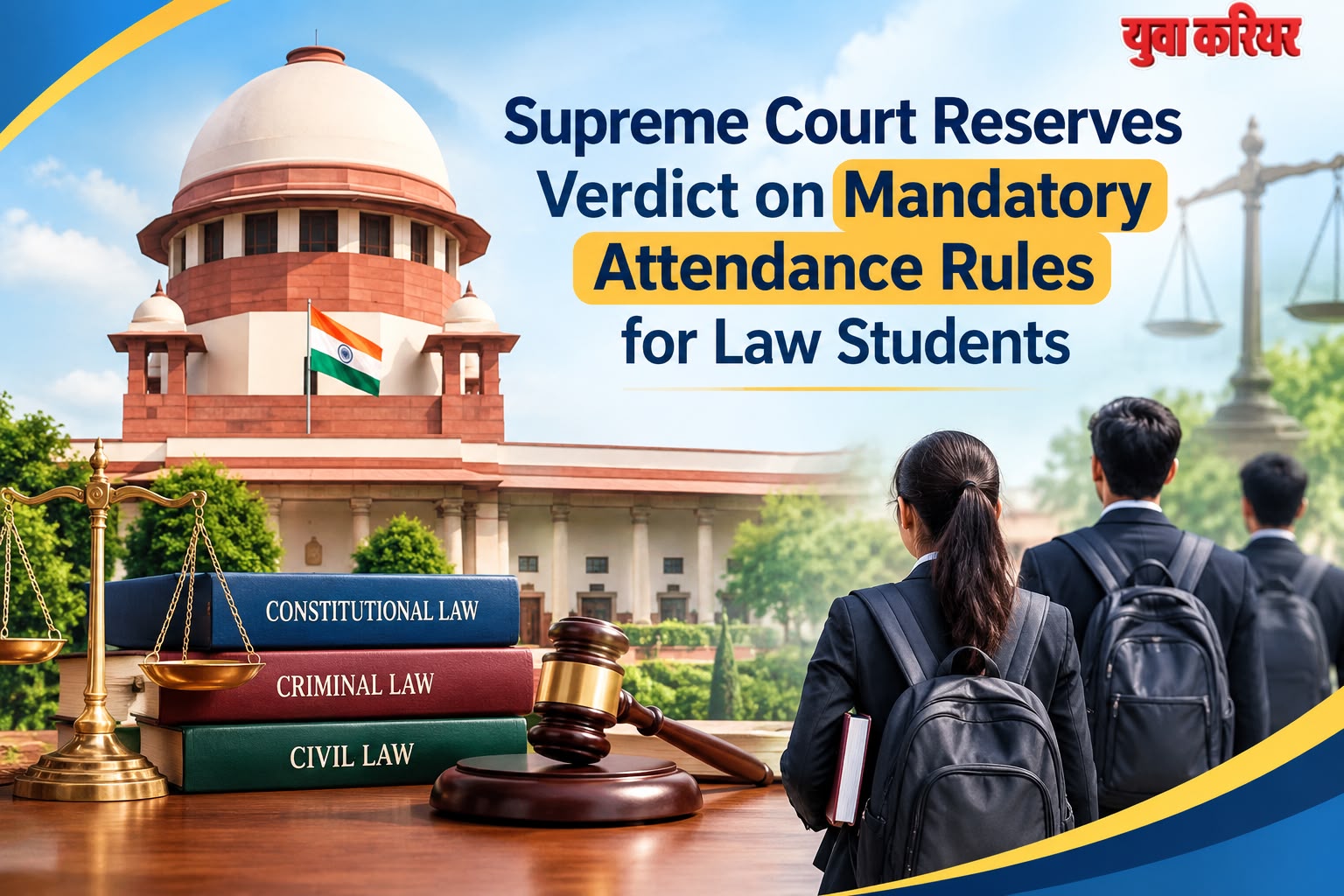
The Supreme Court on October 6, 2026, reserved its judgment on a batch of petitions challenging a Delhi High Court ruling that restricted law colleges from preventing students from appearing in examinations solely because of insufficient attendance.
A three-judge bench comprising Justices Vikram Nath, Sandeep Mehta and Augustine George Masih heard arguments from the Bar Council of India, educational institutions and other parties before concluding the hearing.
Dispute over attendance Requirements
The case concerns the scope of minimum attendance requirements in legal education and whether a shortage of attendance can by itself prevent a law student from taking examinations or continuing academic studies.
The Delhi High Court had ruled in November 2025 that students enrolled in recognised law colleges and universities could not be stopped from appearing for examinations or continuing their academic progression solely because they had fallen short of the prescribed attendance requirement.
The judgment emerged from proceedings initiated by the High Court on its own motion concerning issues surrounding the death of law student Sushant Rohilla in 2017.
Challenge before the Supreme Court
The Bar Council of India and NMIMS Law College challenged the High Court’s ruling before the Supreme Court.
The challenge raises broader questions concerning academic standards, institutional autonomy and the role of attendance requirements in professional legal education. The petitioners have argued that removing mandatory attendance requirements could affect academic discipline and the standards expected in legal training.
Earlier in 2026, the Supreme Court had stayed the operation of the relevant direction of the Delhi High Court prospectively.
The Supreme Court also subsequently addressed the position of students whose academic session was already underway when the Delhi High Court delivered its ruling. Those students received limited protection for that academic session, including access to final or supplementary examinations in specified circumstances.
Judgment now Awaited
With the arguments in the present batch of petitions completed, the Supreme Court has reserved its verdict.
The eventual decision is expected to clarify the legal position on mandatory attendance requirements for law students and the extent to which colleges and universities can rely on attendance shortages when deciding whether students may appear for examinations.
Until the Supreme Court delivers its final judgment, the dispute over the role and enforceability of minimum attendance requirements in legal education remains pending.

Comments ( 0)
Leave a Comment
No comments yet. Be the first to comment!