


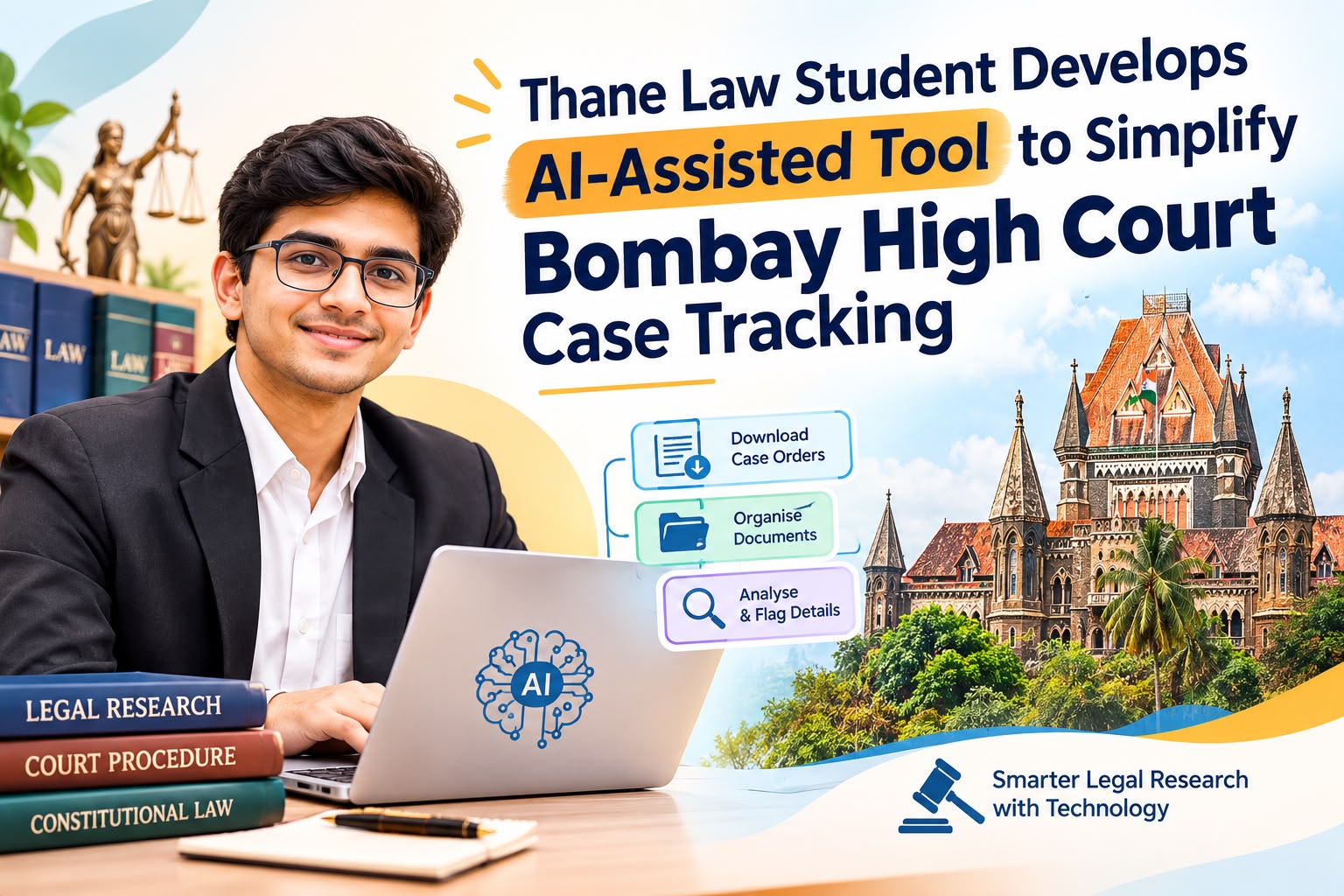
A law student from Thane has developed a computer-based tool designed to make tracking Bombay High Court cases and organising court orders easier. The application uses a case’s unique CNR number to locate and download available orders, helping reduce the time required to collect and arrange case documents manually.
Vishal Shantaram Shirsat, a third-year student at Smt Smita Ravindra Ghodvinde Law College, developed the tool using Python and artificial intelligence assistance despite having no prior programming experience.
The project focuses on a practical challenge faced by litigants and legal practitioners: keeping track of court orders, hearing dates and case-related paperwork.
How the case-tracking tool works
The application uses the Case Number Record (CNR), a unique identifier assigned to a case in the eCourts system, to locate the relevant matter on the court’s website.
Once the case is identified, the tool downloads its available orders and organises the files by date. It stores them in a folder labelled with the case number and CNR, making the documents easier to retrieve.
Shirsat has indicated that collecting orders for a single case previously took him nearly an hour when done manually. The automated process can complete the task in approximately one minute, according to his account.
Document analysis and hearing-date check
The application also includes a document-analysis feature. Users can add case-related papers, including first information reports (FIRs) and notices, to the same folder as the downloaded court orders.
The software examines these documents and prepares a basic report containing details such as the case number, names of the parties, the judge and relevant dates. It also identifies procedural terms, including adjournment, dismissal, admission of a request, issuance of notice and interim relief.
Another feature compares scheduled hearing dates with the available orders. If an order appears to be missing for a particular date, the report flags the discrepancy for further examination.
The tool can also highlight inconsistencies between information contained in court orders and the documents uploaded by the user.
However, the application is intended to assist with document organisation and preliminary review, not to replace professional legal assessment. Its findings are a starting point for further verification rather than a legal opinion or authoritative determination of a case’s status.
Privacy and technical limitations
The software currently runs locally on Shirsat’s laptop without requiring an account or sending documents to an external server. This approach reflects his concern about the confidentiality of case papers, which may contain sensitive personal and legal information.
The application nevertheless has technical limitations. Changes to the layout or structure of the court’s website can disrupt its operation, requiring adjustments to the software.
Its usefulness also depends on the availability and accuracy of the underlying court records. A flagged discrepancy does not, by itself, establish that a court order was not passed or that a procedural error occurred.
A practical application of AI in legal education
The project demonstrates how law students can use programming tools and AI assistance to address practical problems associated with legal research and case management.
Rather than treating technology solely as a means of studying legal concepts, Shirsat has applied it to the administrative work involved in following proceedings and reviewing case records.
He has also expressed an interest in receiving assistance from students and developers who could help improve the application or adapt it for other courts.
Any expansion to additional courts would require suitable configurations and testing to account for differences in their websites and document systems.
The project highlights a potential role for AI-assisted tools in reducing repetitive legal work while keeping human review central to the interpretation of court records. Its broader value will depend on reliability, careful handling of confidential documents and the ability to adapt to changing court systems.



Comments ( 0)
Leave a Comment
No comments yet. Be the first to comment!