


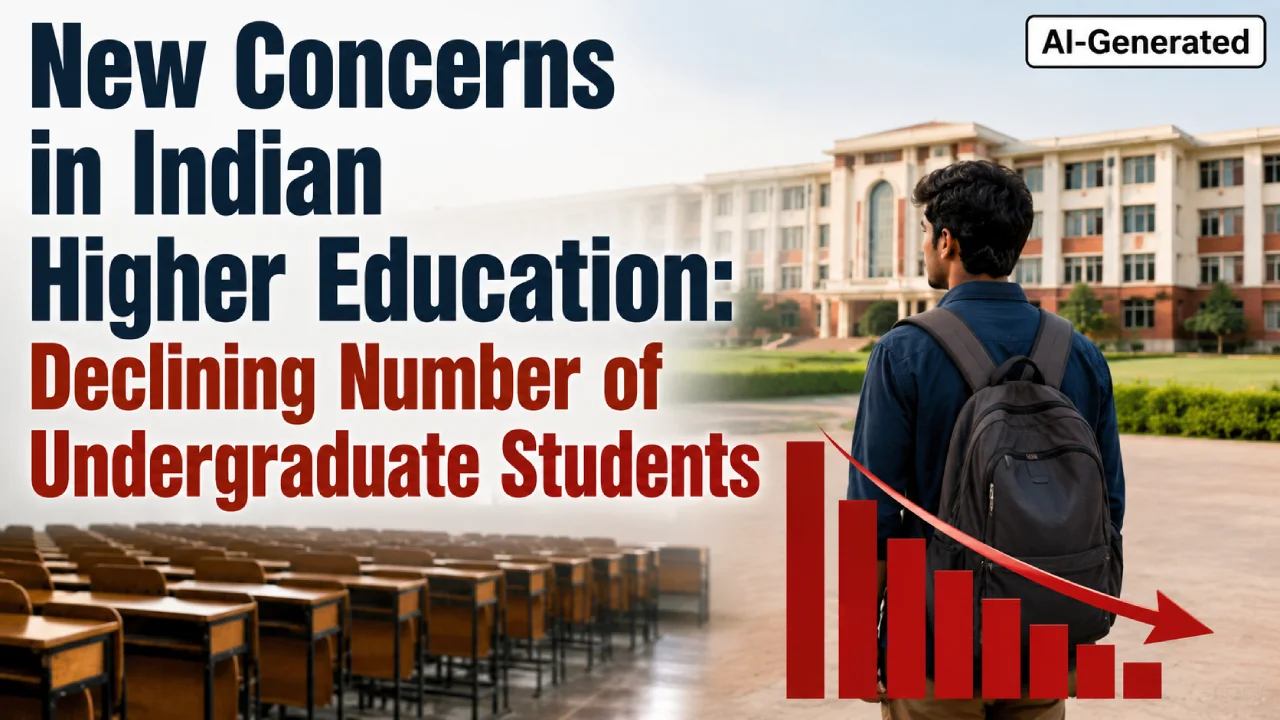
Fresh concerns have arisen regarding India's higher education system. On one hand, questions are being raised about the National Testing Agency's (NTA) decision to re-conduct the UGC-NET June 2024 examination for three subjects; on the other, the decline in the number of undergraduate students across the country has also drawn attention.
The NTA decided to hold a re-examination after identifying multiple errors and repeated questions in the papers for English, Commerce, and Sociology. This has restart a debate concerning the transparency and reliability of the examination process.
Compared to the pre-pandemic period of 2018–19, the share of undergraduate students within the total higher education enrollment dropped by approximately 3 per cent in 2023–24. Moreover, the total number of students enrolled at the undergraduate level in 2023–24 also declined compared to the previous year. So, this issue is not only a problem with the examination system; it also needs a broader reflection on the state of higher education.
A fresh controversy has arisen regarding the UGC NET June 2026 examination. The National Testing Agency (NTA) has decided to re-conduct the exams for three subjects: English, Commerce, and Sociology.
This decision follows the discovery of multiple errors in the question papers and the repetition of identical questions. UGC NET is a crucial examination that offers numerous candidates the opportunity to build careers in higher education, research, and the teaching profession; consequently, any flaws in the exam can directly impact the candidates' plans.
According to the report, the total number of students enrolled at the undergraduate level in India's higher education system during 2023-24 was approximately 3.458 crore.
This figure represents a 0.27 per cent decline compared to the previous year. Notably, this marks the first time since 2011 that an annual drop in undergraduate student enrollment has been observed.
On the other hand, the total number of students across the country's higher education sector increased by 0.82 per cent. In other words, while there was growth in the overall higher education system, the scenario at the undergraduate level was somewhat different.
The trend of declining undergraduate student numbers is not uniform across all states in the country.
According to the data, the sharpest decline in the share of undergraduate students was observed in Rajasthan and Madhya Pradesh. Even in Delhi—one of the country's major hubs for higher education—the share of undergraduate students fell by 0.83 per cent.
However, Delhi did not feature among the top ten regions in the country regarding the decline in the share of undergraduate students.
At least two issues are becoming clear from recent events: the reliability of the examination system and student participation at the undergraduate level.
Regarding examinations, students need a system in which they have confidence in the question papers, answer keys, and results. While it is certainly essential to have mechanisms for rectifying errors once detected, it is even more crucial to verify question papers at multiple stages prior to the examination.
On the other hand, the reasons for the decline in undergraduate admissions may vary from state to state. Therefore, rather than drawing conclusions based solely on a single statistic, it is necessary to analyse the local education system, economic conditions, and other relevant factors.




Comments ( 0)
Leave a Comment
No comments yet. Be the first to comment!